


Sprout Social vs Hootsuite for Small Business
- Elana Rheinhart
- Jul 29
- 10 min read

For a single-location or reputation-sensitive small business, Sprout Social is the cleaner choice. For multi-location operations or high-volume ad campaigns, Hootsuite fits better. And if you lack the internal bandwidth to manage either platform consistently, hiring a managed social media agency is the faster, lower-risk path.
Sprout Social: Deeper analytics and approval workflows make it the right fit for local businesses where brand reputation and reporting clarity matter most. Starts at $199/month (5 profiles, 1 user). A 30-day trial is available.
Hootsuite: Broader ad-management support and bulk scheduling across multiple profiles make it the practical pick for multi-location or content-heavy teams. Starts at $99/month (10 profiles, 1 user). Free trial available.
Hire an agency: When you need consistent output but lack the staff or time to manage a platform, outsourcing social media removes the tool-management burden entirely and delivers results without a learning curve.
Sprout Social vs Hootsuite: side-by-side comparison
Dimension | Sprout Social | Hootsuite |
Ease of use | Cleaner UI; higher G2 ease-of-use score (8.8 vs 8.6) | Broader toolset; steeper learning curve per G2 reviews |
Analytics & reporting | Deep cross-channel reports; white-label exports; G2 social reporting score 8.7 | Solid analytics; customizable dashboards; G2 score 8.0 |
Publishing & scheduling | Clean calendar; AI timing suggestions; less bulk-focused | Bulk scheduling; high-volume multi-platform publishing |
Social ads management | Limited; paid ads not schedulable within platform | Integrated ad planning, publishing, and optimization across all plans |
Team workflows & approvals | Intuitive approval queues; G2 approval score 8.1 | Approval workflows on higher-tier plans only; G2 score 7.8 |
Integrations & ecosystem | Native Salesforce and HubSpot CRM integrations | Broader ecosystem connectivity |
Pricing & scalability | Starts at $199/month (5 profiles, 1 user) | Starts at $99/month (10 profiles, 1 user) |
Customer support | G2 quality of support score 8.7 | G2 quality of support score 8.1 |
Best for | Local, reputation-sensitive, analytics-focused teams | Multi-location, ad-heavy, high-volume publishing teams |
Three practical differences that affect small businesses most:
Hootsuite includes ad campaign management on every plan; Sprout Social does not let you schedule or publish paid ads natively.
Sprout Social’s approval workflows and Smart Inbox are available at lower plan tiers; Hootsuite gates these behind higher-priced plans, which may affect accessibility depending on plan choice.
Costs scale quickly on both platforms as you add profiles, seats, or listening features, so a 12–24 month growth forecast matters before you commit.
Both platforms offer free trials. Use them to validate reporting outputs and inbox usability before signing a contract.
What each platform actually does for your business day-to-day
Analytics and reporting
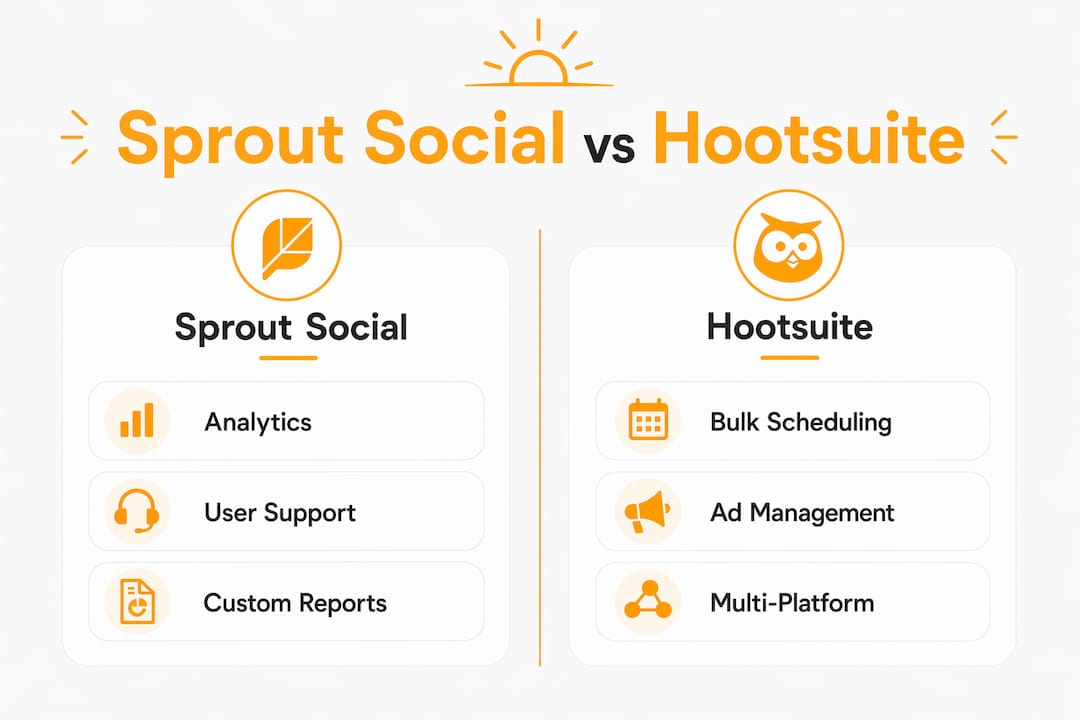
Sprout Social’s analytics suite covers cross-channel performance, competitor benchmarking, and paid-versus-organic breakdowns with presentation-ready exports. Its G2 social reporting score of 8.7 reflects how polished those outputs are for client-facing use. Hootsuite’s dashboards are customizable and solid, but users consistently rate them less refined for executive reporting.
Publishing and scheduling
Hootsuite is built for volume. Bulk scheduling, a visual content calendar, and multi-platform publishing across Facebook, Instagram, X, LinkedIn, TikTok, Pinterest, YouTube, and Google Business Profile make it efficient for teams managing multiple accounts. Sprout’s calendar is cleaner and adds AI-powered timing suggestions, but it is less feature-dense for bulk workflows.

Social ads management
Hootsuite lets you plan, publish, and optimize Facebook, Instagram, and LinkedIn ad campaigns directly within the dashboard on every plan. Sprout Social’s paid advertising features are limited by comparison, and scheduling paid ads natively is not supported. For any business running consistent paid social, this is a decisive difference.
Team workflows, approvals, and inbox
Sprout’s Smart Inbox is consistently rated above Hootsuite for unification, sentiment scoring, and assignment workflows. Approval queues are available at lower plan tiers. Hootsuite’s inbox is functional, but advanced approval workflows require a higher-tier plan. Both platforms support role-based access and task assignment.
Statistic: On G2, Sprout Social’s quality of support scores 8.7 versus Hootsuite’s 8.1, and Sprout’s approval workflow score is 8.1 versus Hootsuite’s 7.8.
Pro Tip: During your 30-day trial, build one real client-facing report and run one approval cycle from draft to published post. If either step feels clunky, that friction compounds every week you use the platform.
How pricing and add-ons change your true cost over 12–24 months
Hootsuite’s Professional plan starts at $99/month for one user and 10 profiles. The Team plan runs $249/month and adds more users and features. Sprout Social’s Standard plan starts at $199/month for one user and 5 profiles; higher-tier plans unlock social listening and competitive analysis.
The entry price is rarely the final price. Hidden costs accumulate fast:
Training time and re-learning after interface updates
Permission administration as your team grows
Report rebuilding when client needs change
Premium add-ons for listening, advanced analytics, or additional profiles
A 12–24 month planning checklist helps you forecast real spend:
How many social profiles will you manage in 18 months?
Will you add team members who each need a seat?
Do you need social listening, or will basic mention tracking suffice?
Will you run paid ads, and does the platform support that natively?
For social media marketing costs beyond platform fees, factor in content production, creative assets, and the staff hours required to manage the tool itself.
Pro Tip: Run a 30-day pilot using your actual content calendar, not a test account. Track the hours your team spends on setup, scheduling, and reporting. That number is your true weekly overhead, and it is often larger than the subscription fee.
What switching looks like: onboarding, migration, and support
Category | Sprout Social | Hootsuite |
Typical setup time | 1–2 weeks for profile linking, permissions, and first report | 1–3 weeks; broader integration setup can extend timeline |
Common migration blockers | Historical analytics require manual export; scheduled posts do not transfer | Scheduled posts and content library require manual rebuild |
Support level | Dedicated onboarding on higher plans; strong self-service docs | Self-service docs; onboarding support on enterprise plans |
Data migration between platforms is mostly manual. Scheduled posts, historical analytics, and saved content libraries typically require export and rebuild. Plan for at least two weeks of parallel running if you are switching from an existing tool.
Privacy checks matter when adding third-party integrations. Before connecting listening tools or audience analytics apps, review their data-handling practices to confirm they meet your business’s compliance requirements.
Decision checklist: how to choose a platform or brief an agency
Use this checklist before signing up or sending a proposal request:
Does the platform’s approval workflow match how your team reviews content today?
Can you export reports in a format your clients or stakeholders will actually read?
Does ad management happen inside the platform, or will you need a separate tool?
How does the inbox handle duplicate replies when multiple team members are active?
Is the mobile app functional enough for your team to approve and respond on the go?
Which integrations are non-negotiable (CRM, e-commerce, project management)?
What does the price look like at 18 months with your projected profile and seat count?
Red flags to watch for:
Approval workflows or inbox features locked behind expensive plan upgrades
No clear data export path for historical analytics
Per-seat pricing that jumps sharply at three or more users
Social listening coverage that does not include the platforms your audience uses
Questions to ask during a demo: request a sample report from a business similar to yours, ask about onboarding scope and SLA response times, and confirm which features require add-on fees.
Pro Tip: Schedule your pilot during your busiest content week, not a slow period. A platform that handles your peak workload without friction is the one worth paying for.
Which platform fits your situation?
Local shop or single-location service business: Sprout Social’s cleaner reporting and intuitive inbox make it the better fit for local business social media. Start with the 30-day trial and build one real report.
Multi-location or franchise operation: Hootsuite’s bulk scheduling and broader profile limits handle the volume. Request a team plan demo focused on content calendar management.
Tight budget, early stage: Both platforms may be more than you need right now. Consider starting with a lighter tool or a managed service before committing to enterprise pricing.
Ad-heavy campaigns: Hootsuite’s integrated ad management across all plans is the clear advantage. Sprout Social requires workarounds for paid distribution.
Agency-managed clients: If you are briefing an agency to manage your social media, the platform choice is largely the agency’s decision. Focus your brief on reporting format, approval process, and response SLAs instead.
What users say: verified reviews from G2 and Capterra
G2’s head-to-head comparison shows Sprout Social outscoring Hootsuite across ease of use (8.8 vs 8.6), quality of support (8.7 vs 8.1), social reporting (8.7 vs 8.0), post performance tracking (8.8 vs 8.6), and social measurement (8.6 vs 8.1). Hootsuite scores comparably on content calendar functionality and holds an advantage in integration breadth.
On Capterra and across independent review roundups, Sprout Social carries a 4.3-star overall rating versus Hootsuite’s 4.0 stars. Users frequently cite Hootsuite’s steeper learning curve and note that advanced features like a unified inbox and approval workflows require higher-tier plans. Sprout Social users praise reporting depth and support responsiveness but flag the price as a barrier for smaller teams.
Security and compliance features
Both platforms support role-based access controls, two-factor authentication, and permission management at the user level. Sprout Social’s enterprise plans include additional compliance features relevant to regulated industries. Hootsuite’s broader integration ecosystem means more third-party connections, which increases the surface area for data handling. Before connecting any third-party listening or analytics tool, verify its privacy practices independently.
Mobile app usability
Sprout Social’s mobile app supports post scheduling, inbox management, and approval actions, making it practical for business owners who need to review and approve content away from a desk. Hootsuite’s mobile app covers scheduling and basic analytics but is generally considered less polished for approval workflows on smaller screens. For Colorado-based businesses where owners are often on-site rather than at a desk, Sprout’s mobile approval experience is a real operational advantage.
Customization and automation capabilities
Sprout Social offers pre-built and fully customizable reports, white-label export options, and automated report delivery scheduling. Its social analytics tools integrate listening data directly into reporting dashboards. Hootsuite’s OwlyWriter AI generates captions and content formats; its bulk scheduling and content library support high-volume automated posting workflows. Both platforms offer AI caption generation and optimal posting time suggestions, though Hootsuite’s timing recommendations are goal-specific (reach, awareness, engagement, or traffic) while Sprout’s are more general.
Key Takeaways
Sprout Social wins on analytics depth and support quality; Hootsuite wins on ad integration, bulk publishing, and entry-level price, making the right choice entirely dependent on your operational priorities.
Point | Details |
Sprout Social for reporting | G2 social reporting score of 8.7 makes it the stronger choice for client-facing analytics. |
Hootsuite for ads and volume | Integrated ad management on every plan and bulk scheduling suit multi-location or ad-heavy teams. |
Hidden costs add up fast | Training, permission admin, and add-ons often exceed the base subscription over 12–24 months. |
Workflow fit beats feature count | A platform that matches your team’s daily operations delivers more value than a longer feature list. |
SOL Social Media as an alternative | SOL Social Media’s managed services remove platform overhead entirely, delivering consistent output without a tool-management burden. |
When does hiring an agency beat buying a platform?
The platforms in this comparison are genuinely capable. But capability is not the same as output. Many small businesses buy Sprout Social or Hootsuite, spend weeks on setup, and still publish inconsistently because the bottleneck was never the tool. It was bandwidth.
The real question is not which platform has better features. It is whether your team has the hours, the content, and the process discipline to use either platform at full capacity every week. If the honest answer is no, a managed service solves the problem that software cannot.
Agencies provide output and workflows, not just access. That distinction matters most for businesses in reputation-sensitive industries or those scaling quickly across Colorado’s competitive local markets. When a client briefs SOL Social Media, they get content production, engagement management, and reporting without touching a dashboard.
Pro Tip: If you are evaluating platforms and agencies simultaneously, ask both for a sample deliverable: a report from the platform and a content calendar from the agency. The one that requires less explanation from you is the better operational fit.
SOL Social Media: managed social without the platform overhead
Choosing between two enterprise platforms is the wrong starting point for most small businesses. The real question is whether you want to manage a tool or get results.
SOL Social Media handles content creation, audience engagement, social strategy, live event coverage, and monthly reporting for small businesses across Colorado, without requiring you to learn, configure, or maintain a platform. There is no per-seat pricing surprise, no approval workflow to build from scratch, and no report template to rebuild every quarter. You get a dedicated team that knows your brand, produces real human-written content, and delivers measurable engagement month over month.
For businesses that need consistent social media output without the overhead of managing Sprout Social or Hootsuite internally, SOL’s managed services are the faster path. Book a discovery call to see what a managed social media plan looks like for your business.
Useful sources
Source | Best used for | Link |
G2: Hootsuite vs Sprout Social | Verified user ratings, feature scores, and pricing comparison | G2 comparison |
Sociality.io comparison | Feature differentiation: analytics vs ad management | Sociality.io |
Review Overhaul: local business guide | Local and single-location business recommendations | Review Overhaul |
Iconosquare: how to choose a tool | Hidden costs and 12–24 month planning guidance | Iconosquare |
Save the G2 comparison and at least one independent review before your vendor demo. They give you the questions to ask and the scores to push back on.
FAQ
Which is better for a small local business, Sprout Social or Hootsuite?
Sprout Social is generally the better fit for single-location businesses where reporting clarity and brand reputation matter most. Hootsuite suits multi-location or higher-volume operations better.
Is Hootsuite cheaper than Sprout Social?
Yes. Hootsuite’s Professional plan starts at $99/month for one user and 10 profiles; Sprout Social’s Standard plan starts at $199/month for one user and 5 profiles.
Does Sprout Social support paid social ads?
Sprout Social does not let you schedule or publish paid ads natively. Hootsuite includes ad campaign management across all plans, covering Facebook, Instagram, and LinkedIn.
When should a small business hire an agency instead of buying a platform?
When your team lacks the bandwidth to manage a platform consistently, an agency removes the tool-management burden and delivers output directly. SOL Social Media’s managed services are designed for exactly this situation.
How long does onboarding take for either platform?
Sprout Social typically takes one to two weeks for a small business to complete profile linking, permissions, and a first report. Hootsuite can take one to three weeks, especially when configuring multiple integrations.
Recommended
Comments