


Micro-Influencer Strategy for Small Businesses: 2026 Playbook

A micro influencer strategy pairs your brand with niche creators (typically 10K–100K followers) to generate higher engagement, stronger trust, and measurable ROI at a fraction of what macro campaigns cost. The fastest way to start: run a 3–5 creator pilot with UTM-tracked links, unique promo codes, and a one-page brief. Done right, some programs report an earned-media value of roughly $6.50 for every $1 spent.
Here is what a successful small-business pilot looks like in practice:
Define one clear goal (awareness, trial, or direct conversion) before you recruit a single creator.
Select 3–5 creators whose audience demographics match your actual customer profile.
Give each creator a unique promo code and UTM link so you can attribute results cleanly.
Set a 30-day measurement window and decide your go/no-go threshold before the campaign launches.
The verdict: a well-structured micro-influencer pilot can outperform paid social ads on cost-per-acquisition within the first month, provided you track it properly and brief creators with enough clarity to protect your brand without killing their voice.
Key Takeaways
A well-tracked micro-influencer pilot of 3–5 creators, with UTM links, unique promo codes, and a one-page brief, gives small businesses a measurable, cost-efficient alternative to paid social ads within 30 days.
Point | Details |
Micro-influencer follower range | Target creators with 10K–100K followers for the best balance of reach and engagement. |
Pricing benchmark | Expect to pay $100–$1,000 per post; add 20–50% for whitelisting or paid ad usage rights. |
Pilot size and tracking | Run 3–5 creators simultaneously, each with a unique UTM link and promo code for clean attribution. |
Top KPIs to watch | Monitor CTR, conversion rate, CPA, and ROMI during the first 30-day window. |
SOL Social Media | SOL manages the full pilot process, from creator vetting and contracts to measurement and scale. |
What counts as a micro-influencer, and why does the platform matter?
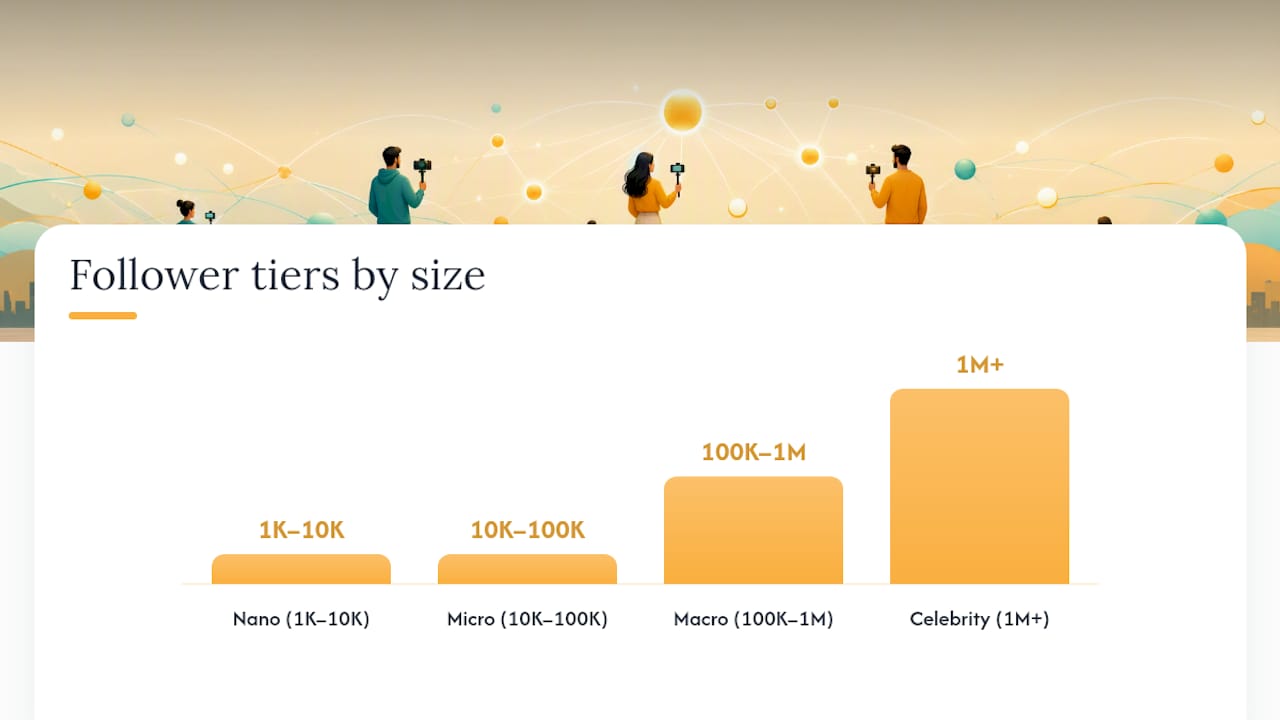
Micro-influencers typically fall in the 10K–100K follower range, sitting between nano creators (under 10K) and macro creators (100K–1M). That middle tier is where you find the most practical balance: audiences large enough to move the needle, yet tight enough that creators still know their followers personally and respond to comments.
Adjacent tiers worth understanding:
Nano (1K–10K): Hyper-local, extremely high trust, very low cost. Best for community-based businesses or geographic pilots.
Macro (100K–1M): Broad reach, lower engagement rates, higher fees. Better for brand awareness at scale once you have proof of concept.
Celebrity/mega (1M+): Reach is massive, but audience alignment is thin and costs are prohibitive for most small businesses.
Platform choice shapes everything about how you find and activate micro-influencers.
Platform | Best for | Content format | Audience discovery strength |
Lifestyle, retail, food, beauty | Reels, Stories, carousels | Strong hashtag and geo search | |
TikTok | Gen Z, entertainment, product demos | Short-form video | Algorithm-driven discovery |
B2B, professional services, SaaS | Articles, short posts, video | ICP-dense niche communities | |
YouTube | Education, tech, fitness | Long-form and Shorts | Search-intent audiences |
Discord/Slack | Niche professional communities | Text, AMAs, community posts | Invite-only, high trust |
For B2B brands, micro-influencers with high “ICP density” (meaning their followers closely match your ideal customer profile) consistently outperform macro creators because relevancy matters far more than raw reach. A LinkedIn creator with 15K engaged SaaS practitioners is worth more to a B2B software company than a general business influencer with 300K mixed followers.
Why micro-influencers often outperform larger creators for small businesses
The global influencer market has grown substantially in recent years, and brands of every size are competing for creator attention. But the most important data point for small businesses is not market size. It is engagement.
Statista’s data on engagement by follower tier consistently shows that smaller influencer tiers achieve higher engagement rates than large celebrity accounts. That gap is not marginal. Micro-influencers tend to generate more comments, saves, and DMs per post because their audiences chose to follow them for a specific reason, not because an algorithm pushed them into a feed.
Three benefits that matter most for small-business budgets:
Cost-efficiency: At roughly $100–$1,000 per post, micro-influencers let you run parallel experiments across multiple creators for the price of a single macro post. You learn faster and spread risk.
Audience alignment: A creator who built their following around gluten-free baking or Denver fitness studios brings you an audience that is pre-qualified for your offer. No media-buy targeting can replicate that.
Authenticity: Micro-influencers function as trusted advisers in their communities. Their product recommendations read as personal endorsements, not advertisements, which is why conversion rates tend to be stronger than display or pre-roll ads.
The earned-media value figure cited by Button Block serves as a benchmark from practitioner experience rather than a guaranteed outcome. Treat it as an aspirational target for a well-tracked pilot, not a baseline assumption.
How do you find micro-influencers who match your customers?
Discovery is where most small businesses waste time. A structured workflow cuts that time significantly.
Step-by-step discovery process
Start with hashtag and keyword search. On Instagram and TikTok, search your core product category plus a niche modifier and a location tag (e.g., #veganfoodie + #Denver or #smallbizmarketing + #Florida). Creators who use these tags consistently are already speaking to your audience.
Check your own followers. Scroll your existing follower list for accounts with 5K–100K followers. These people already know your brand, which makes outreach warmer and onboarding faster.
Use discovery tools. Platforms like Modash, Upfluence, and Creator.co let you filter by follower count, engagement rate, audience demographics, and location. Most offer free trials long enough to run an initial search.
Monitor competitor mentions. Search your competitors’ branded hashtags and tagged posts. Creators who already review similar products are pre-qualified for your category.
Set up an inbound application. Add a “Work with us” link in your Instagram bio or website footer. Interested creators self-select, which saves screening time.
Engage before you pitch. Follow shortlisted creators, comment genuinely on two or three posts, and then reach out. Cold DMs with no prior interaction convert poorly.
Initial screening checklist
Before you send a formal brief, run every candidate through this filter:
Audience demographics match your customer profile (age, location, interests).
Engagement rate is consistent, not spiking only on giveaway posts.
Comment quality shows real conversation, not generic emoji responses.
No recent brand-safety issues (offensive content, controversial partnerships).
Content history aligns with your category for at least the past 90 days.
Pro Tip: Ask shortlisted creators to share a screenshot of their audience insights before you commit. Most are willing, and it saves you from paying for reach that does not match your customer.
How to structure a campaign brief, deliverables, and approvals
A one-page brief is the single most underused tool in micro influencer marketing, and building a brand people trust through custom web design strategies for small businesses can amplify its impact using custom web design strategies for small businesses. It sets expectations, protects your brand, and gives creators the context they need to produce content that actually converts.
One-page brief template
Your brief should cover these elements, in this order:
Campaign goal: One sentence. “Drive 50 trial purchases of [Product] in 30 days.”
Key messages: Two or three points the creator must communicate (not word-for-word scripts).
Mandatory notes: FTC disclosure language (see Section 7), brand name spelling, product claims you cannot make.
Deliverables: Exact content types, quantities, and specs (e.g., “2 × Instagram Reels, 1 × Story set of 3 frames”).
Timeline: Draft submission date, revision window, go-live date.
KPIs: What you will measure and how (UTM link, promo code, engagement rate).
Deliverables and rights
Content type | Specs | Suggested usage rights |
Instagram Reel | 15–60 sec, vertical, captions on | Organic post + 30-day whitelisting |
TikTok video | 15–60 sec, native audio preferred | Organic post only unless paid rights negotiated |
Instagram Story set | 3–5 frames, swipe-up link | Organic short-term window |
YouTube Short | Under one minute, SEO title required | Organic post + UGC library use |
Static feed post | 1080×1080 or 4:5, 3–5 hashtags | Organic post + repurpose in email |
Approval workflow
Allow 48–72 hours for draft review. Respond within that window or waive your right to changes.
Limit revision requests to factual corrections and mandatory compliance notes. Do not rewrite the creator’s voice.
Final sign-off happens before the go-live date, not after.
Pro Tip: Creators who have genuine creative control consistently outperform those given rigid scripts. Your brief should define the guardrails (brand safety, key messages, disclosure), not the dialogue. The creator knows their audience better than you do. Trust that, and the content will feel native rather than sponsored.
Pair your brief with a clear brand strategy framework so creators understand where their content fits in your broader positioning.
What should you pay, and what contract terms protect you?
Pricing varies with format, usage rights, and exclusivity, and small businesses that negotiate each deal from scratch burn time and create inconsistency. Build a rate band tied to deliverables and audience quality, then get finance to approve the band once rather than every individual deal.
Typical pricing bands
Nano creators (1K–10K): $10–$100 per post, often open to product-only barter.
Micro creators (10K–100K): $100–$1,000 per post, depending on format and platform.
Usage rights premium: Add 20–50% to the base rate for whitelisting or paid ad use.
Exclusivity premium: Add 15–30% for category exclusivity during the campaign window.
Compensation models compared
Fixed fee: Clean, predictable, easy to budget. Best for defined deliverables and short campaigns.
Barter (product-only): Works for nano creators and product launches where trial is the goal. Risk: creators may post inconsistently without a financial stake.
Hybrid (fee + affiliate): A base payment plus a commission on tracked sales. Aligns incentives and rewards top performers. Best for evergreen programs.
Performance/affiliate only: Low upfront cost, but quality creators rarely accept it without a base fee. Reserve this for creators who already love your product.
Contract checklist
Every creator agreement should include:
Payment amount, method, and timing (net-15 or net-30 from content approval).
Exact deliverables with specs and go-live dates.
Usage rights: organic window, whitelisting permission, ad reuse rights, and duration.
Exclusivity clause: category and duration (typically 30–90 days).
FTC disclosure requirement (creator must include required language in every post).
Content ownership: who owns the final asset and for how long.
Termination clause: what happens if either party cancels before delivery.
Treat creator content as a long-term asset. Plan for whitelisting, ad reuse, and UGC library use during the brief stage so you are not renegotiating rights after the post goes live.
FTC disclosures and platform policies every small business must enforce
The FTC’s core requirement is straightforward: any material connection between a brand and a creator (cash, free product, affiliate commission, or any other benefit) must be disclosed clearly and conspicuously. “Clearly” means a viewer cannot miss it. “Conspicuously” means it cannot be buried in a wall of hashtags or hidden below the fold.
Sample disclosure language by platform
Instagram/TikTok caption: “#Ad” or “#Sponsored” at the start of the caption, before any “more” truncation. “Thank you to [Brand] for partnering on this post” is not sufficient on its own.
TikTok/YouTube video overlay: A text overlay reading “Paid partnership with [Brand]” visible for at least the first 3 seconds.
Instagram Stories: Use the native “Paid partnership” label AND include “#Ad” in the text overlay on the first frame.
YouTube description: Disclosure in the first two lines of the description, before “Show more.”
Platform policy notes
Instagram and TikTok both offer native branded-content toggles that add a “Paid partnership” label to posts. Require creators to activate this toggle in your contract. Note that whitelisting (running paid ads from a creator’s handle) requires explicit written consent from the creator. Without it, you are in breach of both the platform’s terms and potentially the FTC’s guidelines.
Pro Tip: Copy your required disclosure language directly into the brief and add a checkbox in the contract: “Creator confirms all posts will include the required FTC disclosure as specified in the brief.” That one line shifts legal responsibility to the creator if they fail to comply.
How do you vet creators and measure campaign performance?
Vetting checklist
Before signing any creator, verify:
Audience demographics: Request a screenshot of Instagram Insights or TikTok Analytics. Confirm age range, top locations, and gender split match your customer profile.
Follower growth pattern: A healthy account grows gradually. Sudden spikes (thousands of followers gained in a single week) often indicate purchased followers.
Comment quality: Read 20–30 comments on recent posts. Real engagement includes questions, personal stories, and multi-sentence responses. Generic “Great post!” comments at scale are a red flag.
Past brand partnerships: Review the last 90 days of content for competing brands or brand-safety issues.
Requestable metrics: Ask for CTR or click history on past sponsored posts if the creator has them.
Tracking setup
Every creator in your pilot needs three tracking elements:
A unique UTM link (source = creator handle, medium = influencer, campaign = pilot name).
A unique promo code tied to their handle (e.g., JANE15 for 15% off).
A dedicated landing page or at minimum a UTM-tagged product page so you can isolate traffic.
The U.S. Chamber of Commerce recommends connecting every micro-influencer campaign to a clear offer and a tracked landing page. Without that link, you are measuring impressions, not outcomes.
KPI tracking table
KPI | Why it matters | How to track |
Engagement rate | Signals audience quality and content resonance | Native analytics or third-party tool |
Click-through rate (CTR) | Measures intent to act beyond the post | UTM link in bio or Stories swipe-up |
Conversion rate | Ties influencer traffic to actual purchases | Promo code redemptions + UTM goal completions |
Cost per acquisition (CPA) | Benchmarks efficiency against other channels | Total creator cost ÷ attributed conversions |
Return on media investment (ROMI) | Overall program health | Revenue attributed ÷ total program spend |
For attribution windows, use 7 days for impulse-purchase categories and 30 days for higher-consideration products. Last-click attribution undervalues influencer content because many buyers see the post, research the brand, and convert days later. A multi-touch model (even a simple first-touch + last-touch split) gives a more accurate picture of creator contribution.
Which campaign formats work best for small-business goals?
Four proven campaign recipes
1. Product-seeding wave (awareness goal) Send your product to 5–10 micro-influencers simultaneously with no posting requirement. Creators who genuinely like it will post organically. Those who do become warm candidates for paid partnerships. Budget: product cost plus shipping.

2. Launch countdown (awareness + conversion) Coordinate 3–5 creators to post on the same 3-day window around a product launch or sale. Each creator gets a unique promo code and a brief with the key launch message. Stagger posting times across the day to maximize feed coverage. Expected outcome: concentrated traffic spike, measurable promo code redemptions within 72 hours.
3. How-to/education series (consideration goal) Commission 2–3 creators to produce a multi-part Reels or Shorts series showing your product in use. Works especially well for food, fitness, beauty, and home categories. Each episode links to the next, building a content chain that lives on the creator’s profile for months. Pair this with Instagram growth tactics on your own account to capture the audience spill-over.
4. Affiliate evergreen program (conversion goal) Set up a permanent affiliate structure where creators earn a commission on every sale they drive. Creators keep posting because they keep earning. You pay only on results. Best for brands with a strong repeat-purchase cycle. Use a platform like ShareASale or Impact to manage tracking and payments at scale.
Pilot sizing and expected benchmarks
For a 3–5 creator pilot, industry guides recommend these targets as a starting benchmark:
Posting rate: 80–100% (all contracted posts delivered on time).
UGC capture: at least 3–5 reusable assets per creator.
CTR from bio/swipe-up links: 1–3% is a reasonable baseline for a first pilot.
Promo code conversion rate: 2–5% of link clicks converting to purchases.
After 30 days, compare your CPA against your paid social CPA. If influencer CPA is lower, scale the program. If it is higher, audit the audience fit and the landing page before pausing.
How SOL Social Media runs micro-influencer programs
SOL Social Media’s approach follows a three-phase process designed to reduce guesswork and build programs that compound over time.
Phase 1: Discovery (Days 1–7) Audience research, creator shortlisting, and brief development. SOL audits your existing social presence, identifies the creator profiles most likely to match your customer demographics, and builds a one-page brief with FTC-compliant language baked in.
Phase 2: Pilot (Days 8–37) Outreach, contract signing, content review, and go-live. SOL manages creator communication, tracks draft submissions against the approval timeline, and monitors UTM and promo code performance in real time.
Phase 3: Scale (Day 38+) Performance review, creator tiering (top performers move to longer-term agreements), and program expansion. SOL builds a UGC library from pilot content and identifies whitelisting opportunities to extend the best-performing posts through paid distribution.
SOL Social Media’s process connects creator content directly to business outcomes through UTM tracking, promo code attribution, and a 30-day measurement window that tells you exactly which creators drove revenue and which need to be replaced.
For brands that want to run this process in-house, SOL also offers team workshops that walk your team through brief creation, creator vetting, and measurement setup in a single session. See SOL’s social media growth case studies for campaign outcome examples across retail and service categories.
What most beginners get wrong with micro-influencer campaigns
The most common mistake is launching a campaign before the conversion path is ready. A creator drives 500 clicks to a product page that loads slowly, has no clear offer, and asks visitors to create an account before buying. The campaign looks like it failed. The landing page failed.
Three other mistakes SOL sees repeatedly:
Judging a program on one creator. One creator is a data point, not a verdict. Run 3–5 simultaneously so you can compare and identify what actually works.
Ignoring audience fit in favor of follower count. A creator with 80K followers in the wrong demographic will underperform a creator with 20K followers who are your exact customer. Follower count is a vanity metric without audience alignment.
Weak or missing tracking. If you cannot attribute a sale to a specific creator, you cannot optimize. UTM links and promo codes are non-negotiable, not optional extras.
How to maintain creator relationships long-term
Building micro-influencer relationships is a relationship engine, not a one-off transaction. The creators who perform best in month one will perform even better in month six if you treat them well.
Pay on time, every time. Late payments are the fastest way to lose a creator to a competitor.
Share results with them. Creators want to know their content worked. A quick “your post drove 47 sales” builds loyalty faster than any rate increase.
Co-create the next brief. Ask top performers what content their audience responded to and build the next campaign around that insight.
Offer exclusivity in exchange for a longer commitment. A 90-day exclusive arrangement at a modest premium locks in your best creators and keeps them off competitor campaigns.
Relationship-building advice from practitioner guides consistently emphasizes always-on programs over one-off campaigns. A creator who posts about your brand four times over six months builds far more trust with their audience than one who posts once and disappears.
SOL Social Media can help you launch your micro-influencer program
Running a micro-influencer program well requires more than finding a few creators and sending them product. It requires a brief that protects your brand, contracts that secure usage rights, tracking that ties every post to revenue, and a relationship structure that keeps top creators coming back.
SOL Social Media handles all of it, from pilot setup to scale, so you spend your time on your business rather than chasing creator deliverables.
SOL’s social media engagement services cover creator outreach and vetting, brief and contract management, UTM and promo code setup, and monthly performance reporting. For teams that want to build this capability in-house, the SOL team workshop delivers a hands-on pilot setup in a single session. You can also explore community involvement programs for local creator and ambassador partnerships. Ready to see which service fits your goals? Review SOL’s pricing plans or reach out directly to book a discovery call.
Sources
The following sources informed the data, pricing guidance, and practical workflows in this guide:
FAQ
What follower count defines a micro-influencer?
Micro-influencers typically have between 10K and 100K followers, sitting above nano creators and below macro creators. That range tends to deliver the strongest combination of audience trust and cost-efficiency for small-business campaigns.
How much does it cost to work with micro-influencers?
Expect to pay roughly $100–$1,000 per post depending on platform, format, and usage rights.
How do you measure ROI from a micro-influencer campaign?
Assign each creator a unique UTM link and promo code, then track CTR, promo code redemptions, and CPA over a 30-day window. Divide total revenue attributed to the campaign by total spend to calculate ROMI.
What is the FTC disclosure requirement for influencer posts?
Any creator who receives payment, free product, or an affiliate commission must disclose that relationship clearly and conspicuously in every post. “#Ad” or “#Sponsored” at the start of the caption, before any truncation, satisfies the requirement on Instagram and TikTok.
How many creators should you start with for a first pilot?
Start with 3–5 creators so you have enough data to compare performance without overextending your budget. Running multiple creators simultaneously lets you identify which audience profiles, content formats, and offer types actually drive conversions before you scale.
Recommended
Comments