


Product Launch Social Media Playbook for Small Businesses
A focused, multi-format hero asset distributed across a 5-platform cadence, with creator amplification, will produce a measurable launch lift. Plan for a median outcome, not a viral spike. According to Flowjam’s analysis of 1,173 real launches, the median product launch social media campaign earns roughly 28,258 views, about 30.6% of launches break 100k views, and only 7.9% reach 1M. Build your distribution plan around that median, then use retargeting and owned channels to convert it.
Here is the three-phase structure every launch needs:
Pre-launch (Days -30 to -1): Tease the product, capture an audience, build a designated hashtag, sync your mailing list, brief creators, and set embargo dates.
Launch day (Day 0): Publish your hero asset on the primary platform, schedule native cuts across TikTok, Instagram Reels, YouTube Shorts, LinkedIn, and X, activate creator and employee amplification windows, and layer in paid ads.
Post-launch (Days 1–30): Sustain with UGC collection, retargeting campaigns, a recap post with real metrics, and follow-up product education content.
Production lead time for a properly executed launch runs 3–4 weeks. A single master video capture, exported into five platform-native cuts using a tool like Canva, compresses that timeline and keeps costs manageable for small teams. SOL Social Media runs this exact workflow for clients across retail and service categories.
Key Takeaways
A focused, multi-format hero asset distributed across a coordinated 5-platform cadence with creator amplification and retargeting is the most effective structure for a product launch on social media.
Point | Details |
Expect a median outcome | The median launch earns ~28,258 views; plan distribution to convert that reach, not chase virality. |
One master capture, five cuts | Shoot one hero video and export platform-native cuts (16:9, 9:16, 1:1) to cover all platforms efficiently. |
Stack owned channels on Day 0 | Email, community posts, and social should go out in staggered 2-hour windows for maximum algorithm reach. |
Retarget on Day 2–3 | Shift paid budget to video viewers (50%+ watch time) with a scarcity-timed offer to convert warm audiences. |
SOL Social Media runs the full workflow | From strategy and creative production to launch-day moderation and 30-day reporting for small businesses. |
What does a product launch social media checklist look like?
Pre-launch tasks (Days -30 to -1)
Conduct audience research: identify where your buyers spend time and what content stops their scroll. Focusing on one or two platforms where your core audience is active beats spreading thin across six.
Write and lock your designated hashtag. Test it for existing usage before committing.
Produce teaser content: blurred product shots, “something is coming” countdown posts, and behind-the-scenes clips.
Sync your email list: schedule a pre-launch “first look” email to drop 48 hours before Day 0.
Brief creators with an embargo date, shot list, and disclosure language.
Confirm inventory, fulfillment, and landing page are live and tested before any content goes out.
Launch-day tasks (Day 0)
Publish the hero video on your primary platform at peak audience time.
Schedule native cuts on secondary platforms within a 2-hour window of the hero post.
Activate creator and employee amplification starting 1 hour after your own post goes live.
Launch paid awareness ads targeting cold audiences and retargeting ads targeting warm website visitors simultaneously.
Assign one person to real-time community moderation: respond to every comment within the first 3 hours.
Post-launch tasks (Days 1–30)
Day 1–3: Collect and reshare UGC; push a “thank you for the response” recap post.
Day 4–7: Publish a follow-up educational clip (how it works, FAQ format, or founder story).
Day 7: Pull your 7-day metrics and share a brief recap post with real numbers.
Day 8–30: Run paid retargeting to video viewers who did not convert; publish one piece of product education content per week.
Timeline and budget bands
Pro Tip: Stack your owned channels on launch day: send your email at 8 AM, post your hero asset at 10 AM, and activate your community post at noon. Spacing them by 2 hours compounds reach without cannibalizing each channel’s algorithm signal.
Which platform and format should you use for your launch?
The Arcade playbook recommends producing five exports from one master capture: a 16:9 cut for LinkedIn and YouTube, a 9:16 vertical for TikTok, Instagram Reels, and YouTube Shorts, and a 1:1 square for X. That single-capture approach is what makes a 5-platform launch viable for a team of one to five people.
Platform format and cadence matrix
Platform | Primary Format | Aspect Ratio | Ideal Duration | Launch-Week Cadence | Best Window |
Native video | 16:9 | 60–90 sec | 1 post on Day 0, 1 follow-up Day 3 | Tue–Thu, 9 AM–10 AM | |
YouTube Shorts | Vertical short | 9:16 | 30–60 sec | 1 Short Day 0, 1 educational Day 5 | Mon–Wed, 1–3 PM |
Instagram Reels | Vertical video | 9:16 | 15–30 sec | 1 Reel Day 0, 1 UGC remix Day 4 | Mon–Fri, 11 AM–12 PM |
TikTok | Native vertical | 9:16 | 15–30 sec | 1 launch clip Day 0, 1 remix Day 2 | Tue–Fri, 7–9 PM |
X (Twitter) | Square video + thread | 1:1 | 30–45 sec | Thread Day 0, reply engagement Days 1–3 | Mon–Wed, 8–10 AM |
Native video | 16:9 or 1:1 | 60–90 sec | 1 post Day 0, boosted Day 1 | Wed–Fri, 1–4 PM |
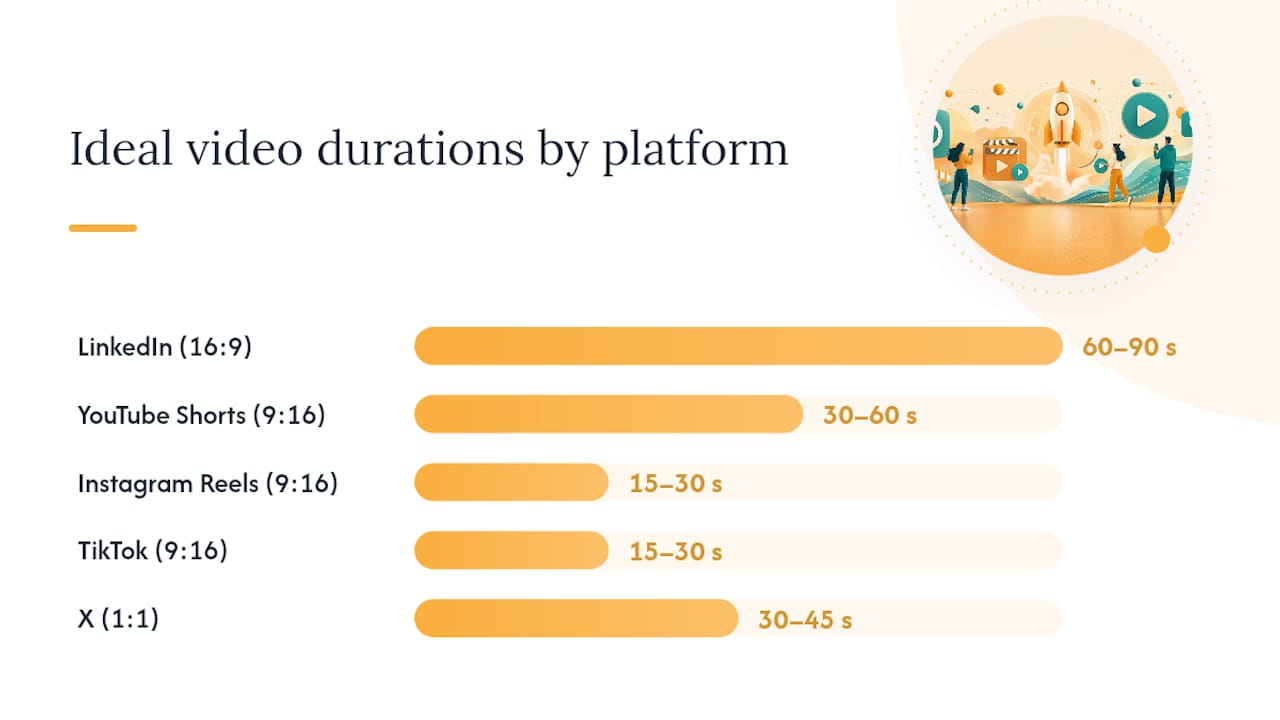
Post timing is informed by HubSpot’s best-time-to-post research, which shows meaningful variation by platform and content type. Use these windows as starting points, then adjust based on your own account’s analytics after the first 48 hours.
For a 1–3 person team, the minimum viable set is the 16:9 LinkedIn hero and the 9:16 vertical for Reels and TikTok. Add the X square and YouTube Short once those two are scheduled. Publish the hero first, then release secondary cuts in 30-minute intervals to avoid algorithm overlap.
Pro Tip: Shoot your master capture in 4K with a clean background and no on-screen text. All platform-specific captions, stickers, and CTAs get added in post. This one decision lets you export every cut from the same source file without reshooting.
What creative assets does a strong launch actually need?
Core asset types
Every launch needs a hero video: 60–90 seconds, product outcome front and center, founder or team member on camera where possible. Flowjam’s data shows founder-led launches appear in 48% of tracked campaigns and dominate the top performance decile. If you can put a real person on screen, do it.
From that hero, you produce:
30–45 second platform cuts for LinkedIn and Facebook, trimmed to the strongest product moment.
15–30 second TikTok-native remix with a hook in the first 2 seconds and a text overlay CTA.
Product carousel (5–8 slides): problem, solution, feature proof, social proof, CTA.
Explainer clip (30 sec): how the product works, step by step, no narration required.
UGC brief for creators: a 3-shot list (unboxing, in-use, reaction) with disclosure language.
Repurposing workflow
Shoot the master capture in one session. Edit a branded master cut with full audio, lower thirds, and product close-ups. From that master, export each platform cut by trimming to the required duration and adding platform-native captions. Create ad-ready versions by removing any time-sensitive language. Schedule organic posts first, then upload ad creatives to your paid campaigns.
Caption formulas
Keep a short library of hooks your team can pull from:
Problem hook: “You’ve been doing [X] the hard way. Here’s what changed.”
Promise hook: “We built [product] to solve [specific problem] in under [time].”
Social proof hook: “[Number] people asked for this. It’s finally here.”
Curiosity hook: “We weren’t going to show this yet. But you asked.”
For small teams, prioritize clarity over cleverness. One product outcome, stated plainly, outperforms a clever tagline that requires context to understand.
How do you amplify reach with creators, paid ads, and owned channels?
Creator strategy
A layered creator approach works better than a single influencer post. Talent Resources describes a hero-plus-ecosystem model: one macro or celebrity creator for broad awareness, supported by 5–10 micro or nano creators (10k–100k followers) who deliver authentic social proof and reusable UGC. Nano and micro creators consistently outperform mega-influencers on engagement rate for many product categories, and their content often converts better because it reads as a genuine recommendation.
Brief every creator with:
Product positioning (one sentence: what it does and who it’s for)
Shot list (3 required shots, 1 optional)
Embargo date and exact go-live window
Disclosure language: “Paid partnership with [Brand]” or “#ad” per FTC guidelines
CTA: where to send their audience (link in bio, promo code, or landing page URL)
Paid media
Launch paid awareness ads on Day 0 targeting cold audiences who match your buyer profile. A small-business paid media sample for a $1,500 launch-week budget:
Audience | Ad Type | Budget Allocation | Days Active |
Cold (interest targeting) | Awareness video | $500 | Days 0–3 |
Warm (video viewers 50%+) | Conversion carousel | $1,500 launch-week budget | Days 2–7 |
Email list lookalike | Consideration video | $1,500 launch-week budget | Days 3–7 |
Owned-channel coordination
Email: send a “first look” teaser 48 hours pre-launch, a launch-day announcement, and a 7-day recap.
Community posts: publish in relevant Facebook Groups, LinkedIn communities, or Slack groups on Day 0 and Day 3.
Retail or e-commerce partners: coordinate product page updates and any co-marketing posts to align with your launch-day timing.
Press: send your pitch 5–7 days before launch with an embargo date. Follow up on Day 0 morning.
Avoid content collision by mapping every partner’s go-live time in a shared calendar. Stagger posts by at least 30 minutes so each one gets its own algorithm window.
Which KPIs should you track for a social media launch?
KPI ladder
Track metrics in order of the buyer journey:
Awareness: reach, impressions, video views (benchmark: ~28,258 median views per launch)
Engagement: likes, comments, shares, saves, and engagement rate (aim for 3–5% on organic posts)
Traffic: CTR to landing page, link clicks, UTM-tracked sessions
Conversion: sign-ups, purchases, demo requests, and conversion rate from landing page
Revenue: revenue attributed to the campaign via UTM and pixel tracking
For a deeper look at attribution methodology, SOL Social Media’s ROI measurement guide covers the full tracking setup.
Tracking setup checklist
Add UTM parameters to every link: utm_source, utm_medium, utm_campaign, utm_content.
Verify your Meta Pixel and TikTok Pixel fire on the landing page before Day 0.
Create a remarketing audience for video viewers (25%, 50%, 75% watch thresholds) in each ad platform.
Name your ad sets consistently: [Product]-[Phase]-[Audience] (e.g., Launch-Awareness-Cold).
QA every link 24 hours before launch.
Reporting template
Daily (Days 0–7): views, reach, engagement rate, CTR, ad spend, and conversions by platform.
7-day recap: total reach, top-performing cut, view-to-bookmark ratio, cost per conversion, and creator performance summary.
30-day attribution: revenue from UTM-tracked sessions, retargeting conversion rate, and email-to-social cross-channel lift.
Retarget those viewers with a scarcity-timed offer (48-hour discount or limited quantity) to convert median reach into measurable sales.*
Ready-to-use post templates for every launch phase
Pre-launch templates
Teaser caption (Instagram/TikTok): “Something we’ve been building for months is almost ready. We’re not showing everything yet. Follow to be the first to know. #[YourHashtag]”
Countdown post (any platform): “3 days. That’s all we’ll say for now. 👀 #[YourHashtag]”
Hashtag announcement (X/Twitter): “We’re launching something new on [Day]. Follow #[YourHashtag] for the full story. RT to spread the word.”
Launch-day templates
LinkedIn hero post: “Today we’re launching [Product Name]. We built it because [one-sentence problem statement]. Here’s what it does: [3 bullet outcomes]. Watch the full video below. [Link] #[YourHashtag] #ProductLaunch”
YouTube Shorts caption: “[Product Name] is live. Here’s the 30-second version of why it matters. Full details in the description. [Link]”
TikTok remix prompt: “POV: you finally have [product outcome]. Show us how you’d use [Product Name]. Tag us and use #[YourHashtag].”
X thread starter: “We just launched [Product Name]. Here’s the story behind it: 🧵 1/ [Hook sentence about the problem it solves]”
Post-launch templates
Recap post: “Day 7 update: [X] people have already [used/signed up/purchased]. Here’s what they’re saying. [UGC screenshot or quote]. Still available: [Link] #[YourHashtag]”
UGC request post: “Have you tried [Product Name] yet? Share your experience and tag us. We’ll feature our favorites this week.”
Review-request DM: “Hi [Name], thanks for your recent purchase of [Product Name]. If you have 60 seconds, a quick review helps us reach more people like you: [Review Link]. No pressure at all.”
Ad copy variations
Ad Goal | Headline | Body Copy | CTA |
Awareness | “Meet [Product Name]” | “[One-sentence outcome]. See how it works.” | Watch Now |
Consideration | “[Problem]? [Product] fixes that.” | “[Feature 1], [Feature 2], [Feature 3]. Starting at $[Price].” | Learn More |
Retargeting | “Still thinking about [Product]?” | “You viewed it. Here’s why [X] people already made the move.” | Shop Now |
What are the most common product launch mistakes and how do you fix them?
Common mistakes
Chasing virality over conversion: A 500k-view video that sends no one to your landing page is a branding exercise, not a launch. Every piece of content needs a single, measurable CTA.
Inconsistent cross-platform messaging: If your LinkedIn post says “limited availability” and your TikTok says “always in stock,” you create confusion that kills trust.
Skipping the creator brief: Creators who don’t know your embargo date or disclosure requirements create compliance risk and off-brand content.
Weak retargeting setup: Launching paid ads without a verified pixel means you’re spending money with no ability to follow up on warm audiences.
No inventory coordination: Driving traffic to a sold-out product page on Day 0 is one of the fastest ways to lose the momentum you spent weeks building.
Quick fixes
Tighten every CTA to one action: “Shop now,” “Sign up,” or “Request a demo.” Remove all secondary links from launch-day posts.
If reach underperforms on Day 1, reallocate 50% of your paid budget to the highest-performing organic cut and boost it directly.
If a creator drops out, publish a founder-led authenticity clip within 24 hours. Raw, on-camera honesty often outperforms polished influencer content anyway.
If negative feedback spikes, respond publicly within 1 hour using this template: “Thanks for flagging this. We’re looking into it now and will follow up directly. [Name], can you DM us your order details?” Then pause paid campaigns targeting that audience segment until the issue is resolved.
If your landing page conversion rate is below 2%, add a time-limited offer (free shipping, 10% off, or a bonus) and update your retargeting ad copy to reflect it.
Launch-day quick-fix checklist
All UTM links tested and working
Pixel firing confirmed on landing page
Creator embargo dates confirmed in writing
Community moderator assigned and briefed
Escalation contact identified for negative feedback
Inventory count verified with fulfillment team
Backup content (founder clip) ready to publish if hero asset underperforms
How SOL Social Media runs product-launch campaigns
SOL Social Media follows a structured process from the first discovery call to the 30-day post-launch report. Discovery covers audience research, platform selection, and KPI alignment. From there, the team moves into creative capture planning: scripting the hero video, building the shot list, and scheduling the production session. Multi-format production follows, exporting the full five-cut set from a single master capture. On launch day, the team manages the posting schedule, creator amplification windows, community moderation, and paid campaign activation in real time. The 30-day sustain phase covers UGC collection, retargeting optimization, and the final attribution report.

For a look at real client growth outcomes, SOL Social Media’s case study library shows how this process performs across different business categories.
Service scope
Social media strategy and launch planning
Hero video production and multi-format asset export
Creator coordination and brief management
Paid amplification setup and optimization
Real-time launch-day community management
7-day and 30-day reporting with attribution
When to hire SOL Social Media vs. run in-house
Hire SOL Social Media if: you have a launch deadline within 6 weeks, your team has no dedicated content producer, you need creator relationships you don’t already have, or your last launch produced no measurable conversion lift.
Run in-house if: you have a content producer on staff, your launch timeline is 90+ days, and you have existing creator relationships and a paid media manager.
What most launch playbooks get wrong about social media
Most launch advice focuses on the wrong constraint. The common framing is “post more, post everywhere, post consistently.” The real constraint for small businesses is almost never posting frequency. It’s message clarity and distribution architecture.
A single, well-produced hero asset with a clear product outcome, distributed through a coordinated cadence across two or three platforms, will outperform a week of daily posts that each say something slightly different. The Flowjam benchmark data makes this concrete: the median launch earns roughly 28,000 views. That is not a failure. That is a real audience. The question is whether your retargeting setup converts those 28,000 views into buyers, or whether you let them scroll past and never see your product again.
The second thing most playbooks underweight is the owned-channel stack. Email and community posts on launch day are not supplementary. They are often the highest-converting traffic source because those audiences already trust you. Treating social media as the only distribution channel and ignoring your email list is leaving your warmest audience out of the launch entirely.
Finally, founder presence matters more than production quality for early-stage and small-business launches. A 60-second clip of the founder explaining the product on a phone camera, with honest language and a clear CTA, frequently outperforms a polished agency video with no human face. The data supports it. Build your launch around a real person saying something true, then distribute it well.
SOL Social Media builds launches that convert, not just campaigns that look good
Small businesses launching a new product need more than a content calendar. They need a coordinated system: the right asset, the right platforms, the right timing, and someone managing the community while the launch is live. That is exactly what SOL Social Media delivers.
SOL Social Media handles the full launch workflow for small businesses across California, Florida, and Colorado, from the initial social media strategy and hero video production to creator coordination, paid amplification, and real-time community engagement on launch day. You get a team that has run this process before, not a template you have to figure out yourself.
If your next product launch is within the next 60 days and you want a coordinated campaign that produces measurable results, contact SOL Social Media to discuss your launch timeline and scope.
Sources
FAQ
What are the 7 steps of a product launch on social media?
The seven steps are: audience research and platform selection, pre-launch teaser campaign with a designated hashtag, hero asset production and multi-format export, launch-day coordinated posting across platforms, creator and employee amplification, paid retargeting for warm audiences, and post-launch UGC collection and reporting.
What is the best platform for a product launch?
The best platform depends on where your buyers are most active. For most small businesses, Instagram Reels and TikTok drive the highest organic reach for new products, while LinkedIn works best for B2B launches. Focusing on one or two platforms consistently outperforms spreading content across every channel at once.
What is the 5-3-2 rule for social media content?
The 5-3-2 rule suggests that for every 10 posts, five should be curated content from others, three should be original educational or brand content, and two should be personal or behind-the-scenes posts. During a product launch, you can adapt this ratio to weight original launch content more heavily while still mixing in community and educational posts.
How long should a product launch social media campaign run?
A well-structured launch campaign runs 30–45 days total: roughly 30 days of pre-launch teaser activity, a focused launch-day push, and 7–30 days of post-launch sustain content, retargeting, and UGC collection.
When should you start paid ads for a product launch?
Launch paid awareness ads on Day 0 alongside your organic posts.
Recommended
Comments