


A 7-Step Social Media Strategy Framework That Drives Results

A social media strategy framework built on seven sequential steps—goals, audience, audit, platforms, content, community, and paid—gives you a document that actually drives business outcomes instead of just filling a content calendar. You define objectives, research who you’re talking to, audit what’s already working, pick the right platforms, build a content system, set community protocols, and balance organic with paid spend.
The seven steps in order:
Goals: Set 1-3 SMART objectives tied to revenue, leads, or retention.
Audience: Build platform-specific personas from real data, not guesses.
Audit: Benchmark your current presence and your competitors.
Platforms: Choose channels based on audience fit, not habit.
Content: Define pillars, formats, and a sustainable calendar.
Community: Set reply SLAs and a moderation protocol.
Paid/measurement: Balance organic and paid spend, then track results.
You don’t need all seven finished before you start. This week, pick one primary platform, write a single SMART goal for the next 90 days, and commit to a 30-day content sprint of three posts a week. Momentum beats perfection here.
Key Takeaways
A social media strategy framework works because it forces objectives, audience data, and measurement into one document that guides every post you publish.
Point | Details |
Start with one goal | Pick one to three SMART goals tied to revenue, leads, or retention before touching content. |
Build data-driven personas | Use analytics, first-party data, and listening, not assumptions, to shape who you target. |
Audit before you post | Run the checklist and prioritize fixes using an impact times effort filter. |
Go deep on one platform | Match audience fit and resources; expand only after hitting benchmarks. |
Set engagement SLAs | Reply to DMs within hours, not days, and keep templates ready for common scenarios. |
Get expert help when ready | SOL Social Media offers strategy audits, managed content, and training to execute this framework consistently. |
What Is a Social Media Strategy Framework?
A social media strategy framework is a structured, repeatable process for turning business goals into a documented plan covering objectives, audience, content, platforms, and measurement. It’s different from a content calendar, which is just the execution layer. Multiple industry guides, including Socialinsider’s seven-step model, converge on roughly the same sequence: set objectives first, then research your audience, audit your current state, benchmark competitors, allocate platforms and resources, build content, and close the loop with measurement.
Skipping steps is the most common failure mode. Business owners often jump straight to “post more content” without ever writing down what success looks like. That’s backwards. A documented strategy exists precisely so you can prove which activities move the needle and which ones are just noise. The framework below walks through each step with templates you can copy today.
Why Do Your Social Goals Need to Match Business Objectives?
Vague goals like “grow our following” or “get more engagement” don’t survive contact with a budget review. Every goal in your social media strategy framework should ladder up to something the business actually cares about: revenue, qualified leads, customer retention, or measurable brand awareness. If a goal can’t be tied to one of those four outcomes, it probably doesn’t belong in your plan.
Step-based guidance from the American Marketing Association consistently starts with SMART goals, specific, measurable, achievable, relevant, and time-bound, before touching content or platforms. Here are five examples you can adapt:
Generate qualified leads from Instagram DMs and link-in-bio clicks over a realistic timeframe.
Increase website referral traffic from social over the next few months.
Grow email list sign-ups from social posts to a steady monthly figure.
Lift customer retention by publishing a monthly loyalty-focused post series, tracked via repeat purchase rate.
Build local brand awareness reflected in increased branded search volume over time.
Objective | Primary KPI | Secondary KPI |
Lead generation | Qualified leads from social | Click-through rate to landing page |
Revenue growth | Attributed sales/conversions | Cart adds from social traffic |
Retention | Repeat purchase rate | Reply/engagement rate on loyalty content |
Brand awareness | Branded search volume | Reach and impression growth |
Pro Tip: Limit yourself to one to three priority goals per quarter. Trying to chase five KPIs at once dilutes your content and your reporting. Review progress every 30 days and adjust the goal, not the whole strategy, if a number isn’t moving.
How Do You Build Personas That Match Your Platforms?
Your audience research determines almost everything downstream, which platforms you use, what content you make, and how you talk to people in comments. A persona built on assumptions instead of data will steer your whole social media plan in the wrong direction.
Start with a simple template: demographics (age, location, income bracket), motivations (what problem are they solving), platform habits (where do they actually spend time), and content triggers (what stops their scroll). You don’t need a 10-page document. Four fields, filled in honestly, beat a beautiful template filled with guesses.
Populate that template using three sources: platform analytics (Instagram Insights, Facebook Audience data), first-party customer data (email lists, purchase history, past inquiries), and social listening (comments, saved posts, direct messages). A healthcare practice might find its Facebook audience skews toward caregivers researching on behalf of a parent, while its Instagram audience is younger patients booking their own appointments, two different personas needing two different tones on the same brand account.
Persona A on Facebook: Caregivers aged 45-64, motivated by trust signals and clear service explanations.
Persona B on Instagram: Patients aged 25-40, responsive to before/after content and quick-answer captions.
Persona C on TikTok or Reels: Younger prospects who respond to behind-the-scenes and staff personality content.
Run a one-hour audience research sprint this week: pull your last 90 days of platform analytics, skim your 20 most recent customer inquiries or reviews, and write down the three questions people ask most often. That’s your persona’s content trigger list.
Pro Tip: Don’t build a persona for every platform you’re on. Build one for the platform where your best customers already spend the most time, then adapt tone, not substance, for secondary channels.
What Should a Social Media Audit and Benchmark Include?
You can’t fix what you haven’t measured. An audit gives you a performance baseline before you touch a single post, and a competitor benchmark shows you where the real gaps and opportunities sit.
Run through this checklist on every active profile:
Profile completeness: bio, contact info, link-in-bio, category tags
Brand consistency: logo, colors, tone across all platforms
Visual asset quality: cover images, highlight covers, pinned posts
Posting cadence over the last 90 days
Top five performing posts by engagement rate, not just likes
Engagement patterns: which post types get replies vs. just views
Tracking setup: is a link-tracking or UTM system in place
For competitor benchmarking, build a simple matrix comparing your account to two or three direct competitors on the same platform.
What to measure | Your account | Competitor A | Competitor B |
Posting frequency (per week) | Record count | Record count | Record count |
Average engagement rate | Record % | Record % | Record % |
Dominant content format | Note format | Note format | Note format |
Content themes covered | List themes | List themes | List themes |
Once you’ve filled that in, apply an impact times effort filter to prioritize fixes. Rank each gap on impact (low, medium, high) and effort (low, medium, high), then tackle the top three high-impact, low-effort items first. A messy bio link is high impact and near-zero effort; a full rebrand is high impact but weeks of effort, so it waits.
Pro Tip: Export your last quarter of analytics directly from each platform’s native dashboard before you start. Screenshots lie; raw exports don’t.
Which Platforms Should You Choose and How Do You Staff Them?
Platform selection isn’t about being everywhere. It’s about matching audience fit, content format, and business outcomes to the channels you actually have the resources to run well. Statista’s platform-size rankings are useful for understanding raw reach, but scale alone doesn’t tell you whether your specific customer is there.
Run each candidate platform through this checklist before committing:
Does your persona actually spend meaningful time here?
Does the platform’s dominant format (video, image, long-form text) match content you can realistically produce?
Can this platform plausibly drive the business outcome tied to your goal?
Do you have the staff hours or budget to maintain it consistently?
Once you’ve picked your channels, split your resources deliberately instead of spreading them evenly.
Every platform you’re active on needs a profile minimum before launch: a complete bio, a clear call to action, on-brand visuals, and a working link setup. An incomplete profile undercuts every post you publish to it.
Small-business-focused guidance is consistent on one point: go deep on one primary platform before expanding. A business chasing five channels at 20% effort each will lose to a competitor running one channel at full depth.
Pro Tip: If you’re not sure which platform is primary, look at where your last ten actual customers, not followers, came from. That’s your answer.
How Do You Structure a Content Strategy and Calendar?
Content pillars are the categories your posts fall into, and they exist so you’re never staring at a blank calendar wondering what to post next. Most small businesses run well with three to five pillars.
Here’s a starter template:
Educational: Answers a common customer question. Example: “3 signs it’s time to replace X.”
Behind-the-scenes: Builds trust through transparency. Example: a day in the life of your team.
Social proof: Reviews, testimonials, before/after results.
Promotional: Direct offers, launches, seasonal campaigns.
Community/culture: Local events, staff spotlights, causes you support.
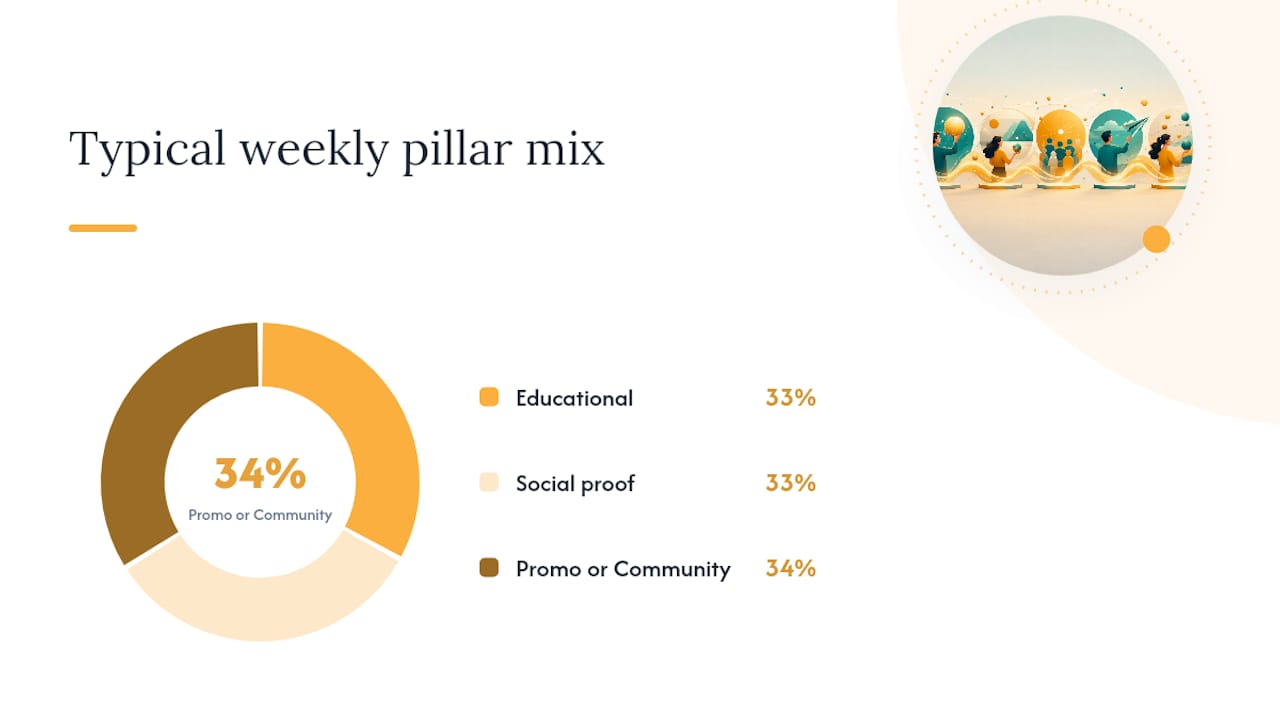
Sequencing matters more than volume. A 30-day calendar might run three posts a week: one educational, one social proof, one promotional or community post, with a reactive or timely post added whenever something relevant happens in your industry or town. Extend that into a 90-day view by mapping which pillar gets emphasis each month, tying it to seasonal demand, product launches, or a testing phase for a new format like short-form video.
Your workflow needs structure or it collapses under its own inconsistency:
Assign clear roles: who writes captions, who shoots or sources visuals, who approves before publishing.
Batch content creation in one sitting per week rather than daily scrambling.
Use a scheduling tool to queue posts instead of manually publishing each one.
Adopt a simple file naming convention (platform_pillar_date) so nobody hunts for assets.
IDEQO’s small-business research breaks social work into four distinct jobs, create, publish, engage, analyze, and recommends batching content creation separately from daily engagement. Treating those as one undifferentiated task is the fastest route to burnout.
It keeps the account feeling alive without abandoning your planned pillars. When something performs unusually well on one platform, repurpose it on a secondary channel rather than starting from scratch; a strong Instagram Reel often works as a TikTok post with minimal editing.
A calendar that’s 100% pre-planned can’t respond to anything happening in real time.*
What Engagement SLAs Keep Your Community Consistent?
Community management is where trust gets built or lost, often faster than any single post can build it. Setting explicit service-level agreements, response time targets, keeps your team consistent and gives you something concrete to hold an agency or employee accountable to.
Reasonable starting SLAs for a small business:
Reply to direct messages within 4 to 6 business hours.
Respond to public comments within 24 hours.
Run two dedicated engagement windows per day, morning and afternoon, rather than checking sporadically.
Keep a few reply templates ready so responses stay consistent in tone:
Positive feedback: “Thank you so much, this genuinely made our day! We’d love to see you again soon.”
Neutral question: “Great question! [Direct answer]. Let us know if you need anything else.”
Complaint: “We’re sorry to hear this. Can you send us a DM with more detail so we can make it right?”
For moderation, set a simple escalation flow: hide obvious spam immediately, delete anything abusive per your platform’s terms, and escalate to a manager or legal contact anything involving a safety claim, legal threat, or PR risk. Keep a basic log of escalated comments with date, action taken, and outcome.
Treating engagement as strategic rather than reactive pays off in discovery, too: platforms tend to reward accounts with real two-way conversation over accounts that only broadcast, which means consistent replies aren’t just good service, they’re a growth lever.

Pro Tip: Assign engagement windows to a calendar block, not a “whenever I get to it” task. Community work that isn’t scheduled is the first thing to slip when you get busy.
How Should You Split Organic and Paid Social Spend?
Organic and paid social do different jobs, and confusing them wastes budget. Organic builds community, trust, and long-term brand recall. Paid accelerates reach, drives conversions, and gets a new offer in front of people who don’t already follow you.
If you’re just starting with paid, set a modest testing floor, many small businesses begin around $300 to $500 a month split across one or two campaign objectives, and resist the urge to scale before you have data.
A simple test-and-scale checklist:
Test one variable at a time: audience, creative, or offer, not all three.
Run each test for at least 5 to 7 days before judging results; shorter windows produce noisy data.
Scale spend only after a test clears your target cost-per-result, not just because it “feels like it’s working.”
Set aside a separate creative-testing budget, distinct from your main campaign spend, so new formats don’t compete with proven ones.
Skipping this step means you’re scaling a campaign built on a guess about who your buyer actually is.*
What Reporting Cadence and Timeline Should You Expect?
Measurement only works if it’s tied back to the goals you set in step one. Track a primary KPI and one or two leading indicators for each objective:
Lead generation: primary is qualified leads, leading indicator is link click-through rate.
Revenue: primary is attributed conversions, leading indicator is cart adds or booking-page visits.
Retention: primary is repeat purchase rate, leading indicator is reply/engagement on loyalty content.
Awareness: primary is branded search or reach growth, leading indicator is share/save rate.
Set a reporting rhythm and stick to it:
Weekly: quick monitoring, are posts publishing on schedule, any spikes or issues.
Monthly: an insight report comparing performance against your KPI targets.
Quarterly: a full strategy review, revisiting goals, personas, and platform mix.
Timeline expectations matter, because most businesses quit right before results show up. At 30 days, expect early signal, engagement rate trends, initial audience growth, but not conversion volume. At 90 days, organic content should show a measurable trend in your primary KPI, and paid tests should have identified at least one winning audience or creative angle. At 180 days, you should see compounding results: content library depth, an established posting rhythm, and enough data to forecast realistic quarterly targets.
Judge performance by benchmarks and trends across weeks, not the fate of any single post. One viral post or one flop tells you almost nothing on its own. Platform-scale data from Statista is a useful backdrop for setting realistic reach expectations relative to your platform choice and audience size.
How Do You Pitch This Strategy Internally for Budget?
A clear, evidence-based pitch gets budget approved faster than a vague request for “more marketing support.” Structure a short deck around six slides:
The problem: current gaps identified in your audit.
Goals: the 1-3 SMART objectives you’re proposing.
Target audience: your persona summary in one slide.
Proposed plan: platform mix, content pillars, and cadence.
Forecasted impact: tie back to the KPI table from your goals section.
The ask: specific budget, hours, or tools needed.
Pair that with a one-page executive summary in bullet form you can paste into an email:
Current state: [one-line audit summary]
Goal: [SMART goal] by [date]
Plan: [platform mix] with [content cadence]
Investment needed: [budget/hours]
Expected outcome: [KPI target]
Have answers ready for the three objections you’ll hear every time: cost (“this is a phased test, not a blank check”), ROI timeline (“30/90/180-day milestones are built in, not open-ended”), and resource constraints (“here’s exactly who does what, and what happens if we don’t staff it”).
Should You Keep Social In-House or Bring in an Agency?
Stay in-house if you have the weekly hours (most small businesses need 3 to 5 hours a week minimum), the skill set to write for your brand voice, and you’re still in an early growth stage where iteration matters more than scale. Consider outsourcing when engagement has stagnated despite consistent posting, when you lack design or copywriting skills, or when growth demands more volume than your team can sustain.
If you do hand off to an agency, prepare a short brief covering your brand voice guidelines, success metrics, current performance benchmarks, and a handful of content examples that represent your best work. Outsourcing tends to work best once you already have a repeatable system and clear benchmarks in place, since that’s what lets you actually hold an agency accountable.
Pro Tip: Run a 90-day pilot with defined KPIs and a built-in review point instead of signing a long-term contract blind. You can read more on structuring that handoff in this guide to outsourcing social media marketing.
Strategy Document vs. Content Plan: What’s the Difference?
Your social media strategy document and your content plan are not the same thing, and confusing them is why so many businesses feel like they’re “doing social” without a real plan. The strategy covers goals, audience, platform choice, and measurement, the why and where. The content plan covers what actually gets posted and when, the execution layer.
A strategy document should contain: your SMART goals, persona summaries, platform rationale, and KPI targets. A content plan should contain: your pillar breakdown, calendar, caption drafts, and asset assignments. Revisit the strategy quarterly; revisit the content plan weekly. Teams that skip the strategy document and jump straight to a calendar often end up with beautifully scheduled posts that don’t move any real business metric.
What Templates Should You Copy This Week?
Paste this condensed audit checklist into a spreadsheet: profile completeness, brand consistency, top five posts, posting cadence, engagement patterns, tracking setup.
Build your 30-day calendar as a grid: Day | Post type (pillar) | Owner | Status. Fill three rows per week.
Run your first 30/90-day rollout against these milestones: Week 1 audit and goals, Weeks 2 to 4 persona and platform setup plus first content batch, Day 60 first monthly report, Day 90 full strategy review against your KPI targets. For more depth on building out this document, see this practical guide to creating a social media strategy.
What We’ve Learned Helping Small Businesses Build This
We’ve watched more than one small business owner try to run social media strategy entirely from memory, posting when inspiration struck and disappearing for weeks when things got busy. The pattern is always the same: engagement is inconsistent because the effort is inconsistent. The businesses that turn things around aren’t the ones with the flashiest content. They’re the ones who commit to a weekly rhythm, even a modest one, and stick with it past the point where results feel slow.
Try this for 30 days: block one hour a week for content batching and 15 minutes a day for engagement replies. That’s it. Don’t add more until that rhythm feels automatic.
Treat your strategy document as something you revise, not something you finish. The version you write this month should look different by next quarter.
How SOL Social Media Can Help You Execute This Framework
Building the framework is one thing. Running it consistently, week after week, is where most small businesses lose momentum, and it’s exactly where SOL Social Media steps in. SOL provides social media strategy development, full audits, managed content creation and posting, and hands-on training for business owners who want to keep execution in-house but need the system built first.
If you’ve read this far and recognized your own business in the “inconsistent posting” pattern, a conversation with SOL Social Media starts with a review of your current profiles and goals, not a sales pitch. You’ll walk away with a clear picture of where your gaps are and what a realistic 90-day plan looks like for your specific audience. Explore SOL’s social media strategy services or, if community engagement and reply consistency are your biggest pain point, look at SOL’s social media engagement services built around exactly the SLA structure covered above. Book a strategy call to get a tailored audit and a copy of the 30-day calendar template.
Sources
Use these for benchmarking your own numbers, not for copying wholesale, every business’s baseline looks different.
The single most useful download for a small business just getting started is the 30-day content calendar template, it forces the pillar and cadence decisions before you ever open a scheduling tool.
FAQ
What Are the 7 C’s of Social Media Strategy?
Definitions vary across sources, but common versions include content, community, conversation, curation, consistency, connection, and conversion, all pointing back to the same idea covered in this framework: content built around real audience needs, delivered consistently, measured against business outcomes.
What Is the 5-5-5 Rule for Social Media?
The 5-5-5 rule generally suggests spending time each day commenting on five posts, sending five DMs, and replying to five comments to build community engagement. It’s a lightweight way to operationalize the engagement SLAs covered above.
What Are the Four Types of Social Media Strategies?
Common categories include awareness-focused, engagement-focused, lead-generation-focused, and retention-focused strategies. Most small businesses run a blend, weighting toward whichever objective matches their current growth stage, rather than committing to just one.
What Is the 5-3-1 Rule on Social Media?
The 5-3-1 rule suggests a weekly content mix: five curated or educational posts, three original brand posts, and one promotional post, a ratio that keeps content from feeling like a constant sales pitch.
How Long Does It Take to See Results From a New Social Strategy?
Expect early engagement signal at 30 days, a measurable trend in your primary KPI by 90 days, and compounding results with an established rhythm by 180 days, based on the timeline framework covered above.
Should a Small Business Handle Social Media In-House or Hire an Agency?
It depends on available weekly hours and in-house skill gaps; many small businesses start in-house and bring in support like SOL Social Media once they have a repeatable system and clear benchmarks to hold a partner accountable to.
Recommended
Comments