


Small Businesses: Social Media Storytelling, 3 Posts a Week, No Hires

Social media storytelling is the practice of shaping posts around a character, a stake, and a resolution instead of a plain announcement. The fastest way to start is not brainstorming a big campaign. Pick one framework, then commit to a three-post weekly cadence, setup, conflict, resolution, so your audience learns to expect and follow your story. This article gives you those frameworks, platform-specific tactics, a four-week pilot plan, and the metrics that prove it worked.
TL;DR:
Building trust with serialized stories over a week requires consistent three-post arcs that highlight character, conflict, and resolution each week.
Using platform-specific edits, reels should hook in the first three seconds with captions, carousels teach in stages, and LinkedIn posts should start with specific moments for best engagement.
Tracking completion rates, saves, shares, profile taps, and story-specific comments over 60 to 90 days provides better insight into storytelling success than likes or broad reach metrics.
Maintaining a documented brand voice and a balanced content mix helps ensure storytelling remains consistent and aligned with business goals, preventing drift over time.
Small businesses can outsource content creation and workflow management to agencies like SOL Social Media to sustain a steady, story-driven posting cadence without a full in-house team.
What Are the Best Frameworks for Social Media Storytelling?
Four frameworks cover almost every situation a small business runs into. Pick the one that matches your goal, not the one that sounds most creative.
Before, After, Bridge (BAB): Show the problem, show the fix, then show how your product or service closed the gap. A caption example: “Six months ago, our client’s Instagram had 200 followers and zero bookings. Today she’s fully booked through March. The bridge? A weekly posting rhythm she could actually stick to.”
Three-act structure (setup, conflict, resolution): Borrowed from the hero’s journey, this works best for serialized content and case studies stretched across multiple posts.
Start in media res: Open mid-action, a customer mid-crisis, a product mid-use, then rewind to explain. This format thrives on Reels and TikTok, where the first second decides whether someone keeps watching.
Star, chain, hook: Introduce a relatable star (your customer, your founder), link a chain of small moments, then land on a hook that invites comments or shares.
Match the framework to the funnel stage:
Building awareness? Use start-in-media-res for maximum scroll-stopping power.
Building trust? Use three-act structure across a serialized week.
Driving conversion? Use BAB, since it puts the transformation front and center.
Every one of these depends on tension. Storytelling research from UWA Online notes that a story needs something at stake to move from informational to emotionally engaging. A before-and-after post without a real obstacle in the middle just reads like an ad with extra steps.
How Do You Adapt One Story Across Platforms?
The core story stays the same. What changes is the pacing, the visual treatment, and the call to action. Salesforce’s small-business marketing guidance points to short-form video and serialized posting as two of the strongest formats for authentic discovery, but each platform still needs its own edit.
Reels and TikTok: Hook in the first zero to three seconds, show the tension fast, deliver the payoff before attention drifts. Burn in captions and subtitles, since most viewers watch with sound off.
Instagram carousels: Use swipe beats to teach something in stages, then close with a clear save-or-share prompt on the last card. Carousels reward depth that a single image can’t hold.
Instagram Stories: Treat these as the daily, lower-stakes layer of your story, quick polls, behind-the-scenes clips, and countdowns that keep the account active between bigger posts.
LinkedIn: Narrative threads work better than announcements. Aim for 150 to 250 words, open with a specific moment, and let the business lesson land at the end rather than the top.
A quick platform checklist: match length to attention span, put your hook in the first line or first frame, choose visuals that support the emotion rather than decorate it, and pick a CTA that fits the platform’s native behavior (save on Instagram, comment on LinkedIn, share on TikTok).
How Do You Build a Weekly Storytelling Cadence?
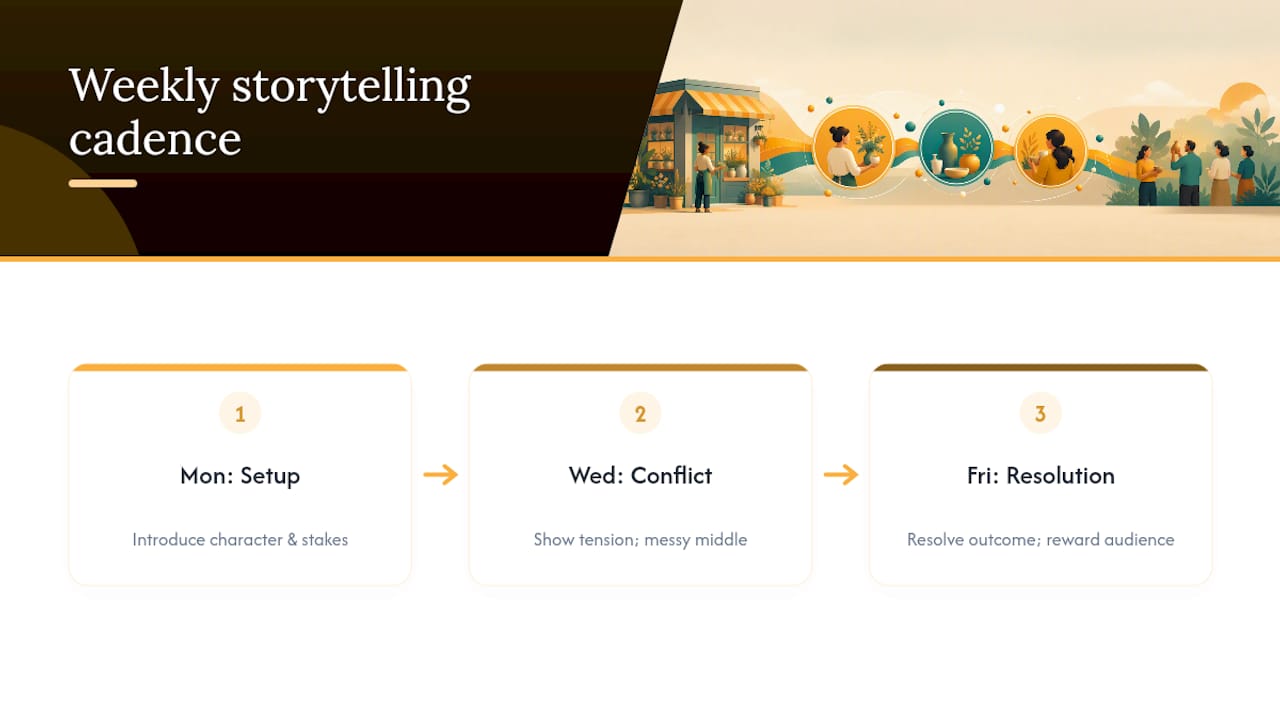
A three-post weekly arc, setup on Monday, conflict on Wednesday, resolution on Friday, gives your audience a reason to check back, and it compounds. ContentStudio’s research on brand storytelling identifies this cadence as a repeatable schedule that high-performing brands use specifically because it builds narrative recognition over time rather than resetting with every post.
Run it as a four-week pilot before committing further.
Week 1: Pick one customer or founder story. Post the setup (who, what, why it matters), the conflict (the obstacle or turning point), and the resolution (the outcome), one post per stage.
Week 2: Repeat with a new story, same three-beat structure, same posting days for consistency.
Week 3: Introduce a platform variation, run the same story arc as a carousel on Instagram and a thread on LinkedIn to compare formats.
Week 4: Check saves, shares, and completion rate against your baseline, then decide whether to continue, adjust the cadence, or test a different framework.
If completion and save rates improve week over week, that’s your go signal. If they stay flat, change the hook before you change the framework.
Pro Tip: Keep a running swipe file of every conflict-stage post that outperforms its setup post. That’s usually where your next hook idea is hiding.
What KPIs Actually Measure Storytelling Success?
Likes tell you almost nothing about whether a story worked. Guidance from MarketingEar on storytelling in social media marketing argues that completion rate, saves, shares, and comments referencing specific story details are far better signals, since they show someone stayed engaged long enough to absorb the narrative.
Track these five metrics weekly:
Completion or watch-through rate: Measures whether your hook actually earned attention past the first three seconds.
Saves: A save means the viewer wants to return to it, a strong intent signal for carousels and tutorials.
Shares: Shares extend reach organically and usually mean the story resonated emotionally, not just informationally.
Profile taps: Shows curiosity about who’s behind the story, a precursor to follows and conversions.
Comments referencing story details: A comment that mentions a specific plot point (not just “love this”) signals the audience actually followed the arc.
Set a 30-day baseline before you start your pilot, then evaluate results over a 60 to 90 day window, comparing story-driven weeks against non-story weeks as a rough control. A minimal dashboard needs only four columns: completion rate, saves, shares, and comment quality, checked weekly rather than daily to avoid overreacting to normal swings.
What Tools Help You Scale Storytelling Production?
You don’t need a production team to run a consistent cadence, you need a repeatable workflow. Editing apps like CapCut and InShot handle captions, subtitles, and quick cuts for Reels and TikTok, while template tools like Canva keep carousel design consistent across weeks. Small-business storytelling guidance from Type and Tale points to exactly this kind of low-friction toolkit as the reason smaller brands can post consistently without a full creative department.
Batch one long story (a customer interview, a behind-the-scenes shoot) into five or six micro-assets, a Reel, three Stories, one carousel, one LinkedIn post.
Build a one-page UGC brief: what to film, how long, what permission language to include before you repost customer content.
Draft captions in batches using a simple prompt template (hook, tension, resolution, CTA) rather than starting from a blank page each time.
For workflow structure beyond the toolkit itself, NULLBIT’s guide to streamlining a digital marketing workflow walks through batching and scheduling systems that pair well with a three-post weekly cadence.
Why Does Storytelling Work Better Than Straight Promotion?
Human brains process narrative differently than they process information. A list of features asks the reader to evaluate and decide, which takes effort. A story with a relatable character and a real obstacle triggers empathy first, and the persuasion happens almost as a side effect. That’s why a testimonial framed as a story (“She almost gave up on her business before this happened…”) consistently outperforms the same testimonial framed as a bullet point of results.
Tension is the mechanism, not decoration. Without something at stake, a post reads as an announcement, and announcements get scrolled past. The UWA Online research on brand narrative makes this point directly: storytelling only becomes emotionally engaging once there’s genuine risk or uncertainty in the middle of the arc. A before-and-after post that skips the messy middle loses the exact ingredient that made it worth watching.
There’s also a recognition effect at play. Once your audience knows your posting rhythm, setup on Monday, conflict on Wednesday, resolution on Friday, they start anticipating the next beat the way they’d anticipate the next episode of a show they follow. That anticipation is what turns casual scrollers into a returning audience, and it’s the psychological reason a serialized cadence outperforms one-off posts even when the content quality is similar.
How Do You Build Real Engagement, Not Just Reach?
Community forms around specificity, not polish. A post that mentions a real customer by name, a real obstacle, a real timeline builds more trust than a beautifully shot but generic inspirational quote. Shifting the spotlight off your brand and onto the people you serve tends to increase both authenticity and shareability, since viewers see themselves in a customer’s story more easily than in a company’s.
Practical ways to build that engagement:
Reply to comments that reference specific story details with equally specific answers, not a generic thank-you.
Ask a direct question at the resolution stage of your weekly arc (“Has this happened to your business too?”) instead of a vague “thoughts?”
Feature a follower’s response or story as the setup for the following week’s post, closing the loop publicly.
Run the conflict-stage post as a poll or question sticker on Stories to invite prediction before you reveal the resolution.
None of this requires a large team. It requires consistency and a willingness to let customers, not the brand, carry the narrative weight. For more tactical formats to rotate into your engagement plan, a list of proven engagement tactics can round out your weekly mix beyond the core three-act cadence.
What Storytelling Mistakes Cost You the Most Engagement?
The most common mistake is skipping the conflict stage entirely. A post that jumps straight from “here’s our product” to “here’s the happy result” has no tension, and without tension, the story doesn’t ask anything of the viewer’s attention. It reads as marketing copy wearing a story costume.
A second mistake is inconsistency. Posting a beautifully told story once, then going silent for three weeks, wastes the recognition effect a cadence builds. Audiences forget fast. A third mistake is over-scripting; polished, ad-agency-sounding captions tend to underperform against plainer, more direct language that sounds like an actual person talking about an actual event.
A fourth mistake is measuring the wrong thing. Chasing likes instead of completion rate or saves means you’ll optimize for posts that look good in a feed for half a second rather than posts that actually get watched, saved, and remembered. And a fifth: forgetting the CTA. Every resolution-stage post needs a next step, comment, save, visit the profile, or the story ends without giving the audience anywhere to go.
Practitioner advice from Gary Vaynerchuk’s guide to storytelling on social media reinforces a simpler fix for most of these problems: post more often, keep it plain, and don’t wait for a perfect story before you start telling one.
How Do You Keep Storytelling On-Brand Every Week?
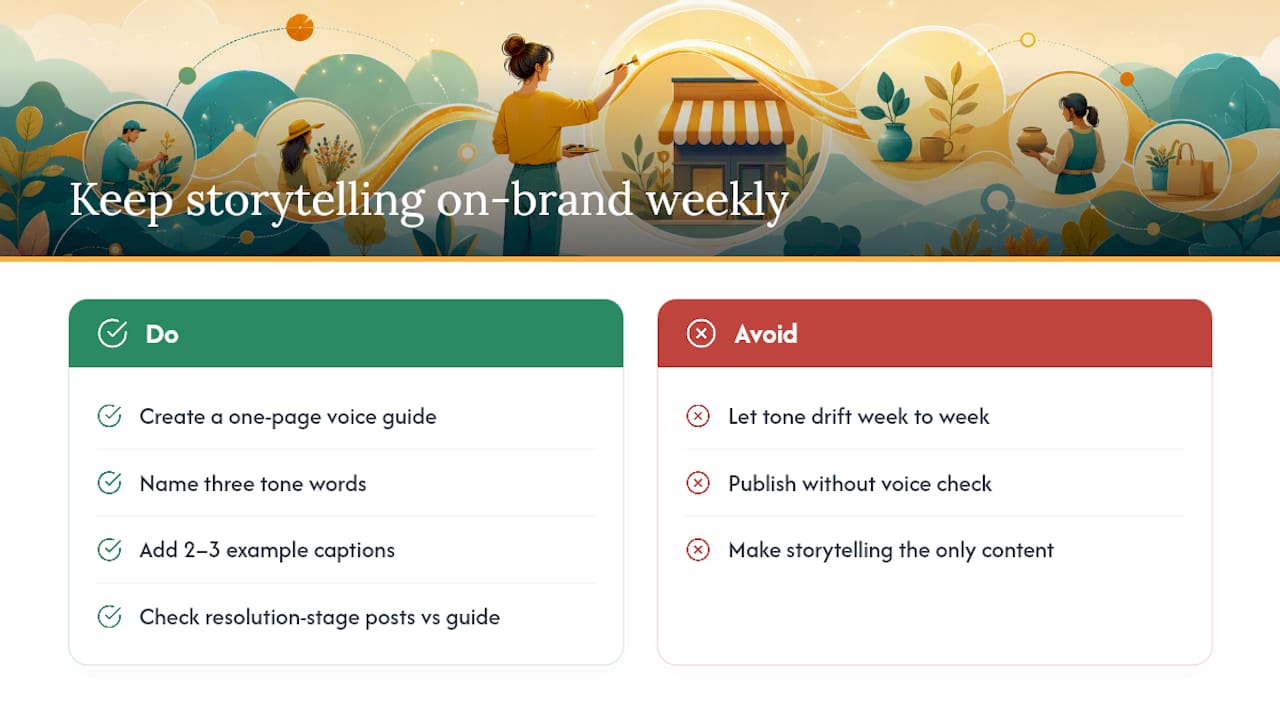
Storytelling drifts when there’s no documented anchor for what your brand sounds like. Small businesses that treat storytelling as a repeatable format, with a written voice guide and reusable templates, stay consistent even when different team members are writing posts. Without that anchor, tone swings week to week and the audience loses the sense that they’re following one consistent voice.
Start with a one-page brand voice reference: three words that describe your tone (warm, direct, a little irreverent, whatever fits), a list of phrases you would never use, and two or three example captions that nail the voice. Check every resolution-stage post against that reference before it goes live, since that’s the post most likely to slip into generic ad language.
Keep your content mix balanced too. A useful rule of thumb from brand storytelling research suggests roughly 30 to 40 percent of your weekly posts should be story-driven, with the remainder covering direct offers, educational content, and community management. That ratio keeps storytelling from feeling like the only thing your brand does, while still giving it enough room to build recognition. Aligning that mix with your broader social media marketing strategy keeps storytelling tied to actual business goals instead of floating as a separate creative exercise.
SOL Social Media’s Perspective on Story-First Programs
Most small businesses don’t fail at storytelling because they lack a good story. They fail because nobody owns the cadence once the excitement of week one wears off. SOL Social Media’s case studies on social media growth tactics consistently show the same pattern: accounts that stick with a documented voice and a repeatable posting rhythm outperform accounts chasing a new creative concept every week.
An effective approach sets itself apart by real human copywriting over templated captions, a cadence built around actual customer stories rather than generic content calendars, and community engagement that treats comments as part of the story, not an afterthought.
Before you build your own pilot, ask honestly: Do you have a documented brand voice? Can you name three customer stories you could tell this month? Do you check saves and shares, or just likes? If the answer to any of those is no, that’s where to start.
— SOL Social Media
How SOL Social Media Can Help You Run a Story-First Pilot
Running a three-post weekly cadence sounds simple until you’re the one writing captions, filming Reels, and checking metrics on top of actually running your business. That’s the gap SOL Social Media closes: real human copywriting and a cadence built around your customers’ actual stories, not a content calendar filled with generic prompts.
If you already know your content needs structure but you’re not sure which framework fits your brand, a Social Media Strategy engagement maps your customer stories to a workable weekly plan. If the bottleneck is production, Social Media Content Creation handles the filming, editing, and caption drafting so your cadence doesn’t depend on you finding a free afternoon. Want your team to run it themselves? Customized Social Media Training builds these frameworks into your own process. For businesses ready to commit to an ongoing story-first program, the Monthly Unlimited and Weekly Consulting plans outline how that support works month to month. Start by booking a strategy session to scope your four-week pilot.
Sources
FAQ
What Is the 5-5-5 Rule for Social Media?
The rule suggests regular engagement across multiple accounts and platforms to build reciprocal community engagement. It works best as a supplement to a documented storytelling cadence, not a replacement for one, since engagement without a consistent narrative rarely builds lasting brand recall.
What Is the 3-1-1 or Similar Content-Mix Rule for Social Media?
Content-mix rules generally recommend balancing promotional posts with educational and story-driven content so an account doesn’t read as a constant sales pitch. A workable version for storytelling specifically is keeping roughly 30 to 40 percent of weekly posts story-driven, per ContentStudio’s brand storytelling research, with the rest split between offers and community content.
What Are the Five C’s of Storytelling?
Definitions vary across marketing sources, but a common version covers character, conflict, context, change, and climax, the same beats that show up in three-act structure and BAB frameworks. Whatever version you use, the constant across all of them is tension: a story without something at stake rarely holds attention.
What Is the 5:3:2 Rule for Social Media Posts?
This rule splits content into a mix of curated third-party posts, original brand posts, and personal or promotional posts, serving as a general content-balance guideline rather than a storytelling framework, and pairs well with a three-post weekly story arc layered on top of your original content.
How Do I Know Which Storytelling Framework to Start With?
Start with Before, After, Bridge if your immediate goal is conversion, since it puts the transformation front and center. Choose three-act structure if you’re building a serialized weekly cadence, since ContentStudio’s research shows this compounds recognition better than isolated posts.
Recommended
Comments