


Six Social Media Management Contract Clauses for Small Business Owners

A standard social media management retainer delivers six things: a social audit and strategy, a content calendar, content creation, publishing and scheduling, community management, and monthly reporting. Paid social and full video production are usually billed separately. Every one of these deliverables needs a number attached to it in the contract, whether that’s posts per week or hours for a comment response, or you have no way to hold the agency accountable.
TL;DR:
Social media management retainers must include specific, measurable deliverables such as exact post counts, content formats, and response times to ensure accountability.
A thorough social media audit should cover account inventory, branding checks, performance metrics, and competitive benchmarking to guide strategy development.
Publishing and community management details, including formatting, response windows, and escalation plans, require precise SLAs to prevent misunderstandings and ensure quality.
Reports should combine key metrics with expert commentary and actionable recommendations, making them meaningful for ongoing social strategy adjustments.
Paid social advertising and large-scale content production are typically excluded from base retainers and require separate agreements with clear scope and billing transparency.
What Counts as a Social Media Management Deliverable?
Deliverables are the tangible, countable outputs a retainer produces each month, not vague promises about “growing your brand.” Industry guides consistently break management packages into seven core components: strategy, content calendar, copywriting, design or editing, scheduling and publishing, community management, and a monthly report. Everything beyond that list, from paid ad management to on-site video shoots, tends to sit outside the base retainer as an add-on.
Here’s what a typical monthly bundle looks like broken into its parts:
Strategy and audit: a written plan covering audience, content pillars, and channel priorities, refreshed quarterly.
Content calendar: a scheduled grid of what posts when, usually delivered 5 to 7 days before the month starts.
Content creation: captions, graphics, carousels, and short video, produced against agreed monthly counts.
Publishing: posts scheduled and pushed live on each platform at the agreed times.
Community management: replies to comments and direct messages within a stated response window.
Reporting: a monthly summary tying results back to your goals, with commentary and next steps.
A quantified spec might read: 12 feed posts and 8 stories per month across Instagram and Facebook, with two rounds of revisions included. That single sentence is the difference between a proposal you can hold an agency to and one you can’t.
What Should a Social Media Audit and Content Calendar Include?
Buyers rarely ask enough questions about the audit, and it’s the deliverable that sets the direction for everything after it. A proper audit is a structured document, not a quick scroll through your feed. It should include an account inventory, branding consistency checks, a performance snapshot, and competitive benchmarking, wrapped up with a ranked action list, often organized as Keep, Fix, or Kill. Most agencies run this quarterly, with a lighter check-in monthly.
The strategy that follows should name your target audience in specific terms, define 3 to 5 content pillars (the recurring themes your posts rotate through), pick the channels that match where your customers actually spend time, and set goals with measurable KPIs attached. A 6-step audit template covering access, profiles, audience, performance, competitive analysis, and action items keeps this repeatable rather than reinvented every quarter.
From there, the content calendar becomes the operational backbone:
Delivery date: the calendar arrives 5 to 7 business days before the month it covers.
Approval window: you get a few business days to review and request changes before it locks.
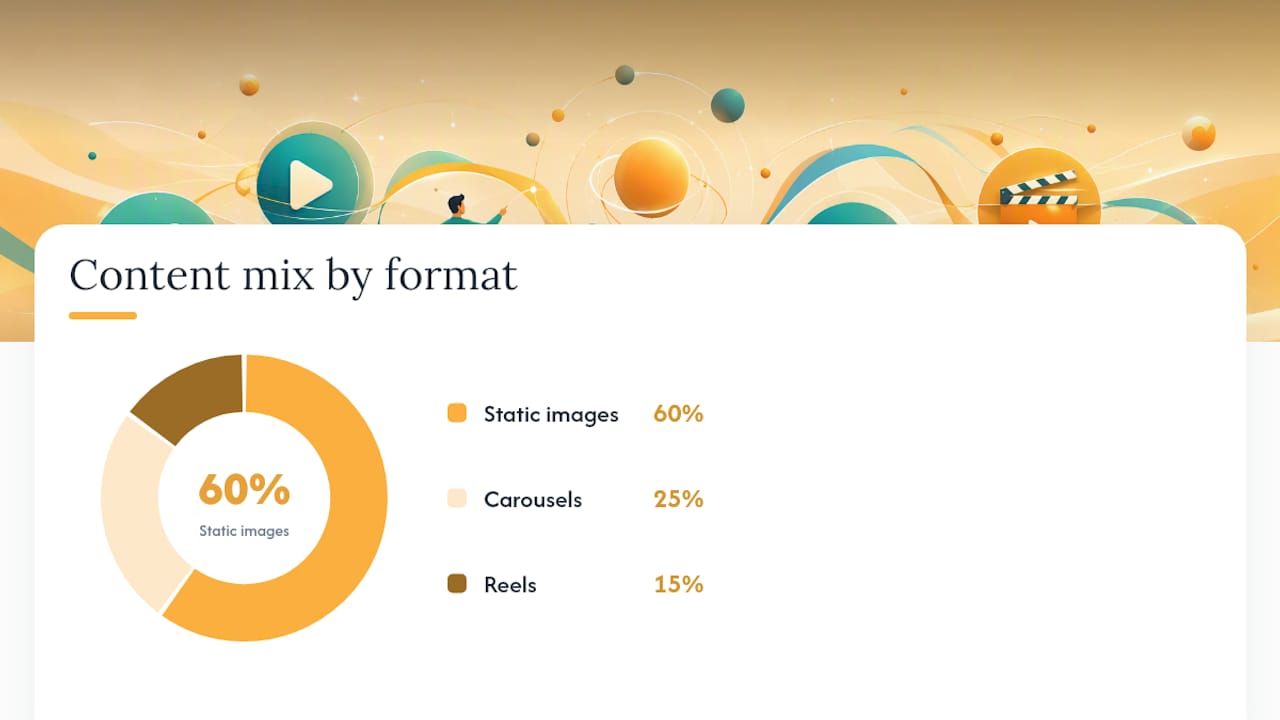
Content mix: a stated ratio of formats, such as 60% static images, 25% carousels, 15% reels, mapped to platform.
Creation specs: post copy, captions, a defined number of image or carousel assets, and reel edits, all with asset ownership spelled out.
Revision rounds: typically one to two rounds included before extra edits carry a fee.
Pro Tip: Ask who owns the raw files, not just the finished posts. If an agency shoots video for you and the retainer ends, you want the original footage in your hands, not just the exported reel.
What SLAs Cover Publishing and Community Management?
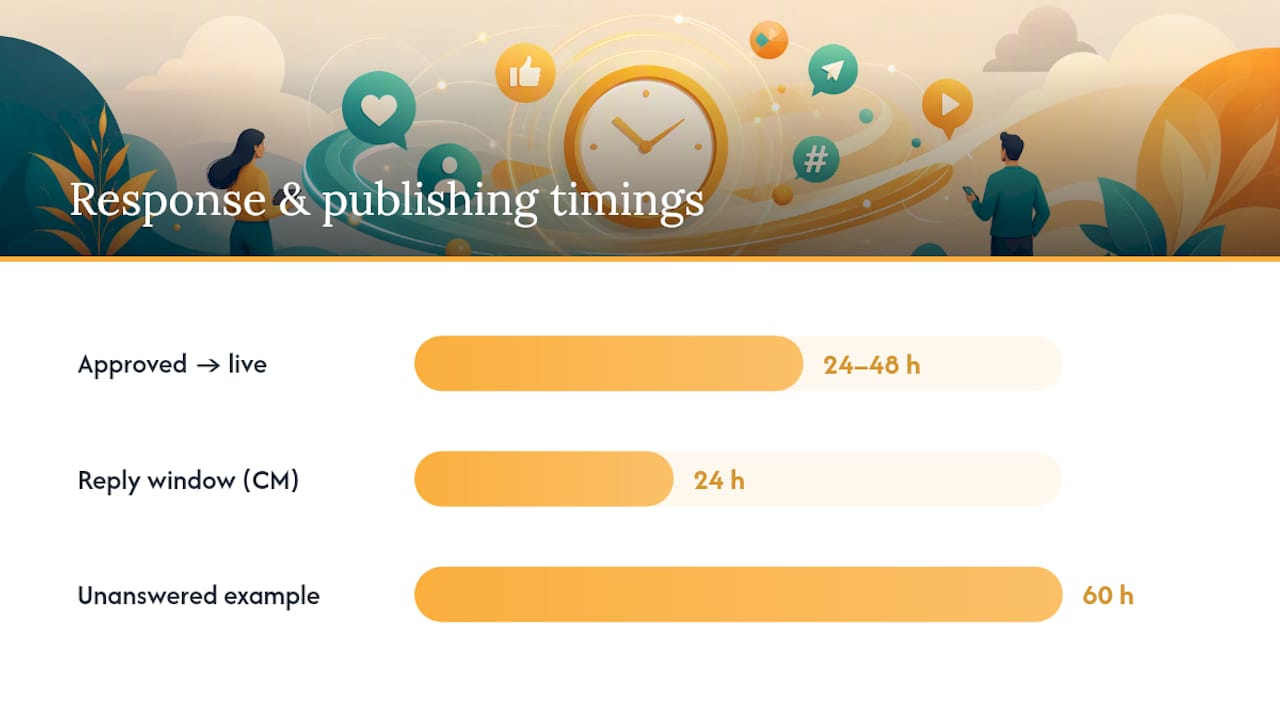
Publishing and community management are where a lot of proposals get vague, and vague is exactly what causes friction three months into a contract. Publishing deliverables should specify how content gets formatted per platform (a square crop for Instagram feed, a vertical crop for Reels and Stories), which scheduling tool handles the queue, and how long approved content sits before it’s live, usually within 24 to 48 hours of sign-off.
Community management needs the same precision:
Comment and message replies within a stated window, commonly within 24 business hours on weekdays.
Defined coverage hours (business hours only, versus extended evening or weekend coverage as an upgrade).
A moderation policy for spam, negative comments, and off-brand replies.
A named escalation contact for anything beyond routine replies.
Escalation planning matters more than most owners realize until they need it. A crisis pause protocol should name who can approve pulling scheduled content, who signs off on a public response, and how the agency documents the incident for later review. Bundling content creation and publishing under one team, rather than splitting them across separate vendors, makes accountability far easier to trace when something goes wrong at 9 p.m. on a Friday.
Pro Tip: If a proposal doesn’t mention weekend or after hours coverage at all, assume there isn’t any. Ask directly, because a negative comment sitting unanswered for 60 hours does more damage than one answered in 24.
What Makes a Social Media Reporting Template Useful?
A report stuffed with raw numbers and no context is close to worthless. What separates a useful report from a dashboard export is commentary that explains why content performed the way it did and what changes next month, not just a column of impressions and likes.
A workable monthly cadence looks like a short PDF delivered within the first week of the new month, followed by a 20 to 30 minute call to walk through it. The report should map metrics to whatever you set as goals during the audit phase: engagement rate if the goal is community building, reach and follower growth if the goal is awareness, or click throughs and conversions if the goal is lead generation. Ask for these baseline metrics in every report:
Engagement rate by platform and content type.
Follower growth, both net and by source where the platform reports it.
Top three performing posts with a one-line reason why.
Reach and impressions against the prior month.
Recommendations for the next 30 days.
Agencies that add short, specific recommendations for the next month, rather than stopping at the numbers, tend to see better client retention because owners can see the report actually driving decisions instead of sitting in an inbox. A solid analytics report template makes this comparison easy month over month, and pairing it with the right tracking tools keeps the underlying data consistent.
Is Paid Social Included in a Management Retainer?
Paid social almost never comes bundled into a base management retainer, and most agencies will say so upfront. What typically sits outside the core package: paid ad management, influencer or creator negotiation, on-location production shoots, and rush or holiday coverage.
Before signing anything that includes these, ask for:
Clear separation of creative ownership between organic content and paid creative.
Full billing transparency, meaning you see exactly what goes to the platform versus what goes to the agency.
Campaign-specific reporting, separate from your organic monthly report.
Most proposals will explicitly exclude influencer outreach, e-commerce integrations, and large-scale video production by default unless you ask for them in writing.
How Much Do These Deliverables Typically Cost?
Price bands scale with exactly what you’d expect: more platforms, higher posting frequency, more video editing, and longer community coverage hours all push the number up. Vendor research on agency offerings shows tiered packages built around those same four levers, from a lean single-platform starter tier up to full-service coverage across four or five channels with daily posting and extended community hours.
When you’re comparing quotes, translate deliverables into a rate rather than judging the sticker price alone:
Deliverables per dollar: divide the quoted monthly fee by total posts, stories, and reels included.
SLA tightness: a 24-hour community response commitment is worth more than an unstated “we’ll get to it.”
Revision allowance: two rounds included beats one round with a $75 fee per extra edit.
Platform coverage: confirm whether “social media management” means two platforms or five before comparing price.
A cheaper quote with vague deliverables usually costs more once you account for the extra edits, missed deadlines, and scope arguments that follow.
What Six Items Should Every Social Media Contract Specify?
A handshake agreement on “we’ll post a few times a week” is not a deliverable. It’s a hope. Contracts need to name specifics, and service agreements that quantify platforms, posts per period, formats, and turnaround times are the ones that actually hold up when a dispute happens.
Quantified deliverables: exact platforms, posts per week or month, format mix, and number of revision rounds included.
Approval workflow: submission dates, review windows (typically 2 to 3 business days), and what happens if you miss a deadline.
IP and asset ownership: who owns finished graphics, video files, and raw footage once the contract ends.
Platform access: who holds admin rights, and how that access transfers back to you at offboarding.
Offboarding runbook: a documented handover process, including follower data and account access transferred back cleanly where the platform allows it.
Notice and cancellation terms: required notice period, any early termination fee, and a clear responsibility matrix for who does what during the transition.
A detailed scope of work attached as a schedule to the main contract, rather than folded into vague paragraph language, is what makes every one of these items enforceable rather than aspirational.
What Questions Should You Ask an Agency Before Signing?
The discovery call is where operational clarity either shows up or doesn’t. Ask directly: how many posts per platform, per month, are included? What’s the community response SLA, and does it cover weekends? Who approves the content calendar, and what happens if you’re late reviewing it? What does offboarding look like if you leave in six months?
Watch for a few red flags. An agency that can’t give you a specific number when you ask “how many posts” is telling you they don’t operate with real deliverables. Vague answers about reporting (“we’ll send you the highlights”) usually mean no structured template exists at all.
Run every proposal through a short checklist: are deliverables measurable and written down, is reporting substantive rather than a screenshot dump, does the account team’s communication style match how you actually run your business, and is there a clear weekly or monthly rhythm to check ins?
Pro Tip: Ask to see a sample monthly report from an existing client before you sign anything. If an agency can’t produce one, that tells you what your own reports will probably look like.
How SOL Social Media Structures Deliverables for Small Businesses
SOL Social Media builds every retainer around quantified specs: a set number of feed posts, stories, and reels per platform, a quarterly audit, a calendar delivered on a fixed date each month, and a defined community response window. Reporting includes commentary and next steps, not just numbers. During an onboarding call, expect a walkthrough of your specific deliverable counts, approval windows, and what the first 30 days will look like before any content goes live.
— SOL Social Media
Ready to See These Deliverables in Action?
You now know what to ask for. The harder part is finding a team that actually delivers a content calendar on schedule, a real community response SLA, and reports you can act on instead of just glance at. SOL Social Media builds retainers around exactly the specs covered above: quantified posts per platform, defined revision rounds, and monthly reporting with real commentary, not raw exports. Real human copywriting is at the center of every piece of content, which means your captions sound like your business, not a template pulled from a content bank.
A discovery call walks through your current social presence, maps out realistic post counts and formats for your industry, and lays out exactly what a first 90 days would look like before you commit to anything. If you’re ready to compare a real proposal against everything in this article, start with SOL Social Media’s social media engagement services and book a call to get specific numbers for your business.
Sources
For deeper reference: the social media audit guide walks through audit structure step by step, the analytics report template turns raw metrics into a usable monthly report, and Pfeiffer Law’s deliverables breakdown is worth reading before you sign any contract.
FAQ
What Are Social Media Deliverables?
Social media deliverables are the specific, countable outputs an agency produces each month: strategy documents, a content calendar, a defined number of posts and stories per platform, scheduled publishing, community management within a stated response window, and a monthly performance report.
What Is the 5-5-5 Rule for Social Media?
The 5-5-5 rule is a content-planning shortcut suggesting you spend a few minutes daily engaging with 5 posts from your own audience, 5 posts from similar accounts, and 5 posts from larger accounts in your niche to stay visible and build relationships.
What Are the 7 C’s of Social Media?
Definitions of the “7 C’s” vary across marketing sources, but common versions cover content, community, curation, conversion, consistency, creativity, and communication as the pillars of a working social strategy.
What Are Examples of Deliverables?
Concrete examples include 12 feed posts and 8 stories per month across two platforms, a quarterly social media audit with a Keep/Fix/Kill action list, a content calendar delivered 5 to 7 days before each month, and a monthly report with commentary and next-step recommendations.
Recommended
Comments