


Instagram vs TikTok for Creators: Pick the Right Platform
- Elana Rheinhart
- Aug 6
- 14 min read

TL;DR:
TikTok offers rapid discovery by seeding content to strangers, regardless of follower count.
Instagram builds community and trust through relationship signals, supporting direct sales and loyalty.
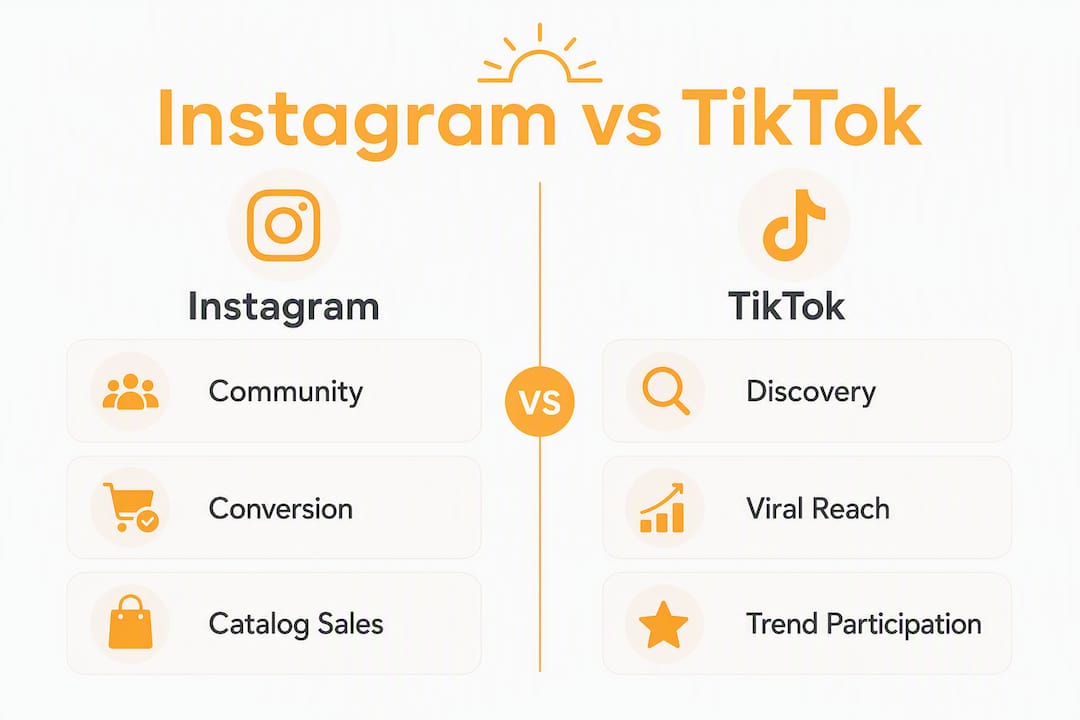
Pick TikTok if your primary goal is discovery. Pick Instagram if you want to build community, drive direct sales, or run a product catalog. Use both if you want a full-funnel strategy where TikTok generates awareness and Instagram closes it.
Here is the quick map:
Discovery and new audience reach: TikTok’s cold-start algorithm seeds your content to a few hundred strangers immediately, regardless of your follower count.
Community, trust, and conversion: Instagram’s relationship-aware ranking rewards saves, DMs, and repeat engagement, making it the stronger sales and loyalty engine.
Commerce and shopping: Instagram’s product tags, DM automation, and mature API integrations create more direct purchase paths than TikTok currently offers.
Virality speed: A brand-new TikTok account can reach thousands of viewers within the first week. On Instagram, early traction usually depends on an existing follower base.
Immediate next step: If you are starting from zero, post on TikTok for four weeks to test content hooks and find what resonates. Then bring your best-performing concepts to Instagram to build a community around them.
How do Instagram and TikTok compare side by side?
Dimension | TikTok | |
Best for | Community, conversion, catalog sales | Discovery, viral reach, trend-driven content |
Content types | Reels, Stories, carousels, Lives, DMs | Short/long video, Lives, Duet, Stitch, Trends |
Algorithm signals | Watch time, saves, DMs, relationship history | Completion rate, reshare velocity, early retention |
Audience | Broad (18–54), strong 25–44 core; 50% of U.S. adults use it | Skews younger (18–34); growing 25–44 segment |
Growth speed | Slower organic; follower-seeded (50–100 initial views) | Faster cold-start; stranger-seeded (200–500 initial views) |
Monetization | Shopping, brand deals, subscriptions, DM automation | Creator Rewards, brand deals, live gifts, TikTok Shop |
Repurposing | Penalizes TikTok watermarks; keyword captions matter | Rewards native uploads; completion rate is the KPI |
Instagram is the better long-term business platform. TikTok is the faster discovery engine. Together, they form a funnel that most solo creators and small businesses can run with a single content calendar.
What can you actually publish on each platform?
Instagram’s content formats
Instagram gives you five primary formats: Reels (short-form video up to 90 seconds for maximum distribution), Stories (24-hour ephemeral content ideal for polls, links, and DMs), carousels (up to 20 slides, excellent for education and saves), Lives (real-time video with shopping integrations), and standard feed posts. Reels sit at the center of Instagram’s distribution engine right now. Carousels are the sleeper format: Instagram’s relationship-aware ranking favors content designed to be saved and rewatched, and a well-structured educational carousel scores on both counts.

For production, aim for Reels in the 15–30 second range for maximum completion, though 60–90 seconds works for tutorial content. Vertical 9:16 framing is non-negotiable. Since 2025, public captions are indexed for search, so keyword-rich descriptions now help your content surface on Instagram Explore and in external search engines, not just through hashtags.
U.S. adult Instagram users spend an average of 25 minutes per day watching video on the app, which means there is genuine appetite for longer, higher-production content alongside quick Reels.
TikTok’s content formats
TikTok’s core format is vertical video, ranging from 15 seconds to 10 minutes, though the 30–60 second window tends to perform best for most niches. Duet and Stitch let you react to or build on other creators’ content, which is one of the fastest organic growth mechanics on the platform. TikTok Trends (sounds, challenges, and visual formats) can accelerate reach dramatically when you enter them early.
TikTok Shop has expanded quickly, but its purchase path is less mature than Instagram’s commerce integrations. Live gifts during TikTok Lives can generate meaningful income for entertainment-focused creators, but the payout mechanics differ significantly from Instagram’s subscription model.
“Content must create clarity and curiosity within the first few seconds to retain viewers — early retention drives platform distribution on both Instagram and TikTok.” (Torro Media)
Pro Tip: Design your creative idea first, then adapt it. Write a core concept (the hook, the payoff, the CTA) and produce one clean master file. Then create a TikTok-native version with trending audio and a TikTok-style text overlay, and a separate Instagram version with a keyword-rich caption and a save-worthy frame. Same idea, two distinct executions.

How do the Instagram and TikTok algorithms actually work?
The distribution models are fundamentally different, and understanding that difference changes how you produce content.
TikTok uses a cold-start model. Every new video gets seeded to a randomized test audience of roughly 200–500 strangers. If completion rate and reshare velocity are strong, TikTok expands distribution to a larger pool. Your follower count barely matters in the first 48 hours. This is why a creator with 200 followers can reach 50,000 people on their third video.
Instagram uses a relationship-aware model. New content gets seeded to a small follower-weighted group of roughly 50–100 accounts. If that group engages (saves, DMs, shares), Instagram expands to Explore and Reels feeds. Saves and DMs carry more weight than likes, and watch time matters more than raw view count.
Signals to optimize per platform
TikTok: Hook within the first two seconds, strong completion rate (watch the full video), reshare velocity (how fast people send it to others), and comment engagement.
TikTok captions: Keep them short and punchy. Hashtags provide context but are no longer the primary reach driver; AI-driven semantic analysis reads your content and audio directly.
Instagram: Total watch time, saves, DM shares, and whether followers come back to view again. Keyword-rich captions now help Explore indexing.
Instagram hashtags: Use 3–5 highly relevant tags as context signals, not as a reach strategy on their own.
Both platforms: The 3-second rule applies everywhere. If your opening frame does not create clarity and curiosity simultaneously, viewers scroll before the algorithm can measure anything.
Stat to know: TikTok seeds content to 200–500 strangers per post; Instagram seeds to 50–100 followers. That gap explains why new creators grow faster on TikTok but convert better on Instagram.
Pro Tip: Run a hook test before you commit to a content series. Post three versions of the same concept with different opening lines on TikTok. The one with the highest 3-second retention rate is your winning hook. Then use that hook on Instagram.
Who actually uses each platform, and which niches win?
Pew Research Center data shows that half of U.S. adults use Instagram, with strong representation across the 18–54 age range. TikTok’s U.S. user base skews younger, with the 18–34 segment dominant, though its 25–44 cohort has grown steadily. Instagram users spend around 33 minutes per day on the app; TikTok users in the U.S. spend 53.8 minutes per day, which signals a higher-attention, more entertainment-oriented use pattern.
Niches that tend to perform best on TikTok
Viral food content (recipes, restaurant reviews, cooking hacks)
Comedy, commentary, and reaction content
Trend-driven fashion and beauty
Fitness challenges and transformation content
Educational “did you know” formats
Niches that tend to perform best on Instagram
Boutique retail and product catalog content
Healthcare, wellness, and lifestyle brands
Local service businesses building community trust
Photography, interior design, and visual-first brands
Coaches, consultants, and educators selling courses or services
The deciding factor is usually buyer intent. TikTok users are in discovery mode: they are open to being surprised. Instagram users often follow accounts they already trust and are closer to a purchase decision. If your business sells something that requires trust before a transaction (a service, a premium product, a healthcare offering), Instagram is where that trust gets built.
What does realistic growth look like on each platform?
Growth speed differs significantly, and setting accurate expectations prevents creators from abandoning a platform too early.
On TikTok, a creator posting consistently can reach meaningful view counts within two to four weeks because of the cold-start seeding model. On Instagram, organic growth from zero is slower: the algorithm rewards existing relationships, so early momentum depends on either an existing audience or paid amplification.
A 12-week growth framework
Weeks 1–4 (TikTok focus): Post 4–5 times per week. Test three to four different hook styles. Track completion rate and reshare velocity as your primary KPIs. Goal: identify two to three content formats that consistently hit above-average completion.
Weeks 5–8 (Instagram introduction): Bring your top-performing TikTok concepts to Instagram as Reels and carousels. Post three times per week. Track saves and DM replies as your primary KPIs. Goal: build a save rate above 1% and generate at least 10 organic DM conversations.
Weeks 9–12 (dual-platform optimization): Increase Instagram posting cadence using your posting frequency guide as a reference. On TikTok, double down on your two winning formats. Begin cross-promoting: mention your Instagram in TikTok videos and vice versa.
Growth checklist
Test at least three hook variations per content theme before scaling production.
Track saves and DMs on Instagram weekly; track completion rate and reshares on TikTok.
Post at consistent times (not random) to train the algorithm’s distribution window.
Use cross-promotion CTAs (“Follow me on Instagram for the full tutorial”) to move TikTok audiences into your Instagram community.
Audit your content every four weeks: cut formats with below-average retention, double the formats that outperform.
Pro Tip: Consistency beats volume. Posting five times per week for four weeks outperforms posting 20 times in one week and going quiet. Both algorithms reward accounts that publish on a predictable schedule.
How do creators make money on each platform?
Monetization maturity differs between the two platforms, and that gap matters when you are choosing where to invest production time.
Revenue stream | TikTok | |
Creator fund / rewards | Subscriptions, Badges in Live | Creator Rewards Program |
Brand deals | Strong; mature influencer market | Strong; growing rapidly |
Shopping / commerce | Product tags, Instagram Shop, DM automation | TikTok Shop (expanding) |
Live gifts | Badges during Lives | Gifts during Lives |
Affiliate links | Link in bio, Stories links, DM links | Link in bio, TikTok Shop affiliate |
DM automation | Mature API; comment-to-DM flows | Limited compared to Instagram |
TikTok’s raw engagement rates run approximately 2.8–3.7% compared to Instagram’s roughly 0.5–1.7%. Higher engagement on TikTok sounds better, but engagement does not equal revenue. Instagram’s DM automation, clickable product tags, and mature API integrations create more direct purchase paths, making it the stronger platform for direct-to-consumer sales.
For brand deals, both platforms are viable. TikTok brand deals tend to prioritize reach and trend participation. Instagram brand deals often command higher rates for creators in lifestyle, wellness, and retail niches because of the platform’s stronger purchase intent signals.
Pro Tip: When negotiating a brand deal, ask for a 30-day exclusivity window on the specific product category rather than a blanket exclusivity clause. This protects your ability to work with other brands while giving the partner meaningful protection.
How do you repurpose content between platforms without losing reach?
Cross-posting the same file is the single most common mistake creators make, and it costs real distribution. Instagram suppresses Reels with TikTok watermarks by an estimated 50–70%. That is not a rumor; it is a documented suppression behavior that affects organic reach from the moment you upload.
The clean repurposing workflow
Export a watermark-free master from your editing app (CapCut, Adobe Premiere, DaVinci Resolve) before you post anywhere.
Create a TikTok-specific export: add trending audio, TikTok-style text overlays, and a hook optimized for the cold-start audience.
Create an Instagram-specific export: add a keyword-rich caption (since captions are now indexed for search), swap audio for a track from Instagram’s licensed library if needed, and frame the opening for a save-worthy first impression.
Retime your hook: TikTok viewers expect the payoff faster (within 1–2 seconds). Instagram viewers tolerate a slightly slower build (2–3 seconds) if the visual quality is high.
Adapt your CTA: “Follow for part two” works on TikTok. “Save this for later” works better on Instagram because saves are a direct algorithm signal.
Common pitfalls and how to avoid them
Watermark suppression: Never download from TikTok and re-upload to Instagram. Always export from your original editing file.
Muted audio: If you used a TikTok-licensed sound, that audio may be muted or blocked on Instagram. Replace it with a track from Instagram’s audio library before uploading.
Caption mismatch: A TikTok caption (“POV: you finally figured it out”) reads as low-effort on Instagram, where keyword-rich, sentence-structured captions now drive search discoverability.
Aggregator penalties: Third-party scheduling tools that auto-post the same file to both platforms simultaneously can trigger suppression. Schedule separately and upload natively when possible.
Pro Tip: Build a two-layer brief for every content idea: a master brief with the core concept, hook, and payoff, plus a platform-specific addendum for TikTok (completion-focused, trending audio) and Instagram (save-focused, keyword caption). This takes five extra minutes per concept and prevents a single brief from underperforming on either platform.
How do you decide which platform to prioritize?
Work through these four questions in order. Your answers will point to a clear primary platform and a realistic effort split.
What is your primary goal? Discovery and new audience reach → TikTok. Community building, trust, and direct sales → Instagram. Both → dual-platform funnel.
Who is your audience? Under 35, entertainment-driven, trend-aware → TikTok. Broad adult demographic, purchase-ready, relationship-oriented → Instagram.
What content type suits your brand? Fast, trend-reactive, personality-driven video → TikTok. Visual catalog, educational carousels, DM-driven sales → Instagram.
What are your production resources? Solo creator with limited time → start with one platform (TikTok for discovery, Instagram for conversion). Small team → run both with a repurposing workflow.
Recommended effort splits by scenario
Solo creator, starting from zero: 70% TikTok, 30% Instagram for the first 8 weeks. Flip to 50/50 once you have identified winning content formats.
Small business selling products: 40% TikTok (awareness), 60% Instagram (catalog, DMs, shopping). Use TikTok to drive profile visits and Instagram to close.
Service business (healthcare, coaching, consulting): 30% TikTok (educational hooks), 70% Instagram (trust-building carousels, Stories, DM conversations).
Pro Tip: Run each platform test for a minimum of four weeks before drawing conclusions. Both algorithms need time to index your content style and distribute it to the right audience. Quitting after one week of low views is the most common reason creators underestimate a platform’s potential.
SOL Social Media’s recommended dual-platform funnel and week-by-week plan
Industry data supports a clear funnel: use TikTok for demand generation and Instagram for trust, cataloging, and closing sales. The operational logic is straightforward. TikTok’s cold-start seeding gets your content in front of strangers who have never heard of your brand. Instagram’s relationship-aware ranking then deepens that relationship once they follow you.
Weeks 0–12: a practical execution plan
Week 1–2: Audit your existing content. Identify your two strongest content themes. Set up both profiles with consistent branding, a keyword-rich bio, and a clear link-in-bio destination.
Week 3–4: Post on TikTok five times per week. Track completion rate and reshare velocity. Do not post on Instagram yet; focus on finding your winning hook.
Week 5–6: Introduce Instagram. Bring your top two TikTok concepts as Reels. Post three times per week. Add one educational carousel per week. Track saves and DM replies.
Week 7–8: Begin cross-promotion. Reference your Instagram in TikTok videos. Use Instagram Stories to drive DM conversations and poll your audience on upcoming content.
Week 9–10: Introduce a monetization element on Instagram (product tag, DM automation, or a link-in-bio offer). Keep TikTok focused on reach and discovery.
Week 11–12: Review your data. Which TikTok formats drove the most profile visits? Which Instagram posts generated the most DMs or saves? Double down on both and cut what underperformed.
Agency or consultant hiring checklist
When you are ready to bring in outside help, use these criteria to evaluate any agency or consultant:
Scope of work: Does the proposal include content creation, scheduling, community management, and reporting, or just posting?
KPIs: Are they tracking saves, DMs, and completion rate, or just follower count and likes?
Reporting cadence: Monthly reporting is the minimum; bi-weekly is better for a new account.
Platform expertise: Can they show platform-specific results (not just aggregate “engagement”) for accounts similar to yours?
Red flags: Guaranteed follower counts, vague “brand awareness” KPIs with no conversion metrics, and contracts that lock you in for 12 months with no performance benchmarks.
For small business social media strategy that covers both platforms, SOL Social Media builds dual-platform plans with clear KPIs and human-written content from day one.
Pro Tip: Before hiring any agency, run a four-week self-managed test on both platforms. You will learn what content resonates with your audience, which makes your agency brief far more specific and your results far more predictable.
Key Takeaways
TikTok wins on discovery speed; Instagram wins on conversion depth, and the most effective creator strategy uses both in a deliberate funnel.
Point | Details |
Match platform to goal | Use TikTok for discovery (cold-start seeding to 200–500 strangers) and Instagram for community and sales. |
Algorithm signals differ | Optimize for completion rate and reshares on TikTok; optimize for saves, DMs, and watch time on Instagram. |
Repurpose clean, not lazy | Export a watermark-free master; a TikTok watermark can suppress Instagram reach by an estimated 50–70%. |
Monetization maturity | Instagram’s DM automation and product tags create more direct purchase paths than TikTok’s current commerce tools. |
SOL Social Media | SOL Social Media builds dual-platform strategies for small businesses, covering content creation, DM engagement, and weekly reporting. |
The platform debate misses the real question
Most creators spend too much time asking “which platform is better?” and not enough time asking “which platform fits my current goal?” The answer changes depending on where you are in your business.
A creator with zero followers and a product to sell should be on TikTok first, not because TikTok is superior, but because its cold-start algorithm is the only mechanism that gives a brand-new account a genuine shot at reaching strangers without paid ads. Instagram’s algorithm is built for relationships, and you cannot build relationships with people who have never heard of you.
But here is what most platform comparison articles get wrong: they treat this as a permanent choice. It is not. The funnel is sequential. TikTok earns the attention; Instagram earns the trust. Skipping TikTok because you prefer Instagram’s aesthetic means you are relying on paid reach or slow organic growth to fill the top of your funnel. Skipping Instagram because TikTok feels more exciting means you are leaving your best conversion and retention tools unused.
The creators and small businesses that grow most efficiently are not the ones who pick a side. They are the ones who understand what each platform is actually built to do and assign content accordingly. That clarity, more than any algorithm hack or trending audio, is what produces consistent, measurable results.
How SOL Social Media helps creators and small businesses choose and grow
Deciding between Instagram and TikTok is one thing. Executing a dual-platform strategy consistently, with content that actually reflects your brand voice, is another challenge entirely.
SOL Social Media works with small businesses and creators who want real results without spending 20 hours a week managing their own social media. The agency’s services cover the full execution stack: content creation with human copywriting (no generic AI filler), community engagement and DM management, social media strategy built around your specific goals, and platform-specific training for business owners who want to manage their own accounts more effectively.
For creators deciding between Instagram and TikTok, SOL Social Media’s approach starts with a social media audit to identify where your audience already lives and what content formats your competitors are underusing. From there, the team builds a content calendar that covers both platforms with a repurposing workflow, so you are not producing double the content to maintain a presence on both.
If you are ready to stop guessing and start growing with a clear plan, explore SOL Social Media’s engagement services or learn more about the agency’s approach to dual-platform strategy.
Useful sources
These are the primary sources behind the data and recommendations in this article, listed from most broadly authoritative to most tactically specific.
Pew Research Center: Social Media Use in the United States — The most authoritative source on U.S. platform adoption rates; confirms that half of U.S. adults use Instagram. Read this first for demographic context.
eMarketer: Social Users Time Spent Forecast — Provides the 25-minute daily Instagram video watch-time figure and broader time-spent benchmarks. Essential for understanding content consumption patterns.
Upgrow: Instagram vs TikTok 2026 Statistics — Aggregates user count, time-spent, and commerce data across both platforms. Good for a fast statistical overview.
Metricool: Instagram vs TikTok in 2026 — Covers the dual-platform funnel recommendation and Instagram’s caption indexing update. Practical and current.
WP Newsify: TikTok vs Instagram Algorithm in 2026 — Explains how AI-driven semantic analysis has reduced hashtag dependency on both platforms. Read alongside the algorithm section above.
CreatorTribune: Why the Same Video Flops on TikTok but Goes Viral on Instagram — The source for the seeding mechanics (200–500 vs 50–100) and the watermark suppression data. Required reading before you set up any cross-posting workflow.
CreatorFlow: Instagram vs TikTok for Creators — Contains the engagement rate comparison (TikTok 2.8–3.7% vs Instagram 0.5–1.7%) and the DM automation analysis. Most useful for monetization planning.
Torro Media: The 3-Second Rule — Concise, practical explanation of hook timing and early retention mechanics. Quick read; apply immediately.
FAQ
What is the number one social media platform right now?
Facebook and YouTube remain the most widely used platforms among U.S. adults by total user count, but Instagram and TikTok lead in active daily engagement and creator growth activity.
Why do people use TikTok instead of Instagram?
TikTok’s cold-start algorithm gives any account, regardless of follower count, a chance to reach thousands of strangers immediately, making it the faster discovery engine. U.S. users also spend 53.8 minutes per day on TikTok versus roughly 33 minutes on Instagram, which reflects its stronger pull as an entertainment platform.
What is the 3-second rule on Instagram?
The 3-second rule means your Reel or video must create clarity and curiosity within the first three seconds or viewers will scroll past before the algorithm can register meaningful retention. Early retention drives distribution on both Instagram and TikTok.
Is TikTok better than Instagram for small businesses?
It depends on the goal. TikTok is better for reaching new audiences fast; Instagram is better for converting those audiences into customers through DM automation, product tags, and community trust. Most small businesses benefit from using both in a funnel, with TikTok driving awareness and Instagram handling conversion.
What is the 5-3-1 rule on Instagram?
The 5-3-1 rule is a content mix guideline suggesting that for every five educational or value-driven posts, you publish three community or engagement posts, and one promotional post. It is a framework for balancing relationship-building with sales content, though the exact ratio should be adjusted based on your audience’s response data.
Recommended
Comments