


Healthcare Social Media Marketing for Medical Practices

The most effective approach to social media for healthcare is compliance-first, education-led, and platform-prioritized: follow HHS HIPAA marketing rules, apply FTC substantiation guidance, and use Hootsuite’s platform best practices as your operational baseline. Before your next post goes live, take these three steps:
Pause any post that includes patient details — names, photos, diagnoses, or anything that could identify a patient — until written authorization is confirmed.
Map your approval workflow — identify who creates content, who reviews for clinical accuracy, and who signs off on compliance before publishing.
Pick one priority platform — Facebook or Instagram for most small practices — and build your process there before expanding.
Pro Tip: Set up a shared folder (Google Drive or SharePoint) right now to store authorization forms and evidence files. You will need that audit trail if OCR or FTC ever comes knocking.
What does a practical healthcare social media plan look like?
A well-run healthcare social media program follows six steps, executed in order, so nothing falls through the cracks. If you are building a social media presence from scratch, this roadmap applies directly.
Define your audience. Identify who you are reaching: prospective patients, current patients, job seekers, or referring providers. Each group needs different content.
Set business-aligned goals. Appointment requests, job applicant volume, and patient education reach are measurable. “More followers” is not a goal.
Run a risk scan. Audit existing posts for any PHI. Remove or archive anything that lacks documented authorization.
Build content pillars. Four pillars work well for most practices: education (health tips, myth-busting), provider trust (staff spotlights without PHI), community (local Colorado health events, partnerships), and recruitment (culture posts, open roles). Each pillar stays PHI-free by design, which keeps most posts out of the marketing authorization requirement entirely.
Prioritize one or two platforms. Hootsuite recommends concentrating resources on 1–2 networks to maximize impact. For most small practices, Facebook and Instagram cover the widest patient demographic.
Build the approval workflow. Every post passes through: content creator → clinical reviewer (accuracy check) → compliance officer (PHI and FTC check) → publish. Document sign-off at each stage.
A simple cadence to start: three posts per week, rotating across your four pillars. Week one might be two education posts and one provider spotlight. Week two adds a community post. Keep it consistent before you scale.

What are the HIPAA and FTC rules you must follow?
HIPAA requires written authorization for any use of PHI in marketing communications. The FTC requires adequate scientific substantiation for objective health claims made through social media or influencer posts. Both agencies treat your brand as responsible, not just the individual who hit “post.”
Pre-publish compliance checklist:
Does the post include any PHI? If yes, is written authorization on file?
Does the post make an objective health claim? If yes, is there a documented evidence file?
Does the post feature an influencer or patient endorser? If yes, is the material connection clearly disclosed?
Is any disclosure visible, unavoidable, and in the same format as the claim (visual + audio if the claim is video)?
Dos and don’ts for common scenarios:
Patient stories: Get written authorization that names the platform, the content, and the right to revoke. Store the signed form with the content asset.
Before/after photos: Require written authorization and an evidence file for any implied efficacy claim. The FTC holds the advertiser liable even when the endorser’s experience is genuine.
Influencer partnerships: Run two simultaneous reviews: the influencer’s wording and disclosures, and your evidence file for any implied effectiveness claim.
User-generated content: Do not reshare patient content without written authorization. Liking or reposting a patient’s story can constitute a disclosure.
Replying to patient comments: Never confirm someone is a patient. Redirect to a secure portal or phone line.
HHS marketing authorization exceptions are narrow. Face-to-face communications and promotional gifts of nominal value do not require prior written authorization. Nearly every digital marketing communication involving PHI falls outside these exceptions and requires authorization before you publish.
Sample authorization note (adapt for your practice):“I authorize [Practice Name] to use my name, photo, and health story on its social media accounts, including Facebook and Instagram, for the purpose of patient education and community outreach. I understand this content may be reshared and I may revoke this authorization in writing at any time.” Store the signed original in your compliance document repository alongside the content asset and evidence file.
How do you build a governance model that prevents PHI exposure?
Two content lanes are the foundation of safe social publishing: a PHI-free education lane for routine posts, and a consented patient-identifiable lane for authorized stories. The PHI-free lane handles the vast majority of your publishing and never triggers a marketing authorization requirement.
Role matrix:
Content creator: Drafts posts using pre-approved templates; flags any patient-identifiable content before routing.
Clinical reviewer: Checks medical accuracy and flags unsupported claims.
Compliance officer: Confirms PHI status, authorization on file, and FTC substantiation.
Community moderator: Manages comments and DMs; redirects health questions to secure channels.
Account security owner: Manages two-factor authentication, password manager access, and admin role assignments.
Training checklist (annual minimum, with scenario refreshers quarterly):
HIPAA basics for social media: what counts as PHI in a post, photo, or reply
Photography rules: no filming in clinical areas without authorization
Incident reporting: how to escalate a suspected disclosure immediately
Scenario exercises: real post examples, comment threads, and DM situations
Incident response (short steps): Detect the potential violation → preserve a screenshot before any removal (HIPAA guidance recommends this for OCR and FTC records) → take the post down if PHI is exposed → notify compliance and legal → document every remediation step in the incident log → update policy to close the gap.
Pro Tip: Privacy settings do not prevent HIPAA violations. PHI shared in a closed Facebook group or a private DM can still be captured and redistributed. Train staff on this explicitly — many assume “private” means protected.
Which KPIs should you track, and what does it cost?
Prioritize business-aligned KPIs and give any new program a 90-day test window before drawing conclusions.
KPI list:
Appointment requests from social — direct revenue proxy; track via UTM-tagged links or form source fields
Website sessions from social — measures top-of-funnel reach
Engagement rate on educational posts — signals content relevance and trust-building
Job applicant source: social — recruitment ROI
Comment/DM response time — patient experience indicator
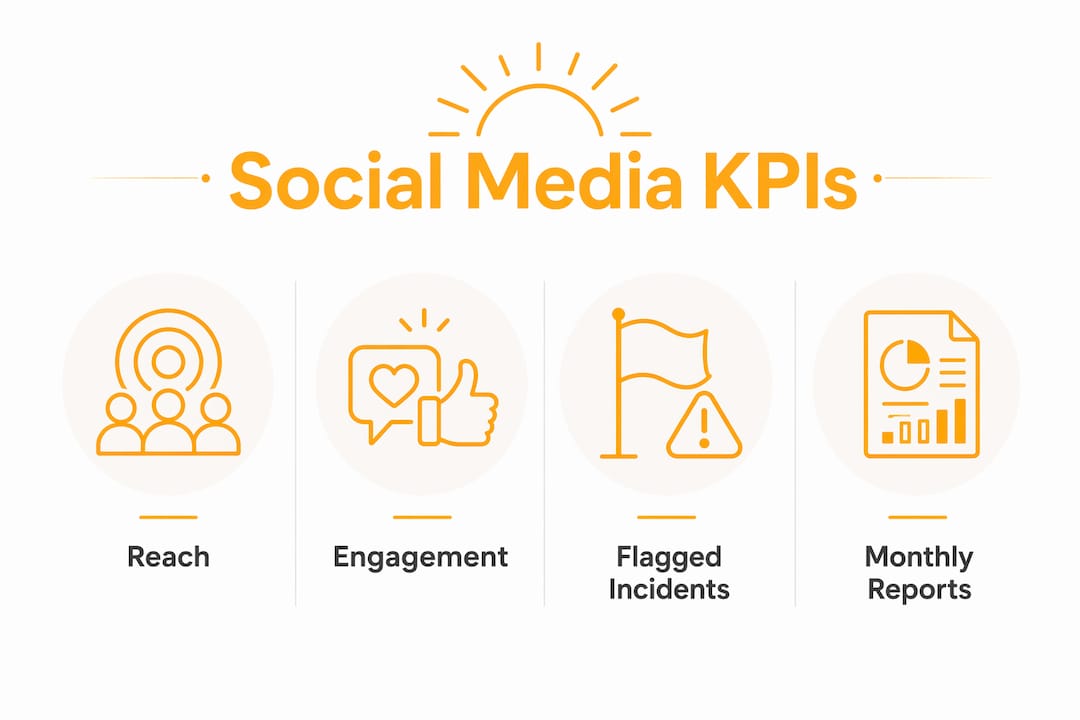
Reporting cadence: Weekly social health snapshot (reach, engagement, flagged incidents) plus a monthly performance report tied to appointment and lead outcomes.
Risk / Cost Factor | Figure |
HIPAA fine ceiling per violation category per year | Can exceed $2.1 million |
HHS OCR total settlements across cases | Have totaled $144.9 million |
Typical in-house monthly hours (small practice) | Can range broadly depending on practice size |
Agency-managed monthly cost range (small practice) | Varies by agency and scope |
Note: In-house hours and agency cost ranges are general market estimates; confirm current pricing with providers.
What content should you post, and how do you plan a month?
Favor “edutaining” content and provider storytelling that never exposes PHI without authorization. For proven post ideas that fit this approach, the format variety matters as much as the topic.
8 proven content types:
Quick-tip Reel (e.g., “3 signs you should see a doctor this week”)
Myth-busting post (“No, you don’t need antibiotics for every sinus infection”)
Provider spotlight (photo + role + fun fact — no patient details)
Facility tour (waiting room, equipment, team culture)
Community partnership post (local Colorado health fair, food bank)
FAQ post (“What should I bring to my first appointment?”)
Seasonal health reminder (flu shots, back-to-school physicals)
Recruitment culture post (“A day in the life of our front desk team”)
Sample 30-day calendar (3 posts/week):
Week | Post 1 | Post 2 | Post 3 |
Week 1 | Quick-tip Reel | Provider spotlight | FAQ post |
Week 2 | Myth-busting post | Community partnership | Seasonal reminder |
Week 3 | Facility tour | Quick-tip Reel | Recruitment post |
Week 4 | Provider spotlight | FAQ post | Community partnership |
For consented patient stories, attach the signed authorization form and evidence file to the content asset in your workflow before the post enters the approval queue.
When should you hire a healthcare social media agency?
Hire a specialized agency when internal capacity, compliance risk, or growth goals exceed what your team can manage reliably. The clearest signals: posts are going out without a compliance review, your team has no documented policy, or you are missing KPI targets for two consecutive quarters.
Questions to ask any agency:
Can you walk us through your HIPAA approval workflow?
How do you handle FTC substantiation and evidence files for health claims?
What is your incident response process if a PHI exposure occurs?
Do you have healthcare-specific case studies you can share?
How do you secure account credentials and manage admin access?
Onboarding timeline:
Discovery week: Audit existing accounts, document current policy gaps, define audience and goals.
Strategy and policy month: Deliver social media policy, approval workflow, content pillars, and platform recommendations.
30-day milestone: First content bank live, approval workflow operational, team trained.
60-day milestone: First monthly performance report delivered, KPIs baselined.
90-day milestone: Strategy adjusted based on data; recruitment or patient education campaigns launched.
Agency deliverables checklist: Social media policy template, editorial calendar, content bank (minimum 30 assets), monthly reporting dashboard, and at least one staff training session.
Key Takeaways
Effective healthcare social media marketing requires compliance-first governance, a documented approval workflow, and business-aligned KPIs tracked over a minimum 90-day window.
Point | Details |
HIPAA authorization is the baseline | Any post using PHI for marketing purposes requires written authorization; most digital posts do not qualify for the narrow exceptions. |
Two content lanes simplify operations | A PHI-free education lane handles routine publishing; a consented lane manages authorized patient stories. |
Platform focus beats platform spread | Start with 1–2 networks and build a repeatable approval process before expanding. |
Compliance risk is financially significant | HIPAA fines can exceed $2.1 million per violation category per year; OCR settlements have totaled $144.9 million. |
SOL Social Media provides end-to-end support | SOL Social Media delivers social strategy, compliance workflow setup, content creation, and ongoing community management for healthcare practices. |
Why authenticity and compliance drive long-term growth
The healthcare practices that build the strongest social media presence are not the ones posting the most. They are the ones posting with the most intention. At SOL Social Media, we see this pattern consistently: a practice that commits to a PHI-free education lane, trains its staff, and publishes three well-reviewed posts per week outperforms a practice that posts daily without a workflow. Compliance is not a constraint on growth. It is the structure that makes growth sustainable.
Healthcare branding online is built on trust, and trust is built post by post, comment by comment. When your audience sees accurate, helpful content from a provider who clearly respects their privacy, they remember it. That is the relationship engine that drives appointment requests and referrals over time.
SOL Social Media supports healthcare practices in Colorado
Small healthcare practices in Colorado need a social media partner who understands both the creative and the compliance side. SOL Social Media delivers exactly that: a done-for-you program that covers social strategy, content creation, approval workflow setup, and ongoing community management — all built around your practice’s voice and your patients’ trust.
Three core services for healthcare practices: social media strategy and content planning, compliance workflow setup (policy templates, approval routing, staff training), and ongoing community management with moderated patient interactions. Case study details and current pricing are available on the services page. Contact SOL Social Media to schedule a strategy session and get a custom plan built for your practice.
Useful sources and templates
These are the primary authoritative resources behind the compliance guidance in this article. Bookmark them and store your authorization forms and evidence files in a secure, access-controlled repository.
HHS HIPAA Marketing Guidance — defines what constitutes marketing under HIPAA and when authorization is required
HHS FAQ on Marketing Authorization — clarifies the two narrow exceptions to the authorization requirement
FTC Health Products Compliance Guidance — covers substantiation standards, endorsement rules, and disclosure requirements
Hootsuite Healthcare Social Media Guide — practical platform guidance, content strategy, and compliance risk context
HIPAA Journal Social Media Guidelines — workforce training guidance and policy language examples
SOL Social Media policy templates and editorial calendar resources are available through the services page at solsocialmedia.com
This article provides general information about healthcare social media compliance, not legal or regulatory advice. Confirm current HHS and FTC requirements with a qualified healthcare attorney or compliance officer for your specific situation.
FAQ
Does HIPAA apply to social media posts?
Yes. Any post, photo, comment, or reply that identifies a patient and reveals health information is subject to HIPAA. Written authorization is required before using PHI in marketing communications, with only two narrow exceptions.
What content is safe to post without patient authorization?
General health education, provider spotlights (without patient details), facility tours, recruitment posts, and community event announcements are all PHI-free and do not trigger the marketing authorization requirement.
How does the FTC apply to healthcare social media?
The FTC requires adequate scientific substantiation for objective health claims made through social media or influencer posts. The advertiser, not just the influencer, is liable if an implied effectiveness claim lacks supporting evidence.
How long before social media produces measurable results for a healthcare practice?
A 90-day window is the standard baseline for meaningful data. Engagement trends typically emerge within 30 days; appointment-request attribution and recruitment impact usually require the full 90-day period.
What should a healthcare practice look for in a social media agency?
Look for documented HIPAA approval workflows, FTC evidence-handling processes, healthcare-specific case studies, and a clear incident response protocol. SOL Social Media provides all of these as part of its healthcare social media management program.
Recommended
Comments