


How Often Should You Post on Facebook? The 2026 Cadence

Post 3 to 5 times a week on your Facebook business page, and stop there. That’s the range where quality and consistency outperform sheer volume, according to SocialInsider’s engagement benchmarks, which found that content relevance matters more than posting count and that many brands see their best per-post results at 3 to 4 posts weekly. Founder or personal profiles can push slightly higher, to 4 to 6 posts, since Facebook’s distribution still favors individual accounts over branded pages. Groups need more activity, often several prompts a week, to keep conversation threads alive.
The one variable that matters more than the number itself is your content mix. Short-form video should anchor your calendar, with image posts and text updates filling the gaps.
Here’s your starting checklist:
Pick one cadence (3 to 5 posts weekly for a business page is the safest default).
Set a 6 to 8 week test window before you touch the number again.
Track weekly reach and per-post engagement rate, not just follower count.
Prioritize short-form video over static link posts in your format mix.
Key Takeaways
Consistent posting at 3 to 5 times weekly, weighted toward short-form video, outperforms high-volume posting because Facebook’s algorithm rewards meaningful interactions and predictable distribution patterns over raw post count.
Point | Details |
Default cadence | Business pages should start at 3–5 posts weekly, with 1–2 as a minimum viable floor. |
Format priority | Weight your mix toward Reels and native video, since they outperform link posts in organic reach. |
Test before optimizing | Run any cadence change for 6–8 weeks and compare per-post engagement against total weekly reach. |
Consistency over volume | A steady weekly rhythm builds a stronger distribution baseline than irregular high-volume bursts. |
Account type matters | Founder profiles can sustain 4–6 posts weekly; groups need 5–7+ to maintain momentum. |
Facebook Posting Frequency by Account Type at a Glance
Your ideal facebook posting frequency depends less on industry and more on account type. A business page behaves differently in Facebook’s distribution system than a personal profile or a group, and your calendar should reflect that.
Account Type | Recommended Posts/Week | Minimum Viable Cadence | Formats to Prioritize |
Business page | 3–5 | 1–2 | Reels, image posts, Stories |
Personal profile (founder) | 4–6 | 2–3 | Native video, photos, text updates |
Group | multiple times per week | minimum viable frequency | Discussion prompts, polls, native video |
Format cadence matters as much as the account-level number. Monolit’s 2026 benchmark data recommends Reels 2 to 3 times weekly, image or text posts 1 to 2 times weekly, and link posts sparingly, since they get suppressed relative to native content.
Reels or short native video: 2–3x/week
Image or text posts: 1–2x/week
Link posts: 0–1x/week
Stories: frequently where resources allow
These are starting points, not fixed rules. Your actual audience behavior, tested over several weeks, should override any published benchmark once you have real Page Insights data to work from.
Why Facebook Posting Frequency Affects Reach in the First Place
Frequency matters because of how Facebook decides what to amplify, not because more posts inherently mean more reach. The platform’s ranking system weighs “meaningful interactions” (comments, replies, shares that spark conversation) far more heavily than passive likes, according to SocialInsider. A post that generates a dozen genuine comments often outperforms one that racks up hundreds of silent reactions.
Timing compounds this effect. WordStream’s analysis of the Facebook algorithm points to a first-hour engagement window as the critical signal: posts that gain traction quickly after publishing get pushed to more feeds, while those that start slow tend to fade within roughly 12 hours. That’s why the best time to post on Facebook in 2026 is less about a universal clock time and more about when your specific audience is actively scrolling, something you can only confirm through your own Page Insights.
Consistency does something timing alone can’t: it stabilizes your baseline distribution. Monolit’s research found that a steady 4 to 5 posts a week builds a predictable pattern the algorithm rewards over irregular bursts of activity followed by silence. Pages that post erratically, heavy one week and dark the next, tend to see more volatile reach swings than pages that show up reliably.
That said, more isn’t automatically better. SocialInsider’s benchmarks show overposting can actively reduce per-post engagement, spreading your audience’s attention thin and diluting the interaction signals each post generates. The practical takeaway:
Comments and replies carry more algorithmic weight than reactions.
The first hour after publishing largely determines a post’s distribution ceiling.
A steady weekly rhythm outperforms sporadic high-volume bursts.
Beyond a certain point, adding posts lowers average engagement per post rather than raising total reach.
Our breakdown of the Facebook algorithm covers the ranking mechanics in more depth if you want to see exactly how these signals interact.
What’s the Right Range for Your Account Type?
Your starting cadence should match your account type and your team’s actual capacity, not an aspirational number pulled from a competitor’s calendar.
Business pages perform best at 3 to 5 posts per week. That’s the sweet spot where SocialInsider’s benchmarks show engagement holding steady without diminishing returns setting in. If you’re a solo owner managing your own page, a minimum viable cadence of 1 to 2 posts weekly keeps you visible without draining your schedule, though Adpicto’s benchmark data notes that local businesses often benefit from supplementing regular posts with Events and photo albums, formats that carry their own distribution advantages.
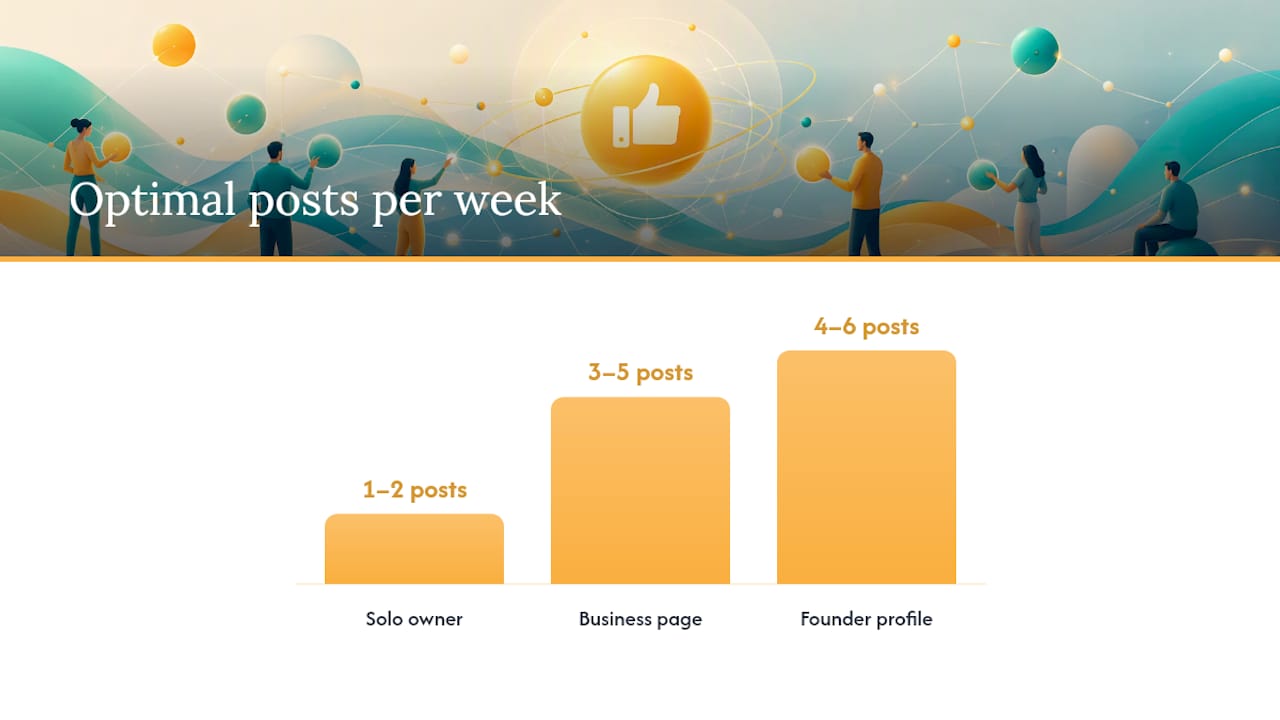
Founder and personal profiles can sustain a higher cadence, typically 4 to 6 posts weekly, because Facebook’s algorithm still extends more organic reach to individual profiles than to branded pages. If you’re building a personal brand alongside your business page, this is where extra posting volume actually pays off.
Groups need the most consistent activity of the three, often 5 to 7 or more prompts weekly, since group engagement depends on maintaining momentum in ongoing conversation threads. A group that goes quiet for a week can lose the discussion energy that made it valuable in the first place.
A few adjustment factors matter regardless of account type:
Smaller pages (under a few thousand followers) should lean toward the lower end of these ranges until they have enough data to test confidently.
Larger, more established pages have more room to experiment with higher frequency because they can absorb a few underperforming posts without major reach damage.
Resource constraints are real. A sustainable 3-post week beats an ambitious 6-post week that collapses after a month.
Sustainability should always outrank ambition when you’re picking a number. A cadence you can maintain for a year beats one you abandon after six weeks.
Building Your Weekly Content Mix Across Formats
Your posting frequency only works if the content mix behind it matches how Facebook actually distributes different formats. Native video and Reels consistently outperform static link posts in organic reach, according to MetadataReactor’s 2026 engagement data, which means your weekly plan should weight toward video first and links last.
Short-form video or Reels, multiple times per week. This is your reach and discovery engine. Facebook actively pushes short native video to new audiences beyond your existing followers, making it the format most likely to grow your page rather than just serve your current base.
Native long-form video, 1 to 2 times weekly. Longer video builds deeper engagement with people who already know your brand. Save this format for behind-the-scenes content, tutorials, or Q&A sessions where viewers are willing to stay longer.
Image and text posts, 1 to 3 times weekly. These remain the easiest way to spark quick conversation. A simple question, a photo with a caption inviting comments, or a poll can generate the back-and-forth interactions the algorithm rewards.
Link posts, 0 to 1 times weekly. Links to external sites get suppressed relative to native content, so use them sparingly. When you do need to share a link, consider placing it in the first comment instead of the post body, or breaking the content into a native post with the link added afterward.
Stories and Live video, scheduled as complementary activity. These formats don’t compete with your feed posts. They maintain visibility between main posts and give your most engaged followers more frequent touchpoints.
Pro Tip: Batch your short-form video shoots. Recording four or five Reels in a single 30-minute session, then spacing them across two weeks, keeps your video cadence consistent without requiring a new production session every few days.
If you need ideas for prompting the comments and replies that drive distribution, our guide to social media engagement tactics covers specific approaches that work well paired with this format mix.
How to Test and Measure the Right Cadence for Your Audience
Benchmarks give you a starting point, not a final answer. The only way to know your actual optimal facebook post times and frequency is to run a structured test against your own audience.
Choose two cadence levels to compare. Pick a lower option (say, 3 posts weekly) and a higher one (5 posts weekly), keeping your format mix roughly constant between both so frequency is the only variable you’re isolating.
Run each cadence for 6 to 8 weeks. Shorter windows get skewed by single viral posts or algorithm fluctuations. A month or two gives you a large enough sample to trust the pattern.
Track five core metrics weekly: reach, impressions, engagement rate per post, link clicks, and follower growth. Page Insights (found under Meta Business Suite) gives you all five without additional tools.
Log results in a simple spreadsheet. A basic weekly row with columns for each metric, plus notes on what you posted, turns guesswork into a decision you can defend.
Compare total weekly reach against per-post engagement rate. This is the step most pages skip. If 5 posts weekly produce higher total reach but each post individually performs worse, you’re diluting attention rather than growing it, and the lower cadence with the same total reach may actually serve you better.
Week Range | Cadence Tested | Metric to Watch | Decision Point |
Weeks 1–4 | Cadence A (lower) | Baseline reach and engagement rate | Establish comparison point |
Weeks 5–8 | Cadence B (higher) | Reach change and per-post engagement shift | Compare totals against Weeks 1–4 |
SocialPilot’s guidance on algorithm strategy notes it’s fine to look at what competitors are doing for general direction, but cadence decisions should ultimately rest on your own Insights data, not someone else’s calendar. What works for a competitor with a different audience size or industry may not transfer to your page at all.
For a deeper look at pinpointing your specific posting windows once you’ve settled on frequency, see our guide on the best times to post on social media.
Scheduling and Workflow: Sustaining Your Cadence Without Burning Out
The best facebook content calendar is the one you can actually maintain three months from now. A cadence that looks great on paper but collapses under real-world time constraints isn’t a strategy, it’s a plan for inconsistency.

Build a repeatable weekly production rhythm: plan your content pillars first, batch-record video and photos in one sitting, edit in a single block, write captions together rather than one at a time, then schedule everything for the week ahead in one sitting. This front-loaded approach means your actual publishing days require zero additional creative work, just hitting “post” on something you already prepared.
Content pillars (recurring themes like behind-the-scenes, customer stories, educational tips, and promotions) give you a repeatable structure so you’re never starting from a blank page. Templates for captions and graphics speed this up further.
Repurpose your blog posts, email newsletters, and longer videos into short-form clips and image quotes instead of creating net-new content for every post.
Delegate specific, well-defined tasks (caption drafts, basic graphic templates) to a team member or freelancer even if you handle strategy yourself.
Set an acceptable quality threshold for solo operators: a phone-shot video with good lighting beats no video at all.
Use a shared calendar or scheduling tool so nothing gets forgotten during a busy week.
Pro Tip: Reserve one hour every Monday for the entire week’s scheduling. Batching this single task, rather than logging in daily to post manually, is often the difference between a consistent page and one that goes dark for weeks at a time.
Our posting schedule template gives you a ready structure to plug your content pillars into, and our guide to content creation workflows covers repurposing tactics in more detail.
Quick Heuristics: 70:20:10, 5-3-1, and When to Break Them
Simple ratios help when you don’t have time to overthink your weekly mix. The 70:20:10 rule suggests 70% of your posts should be original value-driven content, 20% curated or shared from other sources, and 10% promotional. The 5-3-1 rule works similarly for a five-post week: 5 pieces of curated content, 3 original posts, and 1 promotional post, spread across your schedule.
Neither rule is rigid law. Use a minimum viable cadence (1 to 2 posts weekly) when you’re short on resources but still need a presence. Use the sweet spot (3 to 5 posts weekly) as your default. Reserve intensive frequency, daily or near-daily posting, for short windows tied to live events, product launches, or breaking news relevant to your business.
A quick sanity check before you commit to any ratio:
Are more than 1 in 10 posts purely promotional? Dial it back.
Has it been more than a week since a post sparked actual comments? Shift toward conversation-starting formats.
Are you posting daily out of habit rather than strategy? Confirm your Insights data actually supports that volume.
How SOL Social Media Approaches Posting Frequency for Clients
SOL Social Media builds every client’s cadence around a repeatable process: audience audit first, cadence recommendation second, a 6 to 8 week test third, then iterative optimization based on what the data actually shows. We don’t start with a fixed number pulled from a generic playbook, because a retail boutique’s audience behaves differently than a healthcare practice’s.
A typical weekly mix we might recommend for a retail client looks like this: two short-form video posts showcasing new inventory or behind-the-scenes prep, one image post inviting customer photos or reviews, one Stories sequence covering daily updates, and one occasional Live session during a promotion window. A healthcare client’s mix shifts toward educational content and patient-friendly explainer videos, with promotional posts kept minimal.
Consistency is what most small businesses underestimate. We’ve seen pages jump in reach not because they suddenly posted more, but because they stopped disappearing for two weeks at a time and started showing up on a schedule their audience could count on.
Real client results and specific case studies are available on request as we build out our published portfolio.
Audit current posting habits and audience response patterns before recommending changes.
Set a specific cadence and format mix tied to the client’s resources and goals.
Run a defined test window rather than guessing indefinitely.
Adjust based on Page Insights data, not assumptions.
If you’d rather have this process managed for you, our social media strategy services build a custom cadence and content plan around your specific audience and industry, backed by the same testing framework outlined here.
Our Take: Stop Chasing the Perfect Number
The conventional advice on Facebook posting frequency treats it like a math problem with one correct answer. It isn’t. The research points to a range, not a number, and the range matters less than what you put inside it.
Most small businesses get this backward. They fixate on hitting a specific post count while treating content quality and timing as afterthoughts, then wonder why volume alone didn’t move the needle. The data is fairly consistent on this: engagement quality and consistency carry more weight than raw frequency once you’re within a reasonable range.
If we had to name the single biggest gap between published benchmarks and what actually works for small businesses, it’s this: nobody talks enough about sustainability. A 5-post weekly cadence that a business abandons after a month does less for reach than a 3-post cadence maintained for a year. Pick the number you can sustain, run the test, and let your own data, not ours, tell you where to go from there.
— SOL Social Media
Sources
FAQ
What Is the Ideal Posting Frequency on Facebook?
Most small-business pages perform best at 3 to 5 posts per week, according to SocialInsider’s benchmark data. Founder profiles can sustain 4 to 6 posts weekly, while active groups often need 5 to 7 or more to maintain engagement.
What Is the 5-5-5 Rule for Social Media?
Definitions of the 5-5-5 rule vary across sources, and it isn’t a standard covered by the benchmark data behind this article’s recommendations. Stick to the 70:20:10 or 5-3-1 frameworks, which have clearer, more consistent definitions across industry sources.
What Is the 70:20:10 Rule for Social Media Posts?
The 70:20:10 rule allocates 70% of your posts to original, value-driven content, 20% to curated or shared content from other sources, and 10% to direct promotion. It’s a content-mix guideline, not a frequency rule.
What Is the 5-3-1 Rule on Social Media?
The 5-3-1 rule suggests a five-post week made up of 5 curated pieces, 3 original posts, and 1 promotional post, spread across your schedule. It works as a simple starting framework for pages without a defined content strategy yet.
How Do I Know if I’m Posting Too Often on Facebook?
Compare your per-post engagement rate against your total weekly reach. If adding more posts increases total reach but each individual post performs worse, SocialInsider’s benchmarks suggest you’ve crossed into overposting territory.
Recommended
Comments