


Marketing Teams: One Page Brief for Low Risk Social Media Takeovers

A social media takeover is a time-limited handoff, in which a guest creator or partner publishes directly to your brand’s account while you keep editorial control. The appeal is simple: a fresh voice reaches your audience and often theirs too. The single biggest priority is picking one measurable objective and writing it into a one-page takeover brief before anyone touches your login.
TL;DR:
Success hinges on a clear, measurable objective, such as follower growth or link clicks, defined before the takeover planning begins.
Building a concise, one-page brief that covers target audience, host guidelines, content cadence, and success metrics is essential for smooth execution.
Selecting hosts with credible, engaging content aligned with your audience and choosing format types like short-form video or recurring series boosts engagement.
Promoting the takeover across owned channels and teasing the event 48 hours ahead increases audience participation and visibility.
Post-event, archive content, report on the predefined KPI, and repurpose footage to maximize long-term value and content mileage.
What Should Go in Your Takeover Planning Checklist?
Every takeover that goes sideways traces back to the same root cause: no one wrote down what “success” meant before the cameras started rolling. Fix that first, and most other problems shrink.
Start with a single, measurable objective. Pick one and build everything else around it:
Reach or impressions growth over a defined window
Story completion rate or watch time
New follower count during the event
Link clicks or landing-page visits
Direct message inquiries or booking requests
Once you have the objective, build a one-page brief. According to Columbia Business School, the strongest briefs cover:
The audience the takeover is meant to reach and why
The host’s voice, plus approved and prohibited topics
A rough shot list and posting cadence
Required tags, hashtags, and disclosure wording
The call to action and where it points
An escalation contact if something goes wrong
The success metrics tied to your one objective
Timing matters more than teams expect. Harvard Business School recommends planning at least three weeks ahead for a major takeover, though a lighter, single-day event can move faster with a trimmed checklist.
Pro Tip: Send the brief to your host as a shared document, not a message thread. When questions come up mid takeover, you want one source of truth, not a buried text from four days ago.
How Do You Choose the Right Host and Format?
The host makes or breaks the takeover before a single post goes live. Look for real audience overlap with your customer base, not just follower count. Credibility in the topic matters more than polish, and reliability matters more than charisma. A host who shows up late or ignores your brief costs you the objective you just spent three weeks defining.
Format follows the goal, not the trend:
Stories work for day-in-the-life content and behind-the-scenes access, typically 10 to 20 posts across a full day.
Reels or TikTok fit short-form storytelling, usually one to three clips rather than a heavy daily volume.
Live video suits events, product launches, or Q&A sessions where real-time interaction is the point.
Collaborative feed posts work well when you want the takeover to live permanently on the profile, not disappear after 24 hours.
Industry benchmark data shows short-form video and collaborative posts drove much of the engagement growth in 2024, with smaller brands seeing outsized interaction lifts from Reels-style formats. That’s a strong argument for building at least one short-form segment into any takeover, even one that leans mostly on Stories.
How Do You Promote a Takeover Before It Goes Live?
Promotion is not optional. A perfectly planned takeover with no audience watching is a wasted brief. Boston University’s guidance treats promotion as part of the core planning process, not an afterthought bolted on the day before.
Build your promotion push around owned channels first:
Email or newsletter mention a few days out
A calendar listing if your organization runs public events
Cross-department shares from sales, customer service, or leadership accounts
A save-the-date post on your main feed a week ahead
Brief your host on the promotion angle too. Ask them to tease the takeover to their own audience once, roughly 48 hours before, using consistent language and matching hashtags. On the day itself, a small paid boost behind your announcement post can extend reach past your existing followers, and a mid-morning reminder story keeps the event visible for anyone who missed the first post.
What Happens During a Live Takeover?
Real-time moderation is what separates a controlled takeover from a liability. Someone on your team needs to watch the account the entire time, not check in occasionally between meetings.
Assign a brand-side monitor whose only job that day is watching comments, DMs, and post performance.
Open with a welcome post introducing the host and the reason for the takeover.
Space content through the day using the cadence in your brief, roughly 10 to 15 Stories with a couple of feed or Reels posts, based on university guidance.
Add a mid-day highlight post that recaps what’s happened so far for anyone tuning in late.
Close with a sign-off post that thanks the host and hands the account back explicitly.
Build the welcome and sign-off posts into the plan on purpose. HBS’s guidance treats these transition moments as essential, since they tell your audience exactly who’s speaking and when the handoff ends.
Pro Tip: Give your monitor explicit authority to pause the takeover if something goes wrong. Waiting for a group chat vote wastes the minutes that matter most.
What Should You Do After the Takeover Ends?
The work isn’t finished when the host logs off. Archive everything first: save Story highlights, download raw footage, and change the account password immediately.
Report against the objective you set at the start, not a generic engagement summary. If your goal was follower growth, report the net new followers gained during the window. If it was link clicks, report the click-through count against your baseline.
Save raw video and photo assets before they disappear from Story archives
Pull short clips for future Reels or TikTok posts
Draft a brief recap post or blog entry summarizing the day
Flag standout moments for paid creative testing later
Repurposing is where a one-day event pays dividends for weeks. A single takeover can quietly restock your content calendar for the following month if you capture footage deliberately.
What Legal and Security Rules Apply to Takeovers?
Disclosure isn’t optional when money, product, or other material benefits change hands. The FTC’s Endorsement Guides require that relationship to be disclosed clearly and conspicuously in the content itself, and platform disclosure tools alone may not satisfy that standard. Advertisers and agencies can share responsibility for compliance failures, not just the host.
Account security deserves the same rigor:
Use a minimum-access policy: never hand over full account settings.
Grant temporary access only for the duration of the takeover.
Require logout and an immediate password change once it ends.
Name a brand-side monitor with authority to intervene, since a live moderator is essential for catching problems before they spread.
Avoid any tactic resembling fake followers or engagement inflation. That’s a deceptive practice, not a growth hack.
Your brand carries the legal responsibility for what appears on the account, regardless of who typed it.
What Does a Sample Takeover Brief Look Like?
A workable brief fits on one page. Objective, audience, host voice, approved and prohibited topics, shot list, cadence, disclosure language, CTA, escalation contact, and success metrics. That’s it. Anything longer gets skimmed instead of followed.
Team roles matter as much as the document. One person owns host communication before the event. One person monitors live. One person handles reporting after. Handoffs between these roles should happen in writing, not a hallway conversation.
Pre-event: brief approval, host training, promotion schedule
Live: brand-side monitoring, transition posts, escalation readiness
Post-event: archiving, KPI reporting, content repurposing
These checklists can be integrated into monthly management, one-off event support, and training sessions, depending on how much a team wants to run in-house versus hand off.
Pro Tip: Keep a template brief on file year-round. Updating one for a new host takes ten minutes; building one from scratch under deadline pressure rarely goes well.
How Do You Handle a Crisis During a Takeover?
Plan for the takeover going wrong before it starts, not after. A guest host might say something off-brand, a comment thread could turn hostile, or a technical glitch could cut a live stream short mid-sentence. None of that is rare.
The fix starts with the brand-side monitor from your during-execution plan. That person needs pre-approved authority to delete a post, hide a comment, or pause the takeover entirely without waiting for sign-off from someone else. Build a short decision tree into the brief itself: what counts as a minor issue the monitor handles alone, and what counts as major enough to loop in a manager immediately.
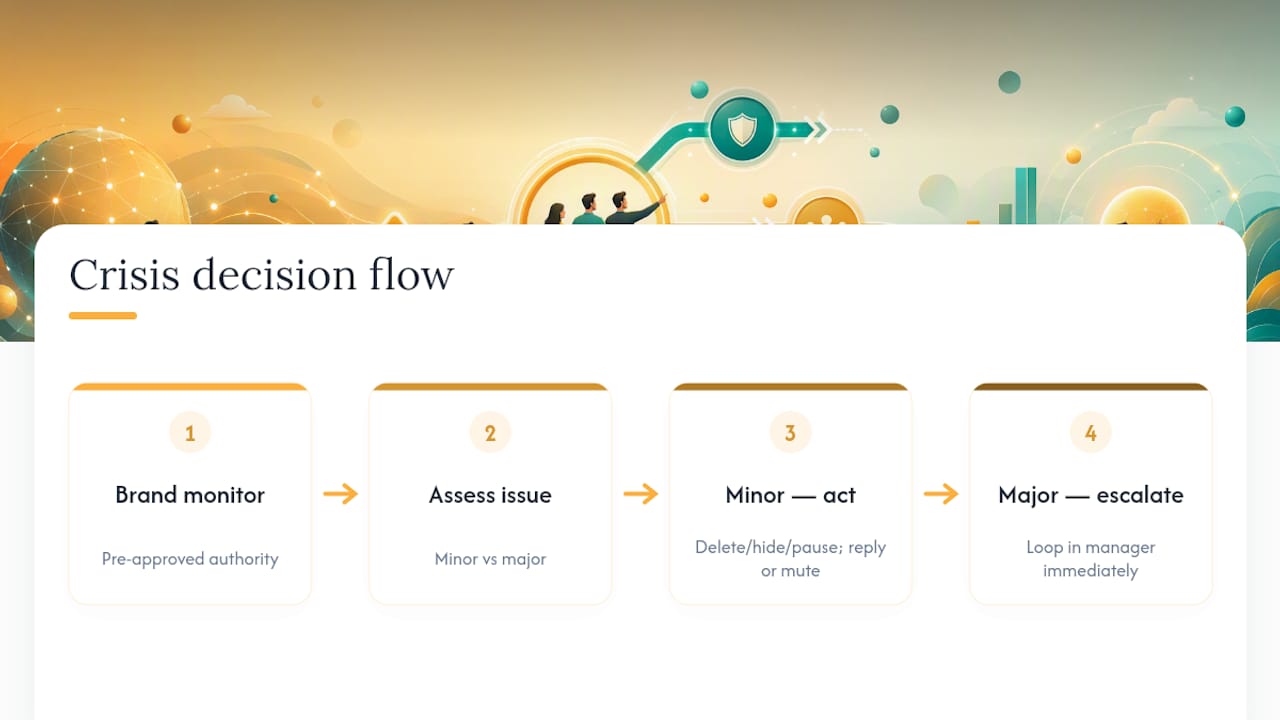
Prewrite a few holding statements before the event, not during it. A generic “we’re looking into this” note buys time without committing to anything, and having it ready means no one is typing under pressure while comments pile up. If a host goes off-script in a way that could embarrass the brand, address it directly and briefly rather than deleting posts silently, since silent deletion tends to draw more attention than the original mistake.
Negative reactions from your existing audience deserve a different response than outside trolling. A regular follower pushing back on tone or content is worth a real reply. Coordinated harassment or spam is worth muting and moving past without engaging. Knowing the difference in the moment, rather than treating every negative comment the same way, keeps a manageable hiccup from turning into a drawn-out story.
How Should You Brief and Train a Guest Host?
A great host with no briefing produces the same risk as a mediocre host with a detailed one, just in a different direction. Training closes that gap.
Start with a short call, not just a written document. Walk the host through your brand voice out loud, using two or three recent posts as examples of tone that worked and one example of tone that missed. Hearing the difference lands faster than reading a style guide.
Cover the prohibited topics list explicitly and explain why each one is off-limits, rather than just listing them. A host who understands the reasoning is far less likely to wander into a gray area than one who’s just following rules they don’t fully buy into.
Walk through the platform mechanics too. Confirm the host knows how to post Stories, tag correctly, and use whatever scheduling or approval tool your team relies on. Do a dry run of at least one post together before the live day if the host has never used the platform’s business features.
Set expectations on responsiveness. Tell the host how quickly to expect replies from your brand-side monitor and how quickly you expect them to flag anything unusual on their end. A five-minute mismatch in expectations here is a common source of avoidable confusion once the takeover is actually live.
What Makes a Social Media Takeover Actually Work?
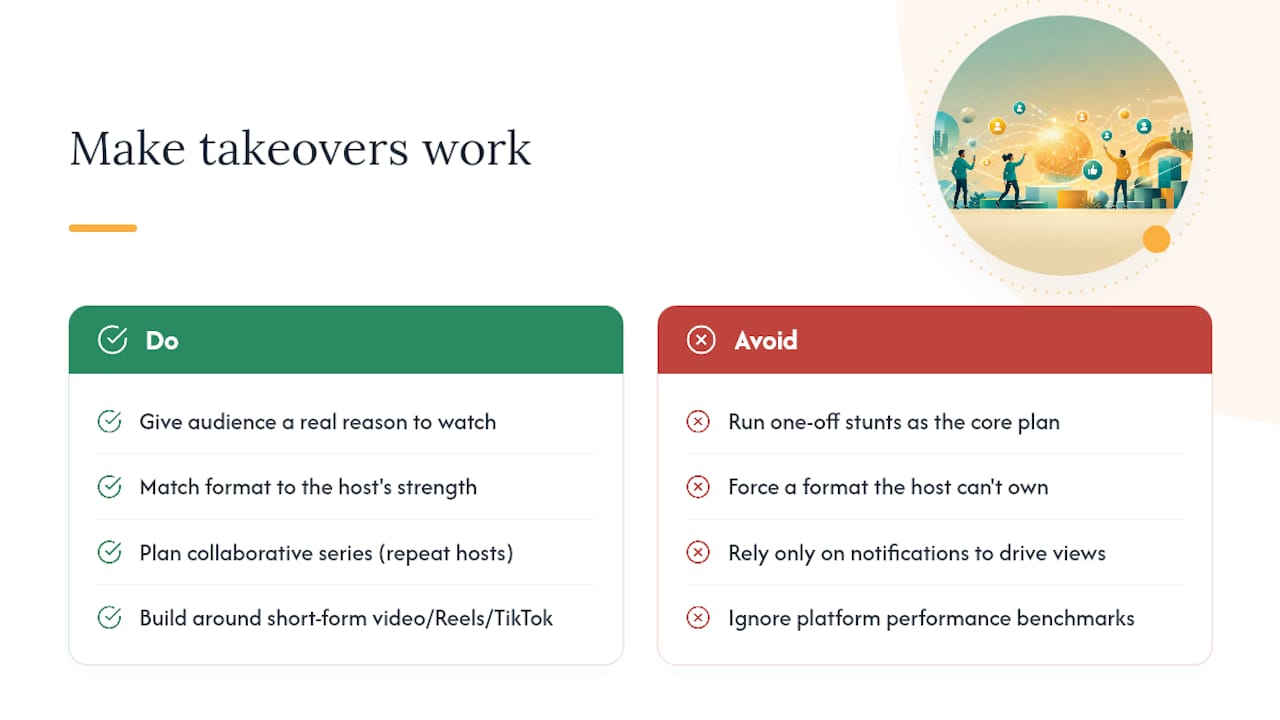
The takeovers that stand out share a pattern: a clear reason for the handoff and a format built around what that host does best. Event coverage works because the host is physically present for something the brand audience can’t otherwise see, live product demos, backstage access, a conference floor. A day-in-the-life takeover works because the host’s ordinary routine is genuinely different from the brand’s usual content, giving followers a reason to keep watching Story after Story.
Collaborative series takeovers, where a host returns for a second or third round rather than a single one-off event, tend to build stronger recurring engagement than isolated single-day stunts. Followers start to expect and look forward to the format, which compounds the reach of each individual post.
Format choice tracks with what performs broadly, too. Emplifi’s benchmark data shows collaborative posts and short-form video drove real engagement lifts in 2024, especially for smaller brands without massive existing followings. A takeover built around a Reel or short TikTok series rides that same wave rather than fighting it.
Even outside pure social takeovers, the underlying mechanic shows up in other formats. Kantar’s research on YouTube Sponsorships found that Takeover-style sponsorship placements produced measurable lifts in unaided brand awareness and favorability, reinforcing that the “guest voice inside a trusted space” mechanic works across formats, not just Instagram Stories. What separates a takeover that gets remembered from one that gets scrolled past almost always comes down to whether the audience had a real reason to show up, not just a notification telling them to.
A Practical Recommendation From SOL Social Media
The strongest takeovers run on “guided freedom”: a genuinely loose feel for the audience, built on a genuinely tight brief behind the scenes. The three mistakes we see most often are skipping the written brief, letting the host manage their own access, and picking vanity metrics instead of one clear KPI. Fix those three, and centralize reporting on a single number, such as net new followers during the window, so success isn’t a matter of opinion afterward.
— SOL Social Media
Get Help Planning and Running Your Next Takeover
A takeover is only as strong as the brief behind it, and writing that brief well takes practice most small business teams don’t get to build in-house. Specialized agencies work with small businesses that want a takeover to run smoothly without pulling a manager off their regular job for three weeks straight.
Our Social Media Strategy service builds the objective and brief before you ever pick a host, and Live Event Social Media Coverage puts a trained monitor on the account during the event itself, so nothing goes unwatched. If your team wants to run takeovers on your own going forward, our Customized Social Media Training walks your staff through the same brief and moderation process we use with clients. For businesses that want ongoing support rather than a one-off, check the Monthly Unlimited and Weekly Consulting plans and get a sense of what fits your team.
Sources
FAQ
What Is a Social Media Takeover?
A social media takeover is a time-limited arrangement where a guest host publishes content on a brand’s account while the brand keeps final editorial control. The format works best with a single measurable objective and a written brief covering the voice, topics, and disclosure.
What Are Examples of Successful Instagram Takeovers?
Effective takeovers include event coverage where a host captures a conference or launch in real time, day-in-the-life Story series that show a genuinely different routine, and recurring collaborative series that bring the same host back multiple times. Benchmark data shows short-form video and collaborative formats drove strong engagement gains in 2024.
What Are the Three Main Types of Takeover?
Most takeovers fall into three categories: event-based coverage tied to a specific happening, day-in-the-life content showing a host’s routine or expertise, and recurring collaborative series where a host returns for multiple posts over time. Format and platform choice should follow whichever type fits your objective.
What Is the 5 5 5 Rule for Social Media?
Definitions of the 5 5 5 rule vary across sources, and it isn’t a standard tied specifically to takeovers. Rather than guessing at a fixed rule, focus takeover planning on the objective, brief, and cadence guidance covered above.
Are People Leaving Social Media?
Usage patterns are shifting toward shorter, more visual formats rather than users leaving platforms altogether. Industry benchmark data points to continued growth in short-form video and collaborative content rather than an overall decline in engagement.
Recommended
Comments