


Competitive Analysis Social Media: 2026 California Guide

What is competitive analysis in social media, and why does it matter?
Competitive analysis in social media is the systematic process of identifying your key competitors and evaluating their social presence across platforms, content strategy, posting patterns, and audience engagement. The goal is not to copy what they do. The goal is to understand why it works, spot the gaps they’re leaving open, and build a smarter strategy around those opportunities.
The metrics that matter most go well beyond follower counts. Engagement per impression and audience retention reveal how deeply a brand connects with its audience, while raw follower numbers can mislead entirely. A competitor with 80,000 followers averaging 30 likes per post is losing the engagement game to a brand with 8,000 followers and genuine conversation in every comment section.
Frameworks like SWOT analysis and the funnel lens approach add strategic depth. Analyzing content through a funnel lens — awareness, consideration, and conversion — reveals which stage of the buyer journey competitors are neglecting, and that gap is often where your brand can move fastest.
Key metrics to track in any competitor audit:
Engagement rate (likes, comments, shares relative to audience size)
Follower growth trends over 30, 60, and 90 days
Posting frequency and consistency across platforms
Content format distribution (Reels, carousels, static images, Stories)
Social share of voice relative to your brand and category
Tools like Sprinklr, Socialinsider, and Sprout Social automate much of this data collection, making it practical even for lean marketing teams. A social media audit is often the right starting point before you run a full competitor analysis.
How do you conduct a social media competitive analysis step by step?
The 6-step framework used by most experienced marketers covers competitor identification, profile auditing, content strategy assessment, engagement measurement, SWOT analysis, and ongoing monitoring. Each step builds on the last.
Step 1: Identify the right competitors. Focus on 3 to 5 competitors — a mix of direct competitors (same product or service) and indirect ones (different offer, same audience). More than five dilutes your focus without adding proportional insight. Include one aspirational brand slightly above your current scale; it sets a realistic ceiling for benchmarking.
Step 2: Audit their profiles. Before diving into content, note platform presence, bio messaging, CTAs, and overall positioning. What does a first-time visitor understand about this brand in five seconds?
Step 3: Analyze their content strategy. Review 10 to 20 recent posts and maps the content mix. What formats dominate? What topics drive the most engagement? Are they leaning into educational content, promotional posts, or community-driven storytelling?
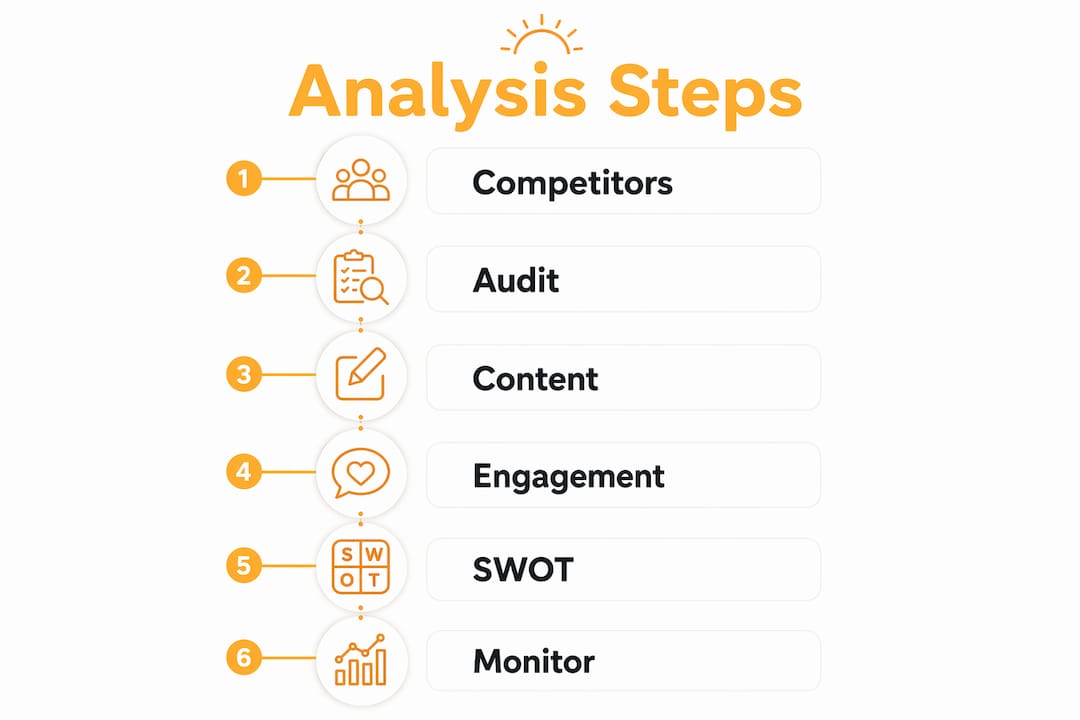
Step 4: Measure engagement and performance. Compare engagement per post against follower size, not just total likes. A competitor with high posting volume but low engagement per post is burning effort without building connection.

Step 5: Apply SWOT analysis. Map competitor strengths (strong brand voice, high production value, frequent posting) against their weaknesses (inconsistent messaging, too much promotional content, low format variety). Your opportunities live in their blind spots. For a deeper look at applying SWOT to campaign planning, the 8 Marketing Campaign Components framework is worth reviewing.
Step 6: Set up ongoing monitoring. Competitive analysis is a cycle, not a one-time project. Quarterly reviews catch strategy shifts before they become threats. Monthly lightweight check-ins work well for fast-moving categories.
Pro Tip: Layer social listening into your process. Earned conversations on Reddit, YouTube comments, and untagged posts reveal genuine customer sentiment that owned-channel metrics never capture. That’s where you find the real competitive intelligence.
Understanding which social media analytics tools support each step makes the process faster and more consistent across reporting cycles.
Which California agencies offer social media competitive analysis services?
California businesses have strong local options for outsourcing this work. The agencies below serve the California market with meaningfully different specializations, so the right fit depends on your industry, budget, and scope.
Agency | Services Offered | Specializations | Certifications & Awards | Best For | Rating |
Social media, SEO, web design, branding, video, Google Ads | Full-service digital marketing, enterprise, e-commerce | Multiple Agency of the Year awards (Clutch.co), Google Premier Partner, recognized by Expertise.com for excellence. | Businesses needing comprehensive digital marketing with national-level credentials | 5★ (165 reviews) | |
SEO, paid social ads, YouTube management, YouTube Ads | Fintech SEO, advanced SEO, honest revenue-focused marketing | Not publicly listed | Brands wanting high-impact SEO and paid social without long-term contracts | 5★ (93 reviews) | |
Social media, SEO, PPC, web design, strategy and data analysis | AI marketing, multi-platform campaigns, education sector | Nationally recognized for AI marketing strategies | Organizations needing AI-enhanced social strategy and multi-channel execution | 5★ (24 reviews) | |
PVCreators | Social media content creation | Authentic and creative digital content production | Not publicly listed | Businesses focused on standout content creation | 5★ (13 reviews) |
Jives Media
Jives Media is the most credentialed full-service option on this list. The agency has managed substantial media and holds a Google Premier Partner designation alongside multiple Clutch.co Agency of the Year awards. For California businesses that need competitive analysis embedded inside a broader digital marketing program — SEO, paid media, branding, and social working together — Jives Media has the infrastructure to run it at scale. Their track record across enterprise and e-commerce clients makes them a natural fit when competitive insights need to connect directly to paid campaign decisions.
Jose Angelo Studios
Jose Angelo Studios takes a narrower, more focused approach. Their fintech SEO specialization and no-long-term-contract model appeal to brands that want measurable revenue growth without being locked into a retainer. If your competitive analysis work centers on search visibility and paid social performance rather than organic content strategy, this agency’s honesty-first positioning and YouTube management capabilities are worth a close look.
Nettra Media
Nettra Media’s differentiator is its AI marketing expertise combined with education sector experience. For organizations running multi-platform campaigns across social, digital ads, and analytics simultaneously, their data-driven approach to strategy and campaign management offers a level of coordination that generalist agencies often lack. They serve the California market and have earned national recognition for their marketing strategies.
PVCreators
PVCreators focuses specifically on social media content creation. If your competitive analysis reveals a content quality gap rather than a strategy gap, and you need a creative partner to close it, PVCreators delivers authentic, platform-native content for California brands.
Red flags to watch for when evaluating any agency: vague deliverables with no defined reporting cadence, promises of guaranteed follower growth, and contracts that lock you in before you’ve seen a single audit. Ask any prospective provider to walk you through their competitive analysis framework, show you a sample report, and name the specific metrics they track for clients in your category.
When comparing agencies, the fractional CMO vs. marketing agency question is worth thinking through first. It shapes what kind of provider relationship actually fits your business model.
SOL Social Media offers a different path for small businesses
If the agencies above feel like more firepower than your current stage requires, SOL Social Media is built for exactly where you are right now.
SOL Social Media works specifically with small businesses that need consistent, authentic social media management without the overhead of a large agency. The focus is on real human copywriting, genuine community engagement, and strategies built around your brand’s actual voice — not a template. Where the agencies above often serve enterprise or mid-market clients with complex multi-channel needs, SOL Social Media specializes in the hands-on relationship that small business owners need to stay visible and grow. From social media engagement services to monthly content planning and live event coverage, every service is designed to produce measurable results without a long-term contract or a bloated retainer. If you’re a California business owner ready to stop guessing and start building a social presence that actually connects, SOL Social Media is the practical next step.
FAQ
What is social media competitive analysis?
Social media competitive analysis is the process of auditing your competitors’ social presence, including content strategy, engagement metrics, posting frequency, and platform use, to identify opportunities and benchmark your own performance.
How many competitors should I analyze?
Focus on 3 to 5 competitors for consistent, manageable reporting. Include both direct and indirect competitors, and consider one aspirational brand slightly above your current scale.
Which metrics matter most in a competitor audit?
Engagement per post and follower growth trends are more revealing than raw follower counts. Also track content format distribution, posting frequency, and social share of voice to get a complete picture of competitor strategy.
How often should I run a competitive analysis?
A quarterly full review is the standard cadence for most businesses. Fast-moving categories benefit from a lighter monthly check-in between full audits to catch strategy shifts early.
Can SOL Social Media help with social media competitive analysis?
Yes. SOL Social Media offers social media audits and strategy services tailored to small businesses, including competitive benchmarking as part of its broader social media management packages.
Key Takeaways
Effective competitive analysis in social media requires tracking the right metrics, applying structured frameworks, and treating the process as an ongoing cycle rather than a one-time project.
Point | Details |
Focus on 3–5 competitors | Analyzing more dilutes focus; a tight set delivers deeper, more actionable insights. |
Prioritize engagement over follower counts | Engagement per post reveals true audience connection far better than raw follower numbers. |
Use the funnel lens | Mapping competitor content to awareness, consideration, and conversion stages exposes strategic gaps you can own. |
Make analysis cyclical | Quarterly full reviews and monthly check-ins keep your strategy current as competitors and platforms shift. |
SOL Social Media for small businesses | SOL Social Media provides hands-on social media management and audits built specifically for small business owners in California. |
Recommended
Comments