


Budget $1,000–$10,000 for Social Media Content in the U.S.

Most small businesses pay somewhere between $1,000 and $10,000 a month for professional social media content creation, depending on platform count, content format, and engagement level. Starter packages for one platform with light posting sit at the low end; full production with video and daily engagement pushes toward the top. The buying rule that matters more than any number: compare deliverables line by line, not headline price, because two “$2,500 retainers” can represent wildly different amounts of work.
TL;DR:
The cost for social media management varies widely, with packages differing in platform count, content formats, posting frequency, and engagement levels.
Management fees should be itemized separately from ad spend and production costs, which are often billed as additional line items.
Choosing a billing model depends on workload predictability; retainers work best for ongoing work, while hourly or project-based pricing suits limited, defined tasks.
Key price drivers include platform complexity, content format, volume, community management level, and scope of live or on-site coverage.
Effective evaluation of spend requires focus on measured outcomes like leads and booked appointments, with results typically visible after three to six months.
What Common Budgets Buy: Starter, Mid-Tier, and Premium Examples
Price bands only mean something when you know what they include. A HeyOrca survey of agencies and freelancers found an average monthly retainer around $2,100, with hourly rates averaging near $67 for social media management work. Clutch data shows many projects come in under $10,000, with monthly costs spread widely depending on scope and duration.
Here’s how those numbers translate into actual packages:
Starter tier: One or two platforms, roughly 8 to 12 posts per month, mostly static graphics and captions, monthly reporting. Businesses with client-supplied photos or product shots often land at the lower end.
Mid-tier: Three to four platforms, a content mix of graphics, carousels, and occasional short-form video, modest community engagement (replying to comments and messages during business hours), and a monthly performance review call.
Premium tier: Daily engagement monitoring, weekly short-form video production, professional photography or filming, and coverage that spans four or more platforms with platform-native formatting rather than one asset copy-pasted everywhere.
The number you sign should represent the management fee only. Ad spend and one-off production charges (a photo shoot, a videographer for an event) are separate line items in a well-structured proposal. If a quote bundles ad spend into the “management fee” without a breakdown, that’s a sign the proposal needs more detail before you compare it to anyone else’s. The Small Business Administration recommends choosing platforms deliberately and using analytics to judge performance, which only works if you know exactly what you’re paying the agency to produce.
How Do Agencies Structure Their Pricing?
The billing model you choose should match how predictable your workload is, not just how much you want to spend. Each structure fits a different situation.
Monthly retainer: The most common model for ongoing content work. A retainer gives an agency continuity to learn your brand voice and improve results over time, which matters because social content compounds. It’s a poor fit if your needs are truly one-off.
Hourly or project-based: Better suited to audits, a single campaign, or a rebrand where the workload is finite and known in advance. You pay for defined hours or a defined deliverable set, then the relationship ends or resets.
Hybrid or performance-based: A base management fee plus a percentage tied to ad spend or a bonus tied to agreed outcomes. This works when both sides agree on what “performance” means before the contract starts, not after a disappointing quarter.
Reporting cadence should match the model. Retainer clients typically get monthly reports tied to a running strategy; project clients get a single wrap-up report at completion. If your proposal doesn’t specify which one you’re getting, ask.
What Actually Drives the Price of a Proposal
Two agencies quoting on paper-thin briefs can land $3,000 apart for reasons that have nothing to do with markup. The scope items below are what actually move the number, according to AgencyAnalytics’ pricing breakdown:
Platform count and posting style. Native content built separately for Instagram, TikTok, and LinkedIn costs more than one asset cross-posted to all three.
Content format. Static images cost the least to produce; carousels and reels sit in the middle; long-form or heavily edited video costs the most because of filming and editing time.
Volume and cadence. Three posts a week on one platform is a different job than daily posts across four.
Production needs. Photography, filming, motion graphics, and captioning each add time that shows up in the invoice.
Community management level. Agencies that monitor and respond to comments and messages within a few hours, including weekends, price that differently than agencies that only post and log off.
Approval process and revisions. Every extra revision round or rush request adds hours the agency has to bill somewhere.
Live event or on-site coverage. Covering a grand opening or in-person event in real time typically carries its own add-on fee.
Adding weekly reels or daily engagement monitoring to a starter package can meaningfully raise the monthly cost, sometimes by more than the video or engagement work alone would suggest, because it also raises coordination overhead. Definitional ambiguity is a quieter cost driver: whether a carousel counts as one post or several, and whether “video” includes filming or only editing, changes what you’re actually buying even when the post count looks identical on paper.
Pro Tip: Before comparing two quotes, ask both agencies to define exactly what counts as one deliverable. A “12 posts a month” package that includes filming is not the same product as one that only edits footage you already have.
What to Put in Every Proposal Request
A proposal you can’t compare against another proposal is a proposal you shouldn’t sign. Request these items from every agency or consultant before you decide:
A deliverables table listing platforms, post types, monthly counts, and estimated engagement hours per platform.
Separated pricing lines for the management fee, any ad spend, and production or pass-through costs like stock footage or paid stock photography.
Approval windows and revision limits, plus a stated policy for what happens to deliverables you never approve in time.
Reporting access, either native platform analytics or a shared dashboard, on a defined monthly or quarterly cadence.
Community management boundaries: which comments get public replies, which get escalated to you privately, and expected response hours.
A clear list of exclusions, such as live events, rush turnarounds, or extra platforms not covered by the base fee.
Watch for red flags: vague language like “regular posting” instead of a specific count, guaranteed follower growth (a claim no legitimate agency can back), and ad spend folded into the management fee with no separate accounting. A six-clause contract checklist built for small business owners covers most of this in plain contract language you can hand to any vendor.
How Do You Know if the Spend Is Working?
Tie your budget to outcomes you actually care about, calls, booked appointments, or qualified leads, rather than likes. Leading indicators like reach, saves, comments, and profile visits matter because they predict those outcomes before the sales numbers show up, not because they’re impressive on their own.
Ask your agency to report cost-per-lead or cost-per-appointment whenever your business model allows it.
Compare total marketing cost against revenue the way the SBA recommends, and insist on a plain-language monthly interpretation, not just a chart.
Give the relationship time. Three months is usually enough for an agency to learn what content resonates with your audience; six months is a more realistic window to see downstream results like booked business.
A retainer that never produces a documented next-step plan is expensive no matter how cheap the monthly number looks.
Smart Ways to Negotiate Without Cutting Corners
You don’t have to accept the first number on a proposal, and you don’t have to sacrifice quality to bring it down.
Ask for a 90-day pilot with clearly defined success metrics before signing a 12-month retainer.
Keep routine content in the base fee, and price premium production, like event coverage or filming, as separate add-ons with fixed costs.
Supply your own raw assets (product photos, headshots, brand files) to cut production hours, but get the resulting turnaround time in writing.
Request a menu of add-ons with fixed prices upfront so a rush request or extra platform doesn’t turn into a surprise invoice.
If full management isn’t affordable yet, ask about consulting or training instead of walking away entirely.
Pro Tip: Agencies would almost always rather negotiate scope than negotiate their hourly rate. Ask what you’d get for 20% less before asking for a straight discount.
Which SOL Social Media Plan Fits Your Budget?
Some agencies build packages around real human copywriting and a strategy shaped by your specific brand, not a template applied across every client on the roster. That’s the practical alternative to agencies that hand new clients a generic content calendar and call it strategy: SOL starts with the specifics of your business, your audience, and your goals before a single post gets written.
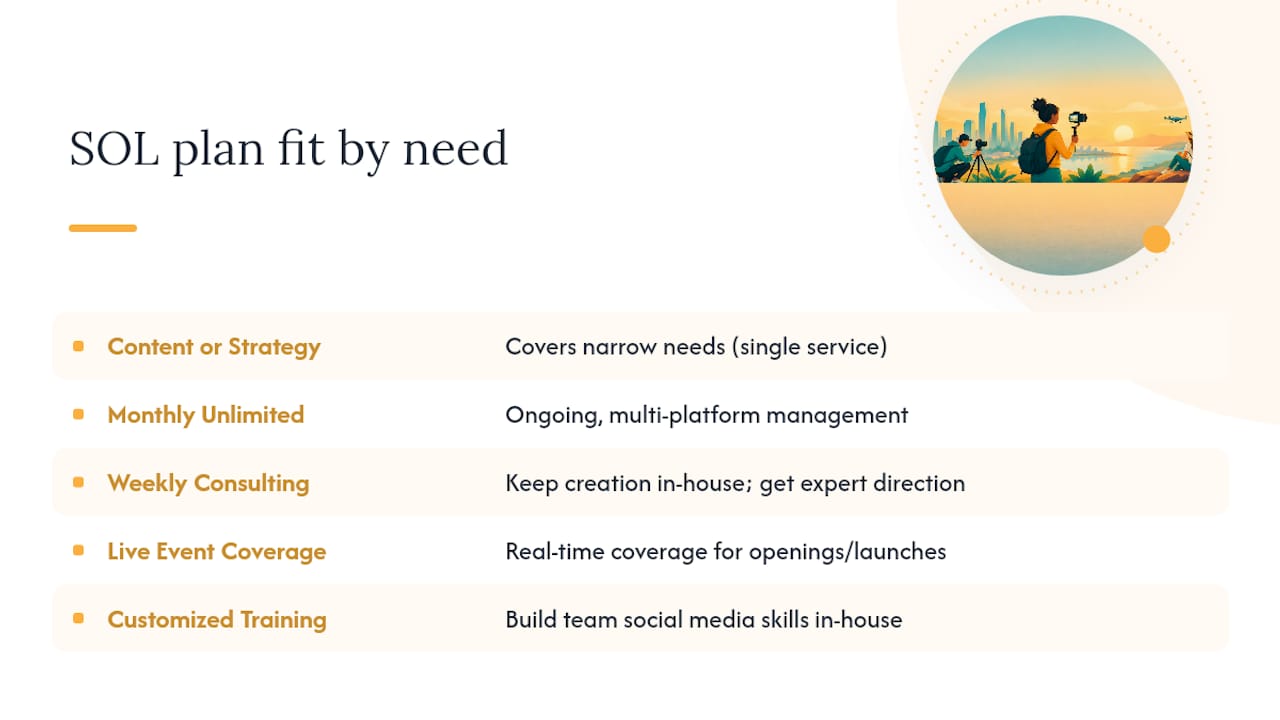
If your needs are narrow, a single service like Social Media Content Creation or Social Media Strategy may cover it. Businesses that need ongoing, multi-platform management fit better with the Monthly Unlimited plan, while owners who want to keep content creation in-house but need expert direction can use Weekly Consulting instead. SOL also offers Live Event Social Media Coverage for businesses that need real-time coverage of openings, launches, or in-person events, and Customized Social Media Training for teams that want to build the skill in-house.
Request a written scope or a custom quote directly through SOL’s pricing plans page, and ask about starting with a defined pilot period so you can evaluate results before committing to a longer contract.
Why Scope, Not Post Count, Should Drive Your Decision
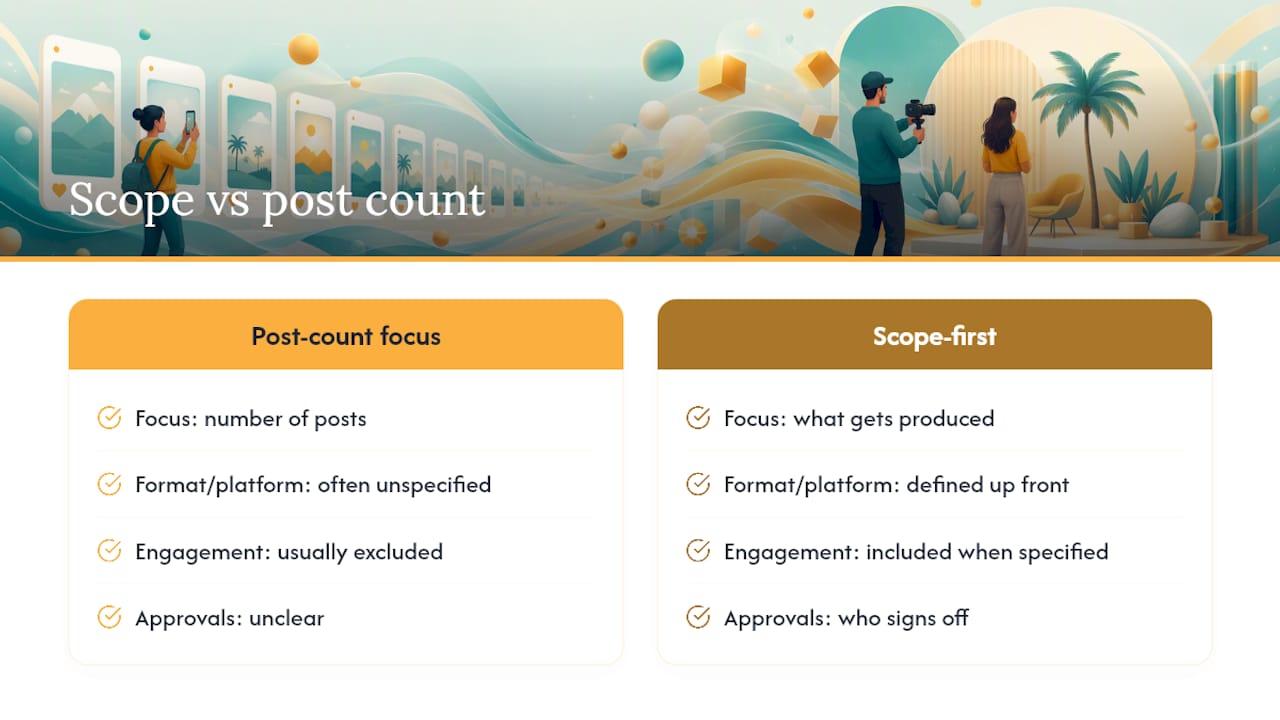
Comparing agencies by post count alone is one of the most common mistakes owners make, and it’s the one that costs the most money over a year. Twelve posts a month means almost nothing without knowing the format, the platform, and whether engagement is included. That’s why SOL Social Media builds proposals around scope first: what gets produced, who approves it, and how results get measured, before any number gets attached to it. A retainer built on continuity beats a cheaper one that starts over every quarter.
— SOL Social Media
Sources
FAQ
How much should a small business budget for social media management?
Most small businesses budget between $1,000 and $10,000 a month, with the average retainer near $2,100 for standard multi-platform management. The right number depends on platform count, content format, and how much community engagement is included. SOL Social Media provides a custom quote based on your specific scope rather than a flat rate.
Is ad spend included in a social media management fee?
No, ad spend is typically billed separately from the management fee, and any proposal that bundles the two without a breakdown deserves a second look. Production costs like photography or video shoots are usually separate line items as well.
What’s the difference between a retainer and project-based pricing?
A retainer covers ongoing, recurring content work and gives an agency time to learn your brand and refine results month over month. Project-based pricing fits one-off work, like a single campaign or an audit, where the scope has a clear start and end.
What should I ask for in a social media proposal?
Request a deliverables table with platforms, post counts, and formats, separated pricing for management versus ad spend, defined approval windows, and a reporting cadence. A detailed contract checklist helps you compare quotes on equal footing instead of guessing from a single total price.
How long before I see results from paid social media management?
Most agencies need about three months to learn what content works for your audience, and six months is a more realistic window for measurable business outcomes like booked appointments. Insist on monthly reporting that ties leading indicators to actual business metrics rather than follower counts alone.
Recommended
Comments