


Stop the Scroll: 11 Plug and Play Video Hook Ideas for Small Teams

A three-part hook, pattern interrupt paired with bold on-screen text and a concrete promise, is the fastest way to stop a scrolling thumb on TikTok, Reels, or Shorts. This article gives you a library of proven hook types, real starter lines you can copy today, platform-specific delivery notes, and a simple testing loop so you can find out which ones actually work for your audience.
TL;DR:
Hooks that use specific, measurable stakes or numbers tend to generate higher 3-second hold rates, especially when the promise is clear and tangible.
Delivering a hook with visual pattern interrupts or mid-action demos increases engagement, provided the video still communicates the topic without sound.
Testing multiple hook variants with the same content and measuring only the hold rate and completion rate offers the most accurate way to identify effective openings.
Platform-specific delivery—for example, fast-paced spoken hooks for TikTok and visual overlays for Reels—significantly improves hook performance across channels.
Prioritizing hook testing over production polish helps ensure viewers stay engaged, as a weak hook will cause even high-quality footage to be scrolled past quickly.
Video Hook Ideas Creators Can Copy Right Now
A hook is the first one to three seconds of a video, and its only job is to interrupt the scroll and open a loop the viewer needs closed. Below are the hook families that show up again and again in high-performing short-form content, along with lines you can adapt in minutes.
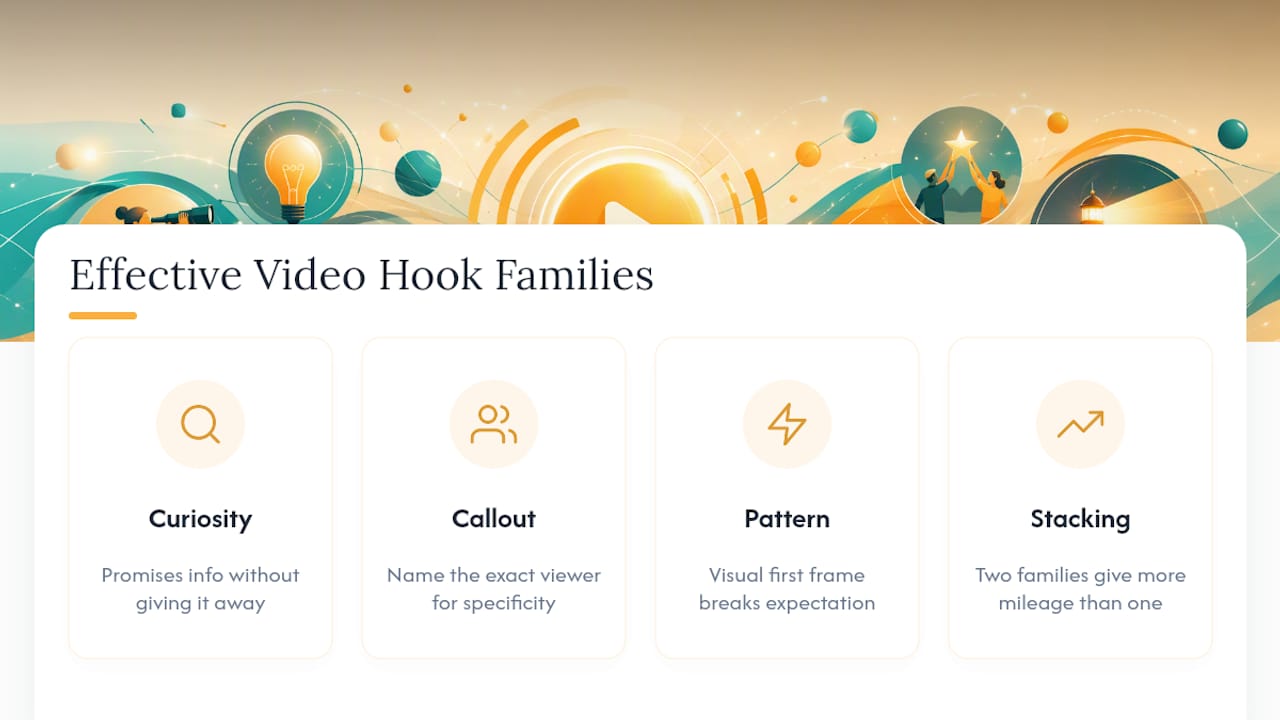
1. Curiosity gap. You promise information without giving it away. “I found out why my posts stopped getting views, and it wasn’t the algorithm.” Use this when your payoff genuinely surprises. Don’t use it if the ending is obvious.
2. Direct callout. You name the exact viewer you want watching. “If you own a salon and haven’t posted in two weeks, this is for you.” Specificity is what makes callouts work. A vague callout (“attention business owners”) gets scrolled past.
3. Stakes or number lead. Concrete numbers make a promise feel real. Here’s what caused it." Round numbers read as filler; specific ones read as fact.
4. Contrarian claim. You state a belief and challenge it. “Posting every day is actually hurting your engagement.” Follow it immediately with a reason, or the claim reads as clickbait with nothing behind it.
5. Pattern interrupt (visual). The first frame breaks a viewer’s expectation before you say a word. Someone tearing paper, spilling something, or standing somewhere unexpected all qualify. Versely’s research on brand hook design notes that six repeatable families, including pattern interrupt and callout, account for most successful brand hooks.

6. In-progress action / demo-first. Start mid-task instead of explaining what you’re about to do. Open on your hands already mixing paint, already typing a reply, already mid-sentence with a client. It reads as more authentic than a setup shot.
7. Tease outcome / “wait for it.” You show a glimpse of the result up front, then rewind to explain how you got there. “Watch what happens to this dough after 10 minutes.” This works because it front-loads payoff instead of asking viewers to trust you’ll deliver one.
8. Urgent warning or command. “Stop doing this on your Instagram bio right now.” Commands work when the stakes are real and immediate; overuse turns your account into noise.
9. Participation or quiz hooks. “Guess which of these three captions got the most comments.” Viewers who guess wrong keep watching to find out why.
10. “Watch till the end” / payoff promise. Use sparingly, and only when the payoff is genuinely worth the wait. This phrase has been overused enough that it now carries some skepticism.
11. Value-promise hooks. “Here’s the exact caption formula I use for every client post.” This works because it tells the viewer, in plain terms, what they walk away with.
You get more mileage stacking two families than relying on one. A stakes-plus-contrarian combo, “I spent a substantial amount on ads and it taught me everything wrong about targeting,” pulls a number and a challenge to conventional wisdom into a single line. Mixing families is one of the simplest ways to make a familiar format feel fresh again.
Why These Hooks Work: The Psychology and the Metrics
Curiosity gaps work because an open question creates mild discomfort the brain wants resolved. Pattern interrupts work because the visual cortex reacts to anything that breaks a predictable pattern, even for a fraction of a second. Social proof and urgency work because they borrow decision shortcuts viewers already use every day: “other people are watching this” and “I might miss something.”
None of that matters if you can’t measure it. Two numbers tell you whether a hook is doing its job:
3-second hold rate: the percentage of viewers still watching after your hook plays out. This is the number that tells the platform your content is worth pushing further.
Completion rate: how many viewers finish the video. A strong hook with a weak body still loses people here.
A testing loop built around these two metrics matters more than raw view counts, because views measure distribution, not whether your hook actually worked.
Certain mistakes reliably kill hold rate. A logo intro before any content plays wastes your most valuable seconds. A slow, explanatory setup (“Hey guys, so today I wanted to talk about…”) gives viewers permission to leave before you’ve said anything. And clickbait without a real payoff trains your own audience to distrust your hooks, which tanks performance on every video after it.
Adapting Hooks for TikTok, Reels, and Shorts
The same hook idea needs a different delivery depending on where it lands. Platform dialects differ in timing, tone, and visual style, and treating every platform the same is one of the fastest ways to underperform on at least one of them.
TikTok rewards a raw, spoken catalyst line delivered within the first 0.5 to 1.5 seconds. Native, slightly unpolished footage tends to outperform anything that looks like an ad.
Reels favors a visual-first opener with bold text overlay and a bit more production polish, with a slightly longer window of about 1.5 to 3 seconds before you need to earn attention.
Shorts benefits from a descriptive, search-validated hook: viewers often arrive through search rather than pure browsing, so a title-style hook that answers a query performs better than pure curiosity bait. Return-viewer familiarity also helps here more than on TikTok or Reels.
Before you post the same video everywhere, run it through a short cross-posting checklist: does it still make sense with the sound off, does the text overlay fit the platform’s safe zone, is the crop and composition correct for each aspect ratio, and does the pacing match what that platform’s audience expects.
Pro Tip: Watch your own hook with the sound muted before you post. If you can’t tell what the video is about in the first two seconds, neither can your audience. Sync Studio’s research on testing hook variants points to the mute test as one of the most underused but decisive diagnostics for repurposing content across platforms.
How to Write, Test, and Iterate Your Hooks
Guessing which hook will land is a waste of production time. Testing removes the guesswork with a simple, repeatable loop.
Write one body, three hooks. Keep the middle and ending of the video identical, then write three openings from different hook families, curiosity, stakes, and pattern interrupt, for instance.
Post the variants. Stagger them across a few days or post them simultaneously across accounts if you’re running paid tests. Either way, keep everything except the hook constant.
Measure hold rate and completion, not views. Isolating the hook as the only variable is what makes the test tell you something real.
Apply decision rules. Cut any hook that falls well below your account’s average 3-second hold rate. Keep the winning family and retire the others. Log the result in a simple hook library so you’re not repeating dead ends.
Diagnostic | Question it answers |
Mute test | Does the hook communicate the topic without sound? |
Scroll test | Would this stop you mid-scroll on your own feed? |
Promise test | Does the video actually deliver what the hook promised? |
Run all three before you post, not after. A short video script template can help you standardize this process if you’re producing several videos a week.
Copy-and-Paste Hook Templates and Micro-Scripts
Edit these directly. Keep overlay text under seven words per line, and never let text and voiceover say the exact same thing at the exact same time, that’s wasted bandwidth. Let the visual carry the setting, the text carry the promise, and the voice carry the stakes.
Curiosity: “The reason this didn’t work had nothing to do with the recipe.”
Stakes/number: “This mistake cost me 3 clients in one month.”
Command: “Stop editing your photos like this.”
Participation: “Which caption do you think performed better? Comment A or B.”
Contrarian: “Everyone tells you to post daily. Here’s why that’s bad advice.”
Demo-first: Open mid-task with overlay text reading, “Watch what happens next.”
Callout: “If you run a small clinic and dread posting, watch this.”
Value-promise: “Save this for the exact caption formula I use every week.”
Overlay text should never exceed two lines on screen at once. If your spoken line and your overlay text are identical, cut one, redundancy wastes the viewer’s attention rather than reinforcing your point.
How SOL Social Media Approaches Hooks for Small Business Accounts
SOL Social Media runs a one-week starter workflow with small-business clients: plan the hooks before anything gets filmed, shoot footage that pays off the specific hook chosen, test three variants against each other, then scale whichever family wins. Planning hooks first, instead of filming and hoping something usable comes out of the edit, cuts wasted shoot time significantly.
Review our Instagram Reels production guide for pacing and text-overlay specifics.
Check our engagement strategy resource if hold rate isn’t translating into follows or leads.
Pro Tip: Before handing hook work to an agency or an in-house hire, ask them to show you three tested hook variants and the hold-rate data behind each one, not just a portfolio of finished videos.
Using Storytelling to Make Hooks Stick
A hook built on story structure holds attention longer than a hook built purely on shock or novelty, because a story creates an open question the brain wants resolved across the entire video, not just the first three seconds. The strongest short-form hooks borrow from classic story mechanics: a character (even if it’s just you), a specific stake, and a turning point the viewer hasn’t reached yet.
“I almost lost my biggest client over a typo” works better as a hook than “here’s a copywriting tip” because it sets up a character, a real consequence, and an unresolved moment. The viewer isn’t just curious about information, they’re invested in what happens to a person.
Keep the story hook honest. If you promise a turning point, deliver one that actually changes something, a decision made, a lesson learned, a result achieved. A story hook with no real turn just becomes a slow, disappointing setup, and that’s exactly the mistake that kills completion rate.
One practical trick: write your hook as the middle of a sentence, not the beginning. “And that’s when I realized the whole campaign was wrong” sounds like you’re already mid-story, which pulls viewers in as if they walked in on something happening. Starting cold, “Let me tell you about a campaign,” reads as an announcement instead of a moment, and announcements are easy to scroll past.
Studying Competitor Hooks Without Copying Them
Watching how competitors and adjacent creators open their videos is one of the fastest ways to spot which hook families are working in your niche right now, without spending a single dollar on testing. Pull up the ten most recent videos from three or four accounts your audience also follows, and write down the exact hook line for each one.
Patterns show up fast. If five of ten hooks use a number in the first sentence, that’s a signal the audience in that niche responds to concrete stakes. If most hooks open mid-action rather than with a spoken introduction, that tells you something about what that specific platform’s audience expects from that niche.
The goal isn’t to copy the line, it’s to copy the structure and swap in your own specifics. If a competitor’s hook is “I tested five skincare brands so you don’t have to,” the structure worth borrowing is the “I did the work for you” promise, not the exact wording. Rewrite it around your own product, service, or story.
Differentiation comes from what you do after the structure, not from avoiding proven formats entirely. Two creators can both open with a stakes hook and land completely different videos because one follows through with a story and the other follows through with a checklist. Study the opener, then make the payoff distinctly yours.
Matching Hooks to Who’s Actually Watching
A hook that works for a 22-year-old audience on TikTok can fall flat with a 45-year-old small-business owner scrolling Reels on a lunch break, and the gap usually isn’t the topic, it’s the delivery. Younger audiences respond well to fast pacing, raw footage, and slang-forward phrasing. Slightly older or more professional audiences often respond better to a calmer opening line with a clear, direct promise.
Start by identifying what your specific audience is already worried about or curious about, not what’s trending broadly. A hook for parents managing a pediatric practice’s social page should sound different from a hook aimed at gym owners, even if both use the same “stakes” family underneath.
Interests matter as much as demographics. An audience of hobbyist bakers responds to visual payoff hooks (“watch this dough rise”), while an audience of B2B service providers responds better to value-promise hooks (“here’s the exact email that got me three new clients”). Match the hook family to what that specific group already wants resolved, not to whatever hook happens to be trending that week.
Test this the same way you test hook families generally: run the same core message through a casual version and a more polished version, and let the hold-rate data tell you which register your specific audience actually prefers.
When to Prioritize Testing Over Production Polish
Test hooks before you invest in better cameras, lighting, or editing software. A polished video with the wrong hook still gets scrolled past in under two seconds. Repurpose footage you already have with a new hook, or use text and motion as a low-cost pattern interrupt, before spending a single dollar upgrading production.
— SOL Social Media
Get Your Hooks Tested and Scaled With SOL Social Media
SOL Social Media builds hook strategy the same way described above, plan first, shoot to pay off the hook, test three variants, then scale the winner, but we do it as a managed service so you’re not running the whole loop solo. Our packages cover social strategy, content creation, hook A/B testing, and hands-on training if you’d rather your own team learn to run this process in-house.
If your team is stuck rewriting captions instead of testing hooks, or your videos look great but never get past the first three seconds, that’s exactly the gap our social media engagement services are built to close. You can also see how we’ve applied this approach with local businesses through our community involvement work. Book a consultation to get your first hook-testing round scheduled this month.
Sources
FAQ
What are some good hook examples?
Strong examples include a number-led stakes line (“This mistake cost me 3 clients”), a contrarian claim (“Posting daily is hurting your engagement”), and a demo-first opener that starts mid-action instead of with an introduction.
What is a catchy hook?
A catchy hook is a short line or visual moment, delivered in the first one to three seconds, that opens an information gap the viewer wants closed before they scroll away.
What are some good video ideas that pair well with strong hooks?
Behind-the-scenes demos, myth-busting videos, and “here’s what actually happened” story formats all pair naturally with curiosity and stakes hooks because they set up a clear payoff.
What is a good attention-grabbing hook?
The most reliable attention-grabbing hooks combine a visual pattern interrupt with bold on-screen text and a spoken promise, so the hook works whether someone is watching with sound on or scrolling on mute.
How do I know if my hook is actually working?
Track your 3-second hold rate and completion rate rather than total views. If a hook variant holds significantly more viewers past the three-second mark, that’s the version worth scaling.
Recommended
Comments