


Testimonials on Social Media: A Small Business Guide

A social-media-ready testimonial is a short, specific customer result you have permission to share — and you should collect, repurpose, and measure them as recurring marketing assets, not one-off posts.
Start here:
Identify 3 customers who recently hit a milestone or gave you a high satisfaction score
Ask soon after a positive signal (renewal, a high NPS score, a compliment in your inbox)
Get written permission covering name, photo, logo, and intended platforms before you publish
Repurpose each approved quote into at least one social post, one ad graphic, and one sales-deck slide
FTC reminder: If a customer received a discount, free product, or any incentive, disclose that connection clearly and conspicuously in every post where the testimonial appears.
Why testimonials move the needle on social media
Social proof is one of the fastest ways to reduce buyer hesitation. When a prospect sees a real customer describing a specific result, the mental friction of “Will this work for me?” drops significantly. That’s the core business case for putting customer reviews on social media front and center.
Many LinkedIn members drive business decisions, which means a well-placed testimonial on LinkedIn can reach the exact people who control purchasing budgets. On Instagram and TikTok, authentic client experiences shared online stop the scroll in a way that polished brand copy rarely does.
Testimonials also pull double duty. Organically, they give your team and satisfied clients something worth sharing on their own profiles, creating a social proof chain that extends your reach without paid spend. In paid campaigns, a customer quote used as ad copy typically outperforms generic brand messaging because it carries third-party credibility.
Pairing your controlled testimonials with public reviews on social media from platforms like Google or Yelp build a balanced trust picture. Third-party reviews carry higher buyer trust than site-only testimonials, so the two formats work together rather than compete.
What counts as a testimonial (and quick examples you can post today)
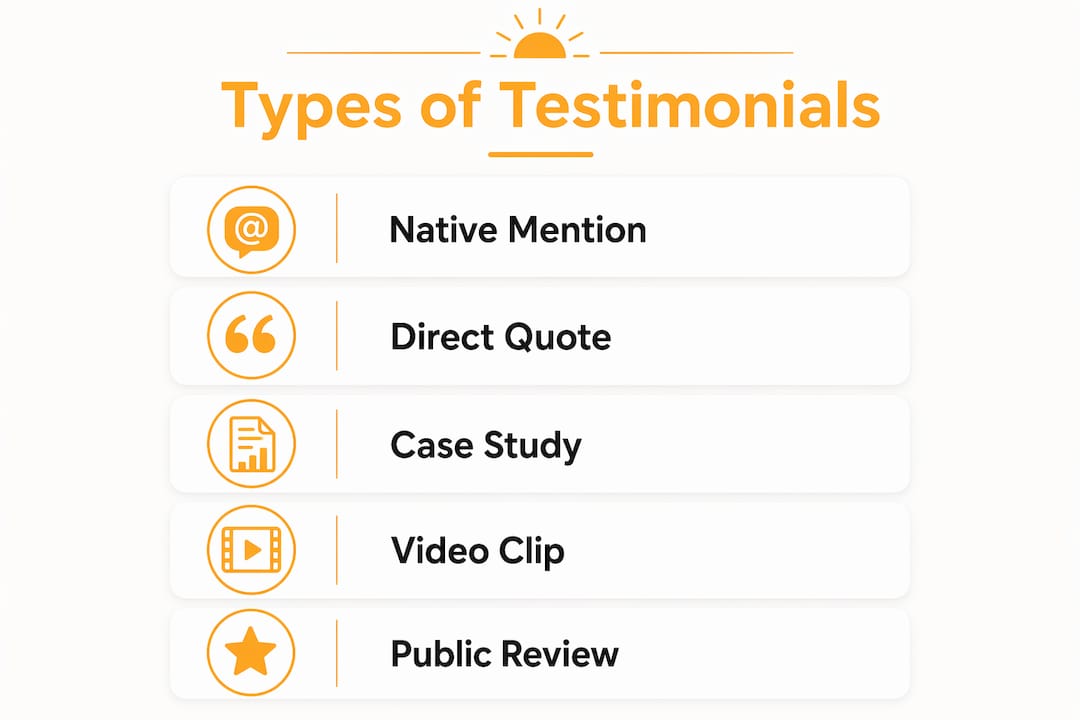
The FTC defines a testimonial as an advertising message that consumers are likely to believe reflects the opinions or experiences of a real customer. In practice, that covers several formats:
Text quote: A sentence or two pulled from an email, survey, or DM, attributed to a named customer
Video testimonial: A 30–90 second clip where the customer speaks directly to camera
Case-study snippet: A before/after summary (challenge → solution → result) formatted as a social caption or carousel slide
Native social mention: A post your customer published on their own profile praising your business
UGC (user-generated content): Photos or videos customers create organically featuring your product or service
For native social mentions, the right move depends on context. Embed the original post when you want to preserve attribution and keep the customer in control. Get explicit written permission before you pull the text into an ad, a landing page, or a graphic where the original source won’t be visible.
Here’s what outcome-driven testimonials look like in practice:
Generic praise like “Great service!” rarely helps a prospect decide. Ask for the challenge, the solution, and a quantifiable result — that structure is what makes a testimonial persuasive on any platform.
How to ask for testimonials: timing, who to ask, and exact questions
Timing is the single biggest variable in whether you get a useful response. The best moments to ask are right after a product milestone, within 48 hours of an NPS score of 9 or 10, after a successful onboarding call, or immediately after a contract renewal.

Who to prioritize: Customers with recognizable logos, specific use cases that mirror your ideal buyer, or roles that carry credibility with your audience (a practice manager, a retail owner, a marketing director). A targeted ask to five high-fit customers outperforms a batch email to fifty.
Step-by-step collection workflow:
Trigger the ask based on a satisfaction signal (NPS 9–10, milestone email, renewal)
Send a short outreach message with 2–3 specific questions (see templates in Section 9)
Offer a pre-drafted quote they can approve or edit in one click
Receive approval in writing, confirming name, title, company, photo, and logo use
Archive the approved asset with provenance notes in your marketing library
Questions that produce specific, usable answers:
“What was the main challenge you were trying to solve before working with us?”
“What specific result did you see, and roughly how long did it take?”
“Why did you choose us over other options?”
“What would you tell a colleague who’s considering working with us?”
Permission checklist before you publish:
Written approval (email or signed form) specifying the exact quote
Confirmation of name, title, and company as they want to appear
Photo and/or logo release for the platforms you plan to use
Clarity on any edits the customer requested
Pro Tip: Pre-drafting a testimonial for a busy customer based on documented wins — then asking them to confirm or edit — dramatically increases completion rates. Most people are happy to approve a well-written draft; few will write one from scratch.
Enterprise customers often require legal or PR sign-off, which can add several weeks to the process. Build that timeline into your content calendar and offer anonymized attribution (e.g., “Senior Manager, Fortune 500 retail company”) when a customer can’t use their full company name.
Legal and disclosure rules you must follow (FTC guidance and a California note)
The FTC’s Trade Regulation Rule on Consumer Reviews and Testimonials, effective October 21, 2024, sets a clear baseline for every U.S. business. The core requirements:
Disclose any material connection between your business and the person giving the testimonial — discounts, free products, affiliate fees, or employment relationships all count
Disclosures must be clear and conspicuous, not buried in hashtags or fine print
Never publish fake, AI-generated, or misrepresented testimonials
Do not suppress negative reviews through legal threats or selective display
What “clear and conspicuous” means in practice:
Acceptable: “#Ad” or “Paid partnership” at the very beginning of a text post, before any other content. Acceptable in a video: a verbal disclosure in the first few seconds AND a visible on-screen text label.
Not acceptable: “#ad” buried after 15 other hashtags at the end of a caption, or a disclosure that appears only in a video description most viewers never read.
California-specific note: California’s Fair Political Practices Commission has its own disclosure rules for paid influencer content in political advertising contexts. For commercial testimonials, the federal FTC standard applies, but California’s consumer protection enforcement is active and can layer on top of federal liability. If you’re a California-based business running paid testimonial campaigns, document everything.
One-sentence compliance checklist: Capture written approval, the exact quote, the customer’s name and title, photo/logo release, disclosure of any incentive, and the platforms where you’ll publish.
Pro Tip: Save every written approval in a dedicated folder in your marketing asset library, tagged by customer name, date, and platform. If you ever face a dispute or an FTC inquiry, provenance documentation is your first line of defense.
How to format and share testimonials for each platform
Each platform rewards a different format. Matching your testimonial content to platform behavior is what separates posts that convert from posts that disappear.

Format | Engagement potential | Production effort | Best platforms |
Text quote graphic | Medium | Low | LinkedIn, Facebook, Instagram |
Short video clip (under 90s) | High | Medium | LinkedIn, TikTok, Instagram Reels, YouTube Shorts |
Carousel / micro case study | High | Medium | LinkedIn, Instagram |
Native embed / repost | Medium | Very low | Facebook, Twitter/X |
Long-form video (2–5 min) | Medium | High | YouTube |
LinkedIn: Open with the customer’s result in the first line (that’s what shows before “see more”). Follow with two sentences of context, then the quote. Tag the customer to trigger their network’s visibility. For video, upload natively — native video completion rates drop sharply after 90 seconds, so keep clips tight and add captions. For carousels, structure slides as: result headline → challenge → solution → quantified result → quote → CTA.
Instagram: Static graphics with a pull quote work well in the feed. Stories are ideal for a quick screenshot or a 15-second customer clip, and you can save them to a “Reviews” highlight. Reels give testimonials the widest organic reach — a 30–45 second clip with captions and a hook in the first two seconds performs best.
Facebook: Community-style amplification works here. Share the post to relevant local groups (with permission), and use testimonials as the creative in boosted posts targeting lookalike audiences. Facebook’s ad platform lets you A/B test a customer quote against a brand headline quickly.
TikTok: Authenticity beats production value. A customer filming a quick, unscripted 20–30 second clip on their phone often outperforms a polished studio video. Use a hook in the on-screen text overlay (“We went from 0 to 400 followers in 30 days”) and add relevant hashtags for discovery.
YouTube: Longer testimonial videos (2–5 minutes) work well here because the audience expects depth. Use timestamps in the description so viewers can jump to the result, and include a link to your website or a relevant landing page in the first two lines of the description.
Dos and don’ts across all platforms:
Do tag the customer (with their permission) to extend reach
Do add captions to every video — most social video is watched without sound
Don’t republish a customer’s native post as your own without explicit permission
Don’t use a testimonial in paid ads without a separate written release for that specific use
Repurposing approved testimonials and measuring their impact
One approved testimonial should generate at least five distinct assets. That’s the Content Loop: a single customer quote becomes a web quote card, a LinkedIn post tagging the customer, a static social graphic, a short ad clip, and a sales-deck slide. Each asset serves a different stage of the buyer journey without requiring a new collection effort.
Repurposing checklist and timing:
Day 1: Publish the primary social post (LinkedIn or Instagram, depending on your audience)
Day 3–7: Schedule a boosted version or paid ad using the same quote
Week 2: Add the quote to your next nurture email as a social proof block
Month 1: Include the case snippet in your sales deck or proposal template
Ongoing: Rotate the graphic into your social content calendar quarterly
Measurement playbook — KPIs to track:
KPI | Definition | Recommended tracking method |
Engagement rate | Likes, comments, shares divided by reach | Native platform analytics |
Click-through rate (CTR) | Clicks on linked content divided by impressions | UTM-tagged links in Google Analytics |
Demo / inquiry requests | Form fills or DMs attributed to testimonial posts | CRM tagging or UTM source labels |
Landing page conversion lift | Conversion rate on pages featuring testimonials vs. those without | A/B test in Google Optimize or similar |
Video view-through rate | Percentage of viewers who watched past the midpoint | Platform video analytics |
Tag every link in a testimonial post with a UTM parameter (source, medium, campaign) so you can trace traffic and conversions back to specific posts. Run a weekly check on engagement metrics and a monthly review of conversion data. That cadence gives you enough signal to know which testimonial formats are actually driving pipeline, not just impressions.
Pairing your testimonial program with digital marketing best practices — consistent posting schedules, audience segmentation, and paid distribution — compounds the impact of each asset you create.
How to respond to negative testimonials and reviews on social media
Not every piece of social media feedback will be positive, and how you respond publicly matters as much as the response itself.
Decision checklist — choose your path quickly:
Is the review factually inaccurate or defamatory? → Document it and consult legal counsel before responding
Is it a legitimate complaint with a fixable issue? → Respond publicly, then move to a private channel
Is it vague frustration with no specific claim? → Acknowledge it briefly and invite a direct conversation
Step-by-step public reply script:
Acknowledge the experience without admitting fault (“Thank you for sharing this — we’re sorry to hear it didn’t meet your expectations.”)
Offer a private channel (“Please reach out to us directly at [email/DM] so we can make this right.”)
Keep it short — one to three sentences publicly, then resolve privately
Follow up: once resolved, ask if the customer would be willing to update their review
When to escalate: If a review contains false statements of fact, personal threats, or appears to be from a competitor, document the post with a screenshot and timestamp before taking any action. California’s defamation laws and Section 230 of the Communications Decency Act both affect what you can and can’t do about third-party reviews — a brief consultation with a business attorney is worth the cost before you send a legal demand.
Negative feedback also has operational value. A pattern of similar complaints is a signal to review your process. A customer whose issue you resolved well is often your most credible testimonial source — they’ve seen how you handle adversity.
Ready-to-use templates: outreach messages, captions, and video briefs
Email request template:
Subject: Quick favor — would you share your experience? Hi [Name], I hope things are going well. We’ve loved working with you on [specific project/result]. Would you be willing to share a short testimonial we could use on social media? To make it easy, I’ve drafted something below based on our work together — feel free to edit or rewrite it however you’d like. If you’re happy with it, just reply with “approved” and let me know if you’d like to be credited differently. Thanks so much!
Short DM / in-app template:
Pre-drafted testimonial example (send for approval):
Caption templates:
LinkedIn: “[Customer name] came to us with [challenge]. Here’s what happened in [timeframe]: [result]. [Quote.] Tag someone who needs to hear this. #[IndustryHashtag]”
Instagram: “Real results from a real client. [Short quote.] Swipe to see the full story. → [CTA]”
TikTok: On-screen text hook: “[Specific result in numbers or timeframe].” Voiceover or caption: “Here’s how [Customer type] did it with [your service].”
30–60 second video brief:
Introduce yourself and your business (5 seconds)
Describe the challenge you had before (10–15 seconds)
Explain what changed after working with us (15–20 seconds)
Give one specific result or number (10 seconds)
Close with a recommendation (5–10 seconds)
Sample permissions text:
Key Takeaways
Treating each approved testimonial as a reusable content asset — collected on a trigger, repurposed into at least five formats, and tracked with UTM tags — is the most reliable way to build a testimonial pipeline that consistently drives social proof and conversions.
Point | Details |
Ask at the right moment | Request testimonials within 48 hours of an NPS 9–10, milestone, or renewal for the best response rates. |
Pre-draft to reduce friction | Send a short draft and ask for a one-click approval; this increases collection success for busy customers. |
Repurpose into five assets | Convert each approved testimonial into a web quote card, LinkedIn post, social graphic, ad clip, and sales-deck slide. |
Disclose every incentive | FTC rules require clear, conspicuous disclosure of any material connection — bury it and you risk federal liability. |
SOL Social Media | SOL Social Media builds and manages testimonial collection workflows, repurposing calendars, and approval systems for small businesses. |
This week’s checklist:
Identify 3 customers to ask (prioritize recent milestones or high NPS scores)
Send pre-drafted testimonial requests with a one-click approval option
Publish one testimonial post and tag the customer (with permission)
Save all written approvals in a dedicated folder
Set a 30-day goal: track engagement rate and CTR on every testimonial post
What SOL Social Media has learned about testimonials
The conventional wisdom says “just ask your happy customers.” That advice isn’t wrong — it’s just incomplete. The businesses that build real social proof pipelines treat testimonial collection the way they treat invoicing: as a weekly operational task triggered by a specific event, not a campaign they run twice a year when they need content.
What we’ve seen consistently is that the gap between businesses with strong social proof and those without isn’t the quality of their customer relationships. It’s the absence of a system. A small retail shop in California with a dozen loyal customers and a simple pre-draft workflow can generate more persuasive testimonial content in a month than a larger competitor running an annual survey.
The other underrated move: employee amplification. When team members share approved testimonials on their own LinkedIn profiles, the reach and credibility multiply in a way that company-only posts can’t replicate. Most small businesses leave that lever completely untouched.
Finally, don’t treat a negative review as a reputation crisis. Treat it as a data point and a recovery opportunity. A customer whose complaint you resolved publicly and professionally is often more persuasive than a five-star review — because they’ve shown your audience how you behave under pressure.
SOL Social Media can run your testimonial program for you
Running a consistent testimonial program takes more than good intentions. It takes a system: collection triggers, pre-drafted outreach, approval workflows, repurposing calendars, and someone who actually executes it week after week.
SOL Social Media builds and manages that entire system for small businesses across California. You get a done-for-you testimonial workflow that fits inside your existing social media management, not a separate project you have to manage yourself.
What’s included:
Pre-drafted collection templates and approval tracking
Platform-specific repurposing (LinkedIn, Instagram, TikTok, Facebook, YouTube)
Monthly content calendar with testimonial posts scheduled and ready to publish
If you’re ready to turn your best client experiences into a consistent content asset, explore our social engagement services or see how we work with clients to build community-driven social proof.
Authoritative sources and official guidance to consult
Use these primary sources to verify compliance requirements and platform-specific rules before you publish:
FTC Final Rule on Consumer Reviews and Testimonials — The official August 2024 announcement covering fake reviews, disclosure requirements, and civil penalty exposure. Start here for compliance.
FTC Endorsements, Influencers, and Reviews hub — Plain-language guidance on disclosure rules, the Consumer Review Fairness Act, and how the Endorsement Guides apply to social media.
FTC Consumer Reviews and Testimonials Rule: Q&A — Answers the most common business questions about what’s covered, including hashtag disclosures and influencer posts.
16 CFR § 465.2 (Cornell LII) — The actual regulatory text on fake or false consumer testimonials; useful if you need the precise legal language for your compliance documentation.
SBA: Customer Testimonials — Maximize Their Marketing Impact — The U.S. Small Business Administration’s practical overview of how to use testimonials effectively in marketing.
B2B online credibility best practices — A partner resource covering credibility-building tactics for B2B businesses, including testimonial strategy and UGC amplification.
Save your approvals. Platform embed features (LinkedIn, Instagram, Facebook) preserve original attribution automatically. For any testimonial you pull into ads or off-platform assets, a written release in your asset library is your compliance record.
FAQ
What is a testimonial on social media?
A testimonial on social media is a customer’s statement about their experience with your business, published or shared on a social platform. It can be a text quote, a short video clip, a carousel post, or a native social mention — any format where a real customer describes a specific result or experience.
Are fake testimonials illegal?
Yes. The FTC’s rule, effective October 21, 2024, explicitly prohibits creating, buying, or disseminating fake or AI-generated testimonials, and allows the agency to seek civil penalties against knowing violators.
What is the new social media law in California relevant to testimonials?
For commercial testimonials, the federal FTC standard applies in California. California’s Fair Political Practices Commission has separate disclosure rules for paid influencer content in political advertising, but for business testimonials, the FTC’s endorsement and disclosure requirements govern — and California’s active consumer protection enforcement can layer additional liability on top.
Can you give an example of a strong testimonial?
A strong testimonial names a specific challenge, a measurable result, and a timeframe: “Before working with [Business], we struggled to get consistent engagement. Within 60 days, our reach doubled and we booked four new clients directly from social.” Generic praise like “Great service!” rarely influences a buying decision.
Do you need permission to share a customer’s social media post?
For embedding a native post, attribution is preserved and generally acceptable. For republishing the text in an ad, a landing page, or a graphic where the original source won’t be visible, you need explicit written permission from the customer before you use it.
Recommended
Comments