


Clipboard Ready Social Media Copywriting for Small Teams, Tested

Social media copywriting is the practice of writing short-form text built to stop a scroll, deliver value fast, and move someone to act, all inside a mobile screen’s first few seconds. The one rule that governs everything else: compress hook, value, and action into your opening lines, because effective copy for mobile-first environments typically fits into two to four lines. Skip accessibility or measurement, and even a clever post underperforms.
TL;DR:
Effective social media copy must have a strong hook, a clear value, and a credible proof moment within the first few lines to capture attention and build trust.
Using proven formulas like AIDA, PAS, or single-claim templates helps streamline content creation and ensures consistency in messaging across platforms.
Tailoring content according to platform norms and accessibility rules increases reach and engagement, especially by using descriptive hashtags and short, clear sentences.
Testing one variable at a time, focusing on a primary metric, and recycling top performers improves results more than constantly creating new content ideas.
Building copy around one outcome, one reader, and one proof point is crucial; combining utility, emotion, and specificity amplifies content sharing and audience action.
What Makes Social Media Copy Actually Work?
Every high-performing post shares five components, and if a post is falling flat, one of these is usually broken.
The hook. Your first line has to signal a payoff, not just grab attention. A question, a bold claim, or a specific number all work, but only if the reader can tell within a beat what they’ll get for staying.
The value. This is the “why should I care” moment. State the benefit plainly, not the feature. “Save two hours a week” beats “our tool has automation.”
The proof moment. One credibility signal, whether that’s a number, a client result, or a recognizable name, builds the trust needed before someone acts. Research on social media psychology shows that an attention to trust to action funnel explains why posts with strong hooks still fail to convert: they skip this step.
The CTA. One CTA, one verb, no hedging. “Get the guide” outperforms “click here” because it tells the reader exactly what they get, not just what to click.
Voice and brevity. Cut every sentence that doesn’t earn its place. Brand voice should show up in word choice and rhythm, not in extra length.
Think of these as diagnostic checkpoints. When a post underperforms, check which of the five is missing before you rewrite the whole thing.
How Do You Write a Social Media Post Step by Step?
A repeatable process beats reinventing your approach every time you sit down to write. Adobe’s own breakdown of the writing process backs this exact sequence, because distilling copy into concrete steps is what separates consistent output from one-off inspiration.
Pick one outcome and one reader. A post trying to do everything for everyone does nothing well. Decide if this post drives comments, clicks, or shares, and write for one persona.
Choose your hook format and draft line one. Question, bold claim, or specific stat. Write three versions before picking one.
Deliver value in two to four skimmable beats. Short lines, one idea per line, no paragraph blocks.
Insert one proof moment, then a single CTA. Not two CTAs. Not three. One.
Edit for clarity and accessibility. Read it aloud. If you stumble, so will your reader.
Plan an A/B test. Swap the hook or the CTA verb, run both for a set window, and record what wins.
Pro Tip: Draft your CTA first, then work backward. Knowing exactly what action you want makes the hook and value beats sharper, because you’re writing toward a specific finish line instead of guessing at one.
This sequence also mirrors what Sprout Social’s copywriting guide recommends: build templates, recycle strong performers, and test relentlessly rather than starting from a blank page every time.
Which Copywriting Formulas Should You Reuse?
You don’t need a new structure for every post. A handful of formulas cover almost every situation, and swapping in your own product, story, or offer is faster than starting cold.
AIDA (Attention, Interest, Desire, Action): Hook with a stat, add context, state the benefit, close with one CTA. Works well for product launches and event promotion.
PAS (Problem, Agitate, Solve): Name the pain point, twist it slightly to make it feel urgent, then offer your fix. Strong for service businesses solving a specific frustration.
The Four U’s (Urgent, Unique, Useful, Ultra-specific): Best for limited-time offers or seasonal promotions where scarcity is real, not manufactured.
The single-claim template: One sentence, one number, one CTA. “We helped a local bakery double Instagram saves in 30 days. Here’s the exact caption formula.” This works because stacking psychological triggers like utility and specificity tends to outperform cleverness alone.
For an Instagram caption, PAS might read: “Posting inconsistently? Your engagement drops every time you disappear for a week. Here’s the content calendar that fixes it.” For a LinkedIn hook, try: “I reviewed 50 small business pages last month. Three mistakes showed up every time.” Keep your brand’s actual vocabulary in the value line. A formula gives you structure; your voice is what makes it sound like you and not a template.
How Should Copy Change Across Platforms?
The core message stays the same, but the delivery has to match how people actually use each platform.
Instagram: Caption supports the visual, so front-load the hook in the first line before the “more” cutoff. Push deeper CTAs to a clear link-in-bio call to action rather than burying a link in the caption itself.
LinkedIn: Readers tolerate longer hooks and first-person storytelling here more than anywhere else. Professional proof (a result, a client win) lands harder than on other platforms.
X: Concise hot takes win, but threading a short story across three or four posts often outperforms a single dense one.
TikTok: The hook lives in the first three seconds of video, and the caption should reframe or add context, not repeat it. CTAs here work best framed as discovery prompts: “Follow for part two.”
Facebook: Mix quick, CTA-driven posts with occasional longer storytelling. Facebook audiences tend to skew older and more tolerant of a slower narrative pace than X or TikTok.
Aligning tone to platform expectations, like using Reels on Instagram and long-form posts on LinkedIn where each fits, keeps a single campaign idea from feeling out of place anywhere it lands.
What Accessibility Rules Should Every Post Follow?
Accessible copy reaches more people and reads better for everyone, screen reader or not.
Write hashtags in CamelCase (#SmallBusinessTips, not #smallbusinesstips) so screen readers parse each word correctly.
Skip ALL CAPS and limit emoji strings. Both can confuse assistive technology and clutter the reading experience.
Keep sentences short and direct. Berkeley’s accessibility guidance points to short, clear sentences as one of the highest-leverage fixes for readability.
Add descriptive alt text to every image, and phrase CTAs explicitly (“Tap the link below” rather than a vague “check it out”). For more on building this into your regular workflow, see this breakdown of accessible content creation.
How Do You Test and Improve Your Copy?
Pick one primary metric before you publish, not after. Engagement posts track comments and shares; conversion posts track click-through rate or cost per acquisition; awareness posts track saves and reach.
Test one variable at a time: hook, CTA verb, or where the proof moment sits in the copy.
Run tests for a full week when possible; smaller accounts need a longer window to gather enough data to trust the result.
Read comments and DMs alongside your numbers. A high click rate with confused comments usually means the copy oversold the offer.
A single well-performing post recycled five to seven times over 60 days often outperforms constant new-idea churn, which makes testing cycles far more valuable than chasing fresh content every single day.
Pre-Publish Checklist for Social Copy
Paste this into your content brief before anything goes live.
One sentence states the core claim. No more, no less.
The hook signals a payoff in the first line.
One proof moment appears (a number, a name, a result).
Exactly one CTA, using a specific verb.
Alt text is written, hashtags are CamelCase, and no line is in ALL CAPS.
Primary metric and test variable are recorded before you hit publish.
What Legal and Ethical Lines Should You Watch?
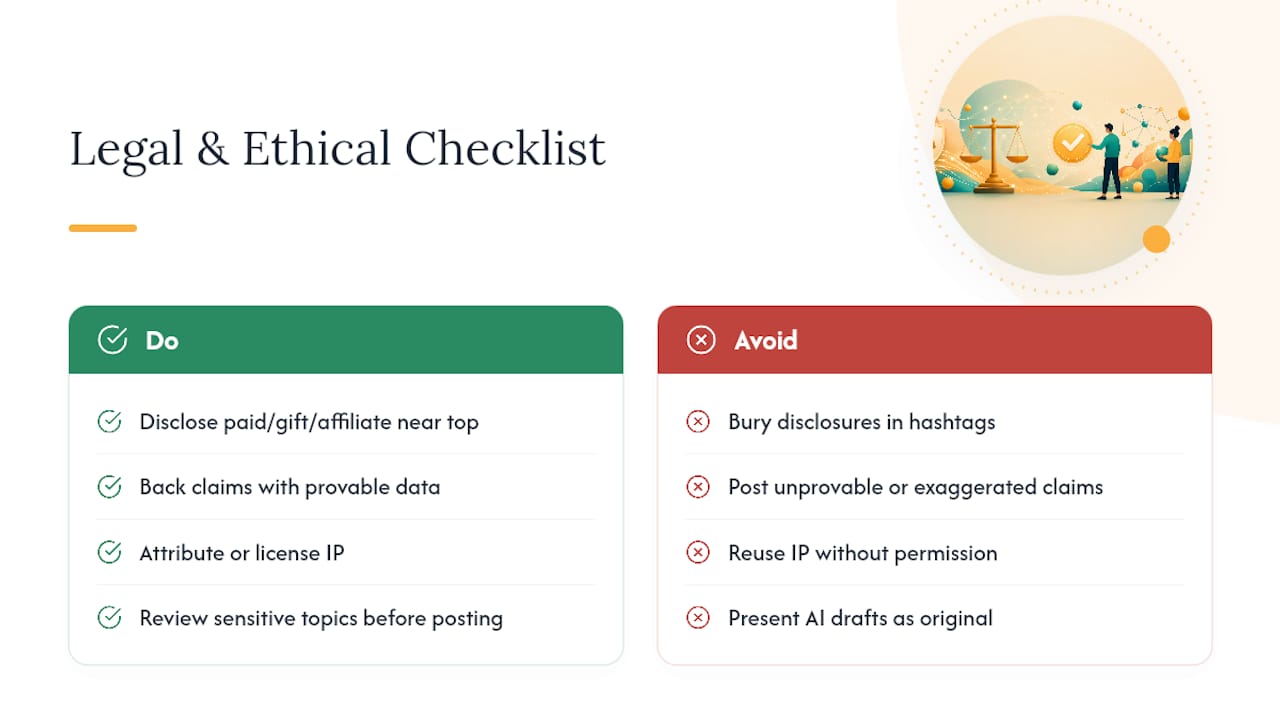
Disclosure isn’t optional when money or product changes hands. Any paid partnership, gifted product, or affiliate link needs a clear disclosure, not buried in hashtags at the bottom of a caption. The FTC in the United States requires disclosures to be clear and conspicuous, meaning “#ad” needs to sit near the top of the post, not after ten unrelated hashtags.
Claims about results need to be true and provable. If your copy says “doubled engagement in 30 days,” you need a real number behind that, not a rounded-up guess. This matters more in regulated categories like healthcare, finance, or legal services, where an exaggerated benefit claim can trigger real regulatory attention, not just a skeptical comment.
Respect intellectual property. Quoting a stat, reposting a graphic, or using a trending audio clip all carry attribution expectations, and “everyone does it” isn’t a defense if a rights’ holder objects.
Handle sensitive topics carefully. Health claims, financial promises, and anything touching protected characteristics (race, religion, disability) need extra scrutiny before you hit publish. A joke that reads fine internally can land very differently once it’s public and permanent.
Finally, be honest about AI use in your process. If a tool generated a draft you’re publishing largely unedited, that’s a different ethical position than using AI to brainstorm hooks you then rewrote entirely in your own voice. Readers increasingly notice the difference, and authenticity, not polish, is what builds trust over time.
What Mistakes Quietly Kill Social Media Copy?
The most common failure isn’t bad writing. It’s writing that tries to do too much at once.
Cramming three CTAs into one post is the fastest way to get zero action, because a confused reader clicks nothing. Burying the hook under a scene-setting intro loses the scroll before the value even appears; the first line has to earn the second one. Writing in a generic corporate voice erases the brand personality that makes a small business feel human on a feed full of polished, impersonal content.
Ignoring accessibility is another quiet killer. Posts using ALL CAPS, dense emoji strings, or hashtags jammed together without CamelCase formatting lose readers using screen readers entirely, and that’s a segment of your audience you never get feedback from, because they simply can’t parse the post.
Publishing without a proof moment is common and costly. A post that states a benefit but offers nothing to back it up reads like every other claim on the internet. And skipping measurement means repeating the same mistakes post after post, since without a primary metric and a test plan, you’re guessing at what worked and what didn’t.
One more: treating every platform identically. A caption written for LinkedIn’s professional tone rarely lands the same way on TikTok, and copy that ignores platform norms tends to read as out of place no matter how strong the underlying idea is.
How Do You Write Copy for Different Audience Segments?
A single post rarely speaks to everyone equally well, and trying to make it do so usually waters down the message until it speaks to no one.
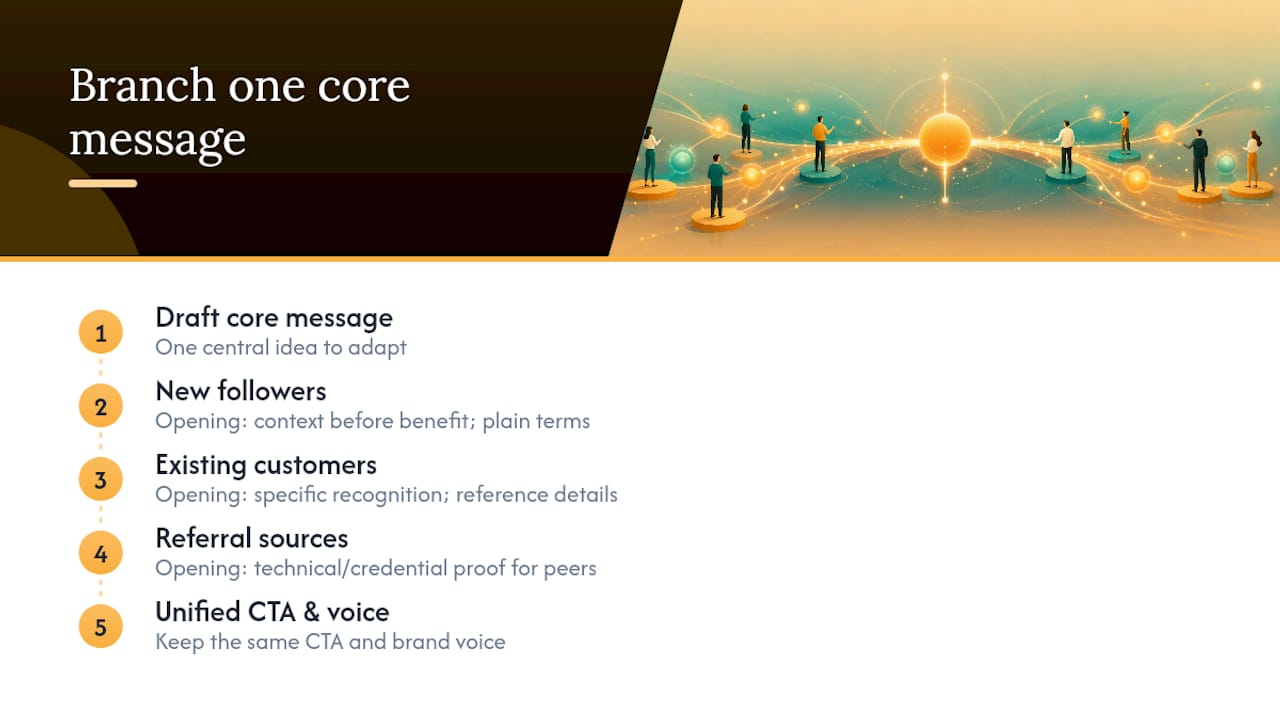
Start by separating your audience into two or three practical segments: new followers who don’t know your brand yet, existing customers deciding whether to return, and referral sources like partners or past clients who might mention you to someone else. Each group needs a different entry point into the same core message.
New followers need context before benefit. They haven’t seen your brand story, so the hook has to work harder to earn their attention, and the value beat should explain what you do in plain terms rather than assuming familiarity. Existing customers, by contrast, respond better to specificity and recognition. A post that references a detail only a returning customer would appreciate builds loyalty faster than a generic sales pitch.
Tone shifts matter too. A healthcare practice writing to anxious first-time patients needs a reassuring, plain-language voice with zero jargon. That same practice writing to referring physicians on LinkedIn can use more technical language and lean on credentials as proof. Retail brands often split similarly: casual, visual-first copy for a general Instagram audience, and more detail-driven copy for an email or LinkedIn audience researching a bigger purchase.
The practical move is to draft one core message, then rewrite the opening and proof moment for each segment while keeping the CTA consistent. That keeps your brand voice intact across every version while still meeting each reader where they actually are.
Why Do Certain Posts Feel Impossible to Scroll Past?
Psychology, not luck, explains why some posts stop a scroll and others vanish. Specific triggers show up again and again in copy that performs well, and understanding them helps you write with intention instead of guessing.
Utility is the strongest single driver. A post that teaches something concrete and immediately usable gets saved and shared far more than one that’s simply entertaining, because the reader has a reason to return to it later. Social currency plays a close second: people share content that makes them look informed, funny, or ahead of a trend to their own network. A stat-driven post (“most small businesses post inconsistently, here’s why that’s costing them”) gives someone a reason to repost it as their own insight.
Emotion rounds out the trio, and research on persuasive language and content spread shows that stacking these triggers together, rather than relying on just one, meaningfully increases how far content travels. A post that’s useful, makes the reader look sharp for sharing it, and carries a real emotional beat outperforms a post that only hits one of those three notes.
Specificity also does more work than most writers assume. “Increase engagement” is forgettable. “We doubled saves in 30 days using one caption change” gives the brain a concrete detail to latch onto, which is part of why numbers and named results consistently outperform vague promises in feed testing.
The SOL Social Media Approach to Copy That Performs
Every brief we write starts with one outcome, one reader, and a required proof moment, no exceptions, because posts without that proof consistently underdeliver on trust. We’ve seen firsthand how a single measurable result baked into a caption changes how a post performs against one that just states a claim. For small teams without a dedicated writer, the same discipline applies at a smaller scale: pick one metric, recycle your best performers on a set cadence, and protect the time to actually review results instead of just publishing and moving on. Real examples of this in practice, including how proof-driven briefs show up in measurable growth, are worth studying if you’re building this process from scratch.
— SOL Social Media
Ready for Copy That Actually Converts?
This service offers an alternative to guessing your way through a content calendar. Where most small businesses either write copy themselves between everything else on their plate or hand it to a generic content mill, SOL builds every post around a real human understanding of your brand voice, backed by the same proof-moment discipline covered above.
A typical engagement includes ongoing content creation, active audience engagement, and monthly measurement against the metrics that actually tie to your goals, not vanity numbers that look good but don’t move the business forward. That means real captions written in your voice, consistent posting instead of sporadic bursts, and a monthly review of what’s working so the next month’s content gets sharper, not just busier. Some small businesses tend to see faster turnaround once posting becomes consistent instead of reactive.
If your current social presence feels inconsistent or your engagement has plateaued, request a social media engagement audit and see exactly where your copy, your cadence, or your proof moments are falling short.
Sources
FAQ
What Is a Social Media Copywriter?
A social media copywriter writes short-form text for platforms like Instagram, LinkedIn, and X, built around a hook, a clear value statement, and a single call to action, tuned to each platform’s format and audience.
Is Copywriting Still Worth It in 2026?
Yes. As feeds get more crowded and algorithms reward saves, shares, and comments over passive views, sharp copy that earns real engagement matters more, not less, and it’s a skill that separates brands that grow from brands that stall out.
What Is the 80/20 Rule in Copywriting?
In social media copywriting, a common version of this rule holds that roughly 80% of a post’s impact comes from the hook and the first line, while the remaining copy simply supports the promise that opening line already made.
Will AI Replace Copywriters?
AI tools can speed up drafting and brainstorming, but they still lack the specific brand voice, real proof points, and audience context that make copy genuinely resonate. Brands that lean entirely on AI-generated captions without a human editing pass tend to sound interchangeable with every other AI-written post in the feed. That’s part of why SOL Social Media builds its process around real human writing informed by client-specific insight, not template output.
Recommended
Comments