


Small Business Social Media Strategy: A Step-by-Step Playbook

A small business social media strategy you can start this week comes down to five decisions: pick one primary platform, post 3–7 times per week, build three content pillars, reply to every comment and DM within 60 minutes during business hours, and measure outcomes that actually move your business (store visits, DM leads, phone calls) rather than follower counts. That structure, applied consistently, is what separates businesses that grow through social from those that post and wonder why nothing happens.
According to a January 2026 survey, 68% of small-business owners in select countries said social posting and paid ads would drive the most value for their business in 2026. The opportunity is real. The gap is execution.
Week 1 setup checklist:
Choose one primary platform based on where your customers already research
Write out three content pillars (what you do, your team/personality, and one industry tip category)
Set up a free scheduling tool and block two content creation hours on your calendar
Define one business-linked goal and its KPI (e.g., 10 DM leads per month)
Audit your existing profile: photo, bio, link, contact button
Week 2 routine checklist:
Batch your first 8–10 posts in a single sitting
Schedule posts for the next two weeks
Set a daily 30-minute reply window (morning or lunch works well)
Check your baseline metrics so you have a starting point to compare against
Timeline to expect:
Days 1–14: Profile polish, first posts live, baseline data collected
Days 15–45: Engagement signals appear (saves, shares, DM replies)
Days 45–90: Consistent traffic patterns and early lead signals
Days 90–120: Measurable leads, calls, or sales attributable to social
A clear, specific, and realistic social media plan is the right starting point. The steps below build that plan from scratch.
What does a strong small business social media strategy look like?
The first thing to get right is your goal, and most small businesses get it wrong. They aim for “more followers” or “better engagement” without connecting either to a dollar amount or a customer action. That disconnect is why social media feels like a time sink for so many owners.
Choose one primary, money-linked objective from this list:
Awareness: New people discover your business (measure: reach, profile visits)
Leads: People contact you or visit your site (measure: DMs, link clicks, form fills)
Sales: Direct purchases or bookings (measure: conversions, promo code redemptions)
Retention: Existing customers stay engaged and return (measure: repeat DM interactions, repeat purchases)
Once you pick one, assign a single KPI to it. Two formulas worth knowing:
Engagement rate = total engagements ÷ reach × 100
Click-through rate (CTR) = link clicks ÷ impressions × 100
A realistic goal for a new account might be: “Generate 15 DM inquiries per month within 90 days.” That is timebound, measurable, and tied to revenue. Practical playbooks consistently recommend setting money-linked goals as the foundation before touching content or platforms.
Goal-setting checklist:
One primary objective with a specific number and deadline
One KPI that maps directly to that objective
A baseline measurement taken before you post anything
A reporting cadence (weekly 10-minute check, monthly 30-minute review)
A budget note: organic-only costs time; paid amplification starts working at $5–$10/day per boosted post
Which platforms should you actually use?
Pick one primary platform where your customer already researches, and add a second only after the first is producing consistent results. Depth beats breadth when you have limited time and budget.
A useful mental model from current strategy frameworks: pair one discovery platform (short-form video or Pinterest) with one relationship platform (LinkedIn, Facebook Groups, or a community forum). Discovery brings new eyes; the relationship platform converts them.
Platform | Best for | Top formats | Recommended cadence | Paid vs. organic | Time/cost to maintain |
Local service businesses, 30–65 audience, community-driven brands | Photos, short video, events, Stories | 4–5x/week | Strong paid ecosystem; organic reach is limited without boosting | Medium; $50–$200/mo in tools + time | |
Visual products, lifestyle, food, beauty, home services | Reels, carousels, Stories, static posts | 3–7 times per week | Reels get organic reach; paid scales well | Medium-high; Reels require more production | |
TikTok | Younger audiences, entertainment-first content, trend-driven niches | Short-form video (15–60 sec), Duets, Lives | 5–7x/week | Organic reach still high; paid growing | High; video-first is time-intensive |
B2B, professional services, hiring, thought leadership | Text posts, carousels, articles, short video | 3–5x/week | Expensive CPCs; organic strong for niche B2B | Low-medium; text-heavy, less production | |
Home, food, fashion, wellness, DIY, wedding | Static Pins, Idea Pins, video Pins | 5–10x/week | Low-cost paid; long content shelf life | Low; evergreen content recycles well | |
X (Twitter) | News commentary, tech, media, real-time events | Short text, threads, polls, links | 5–7x/week | Declining organic reach; paid niche | Low production; high time for engagement |
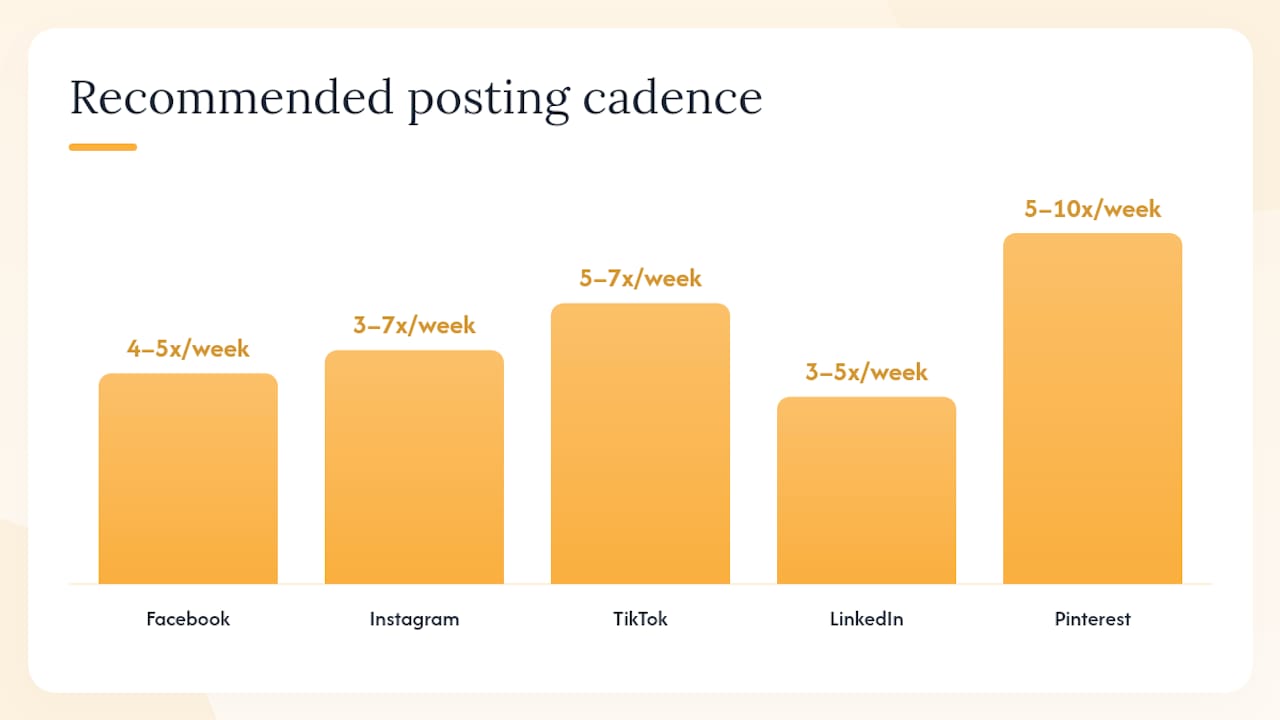
Facebook’s scale makes it the default starting point for most local service businesses. For product-based businesses with strong visuals, Instagram or Pinterest often outperforms. For B2B or professional services, LinkedIn is the clear first choice.
How do you build a content plan that actually works?
Three core pillars cover most of what small businesses need to post:
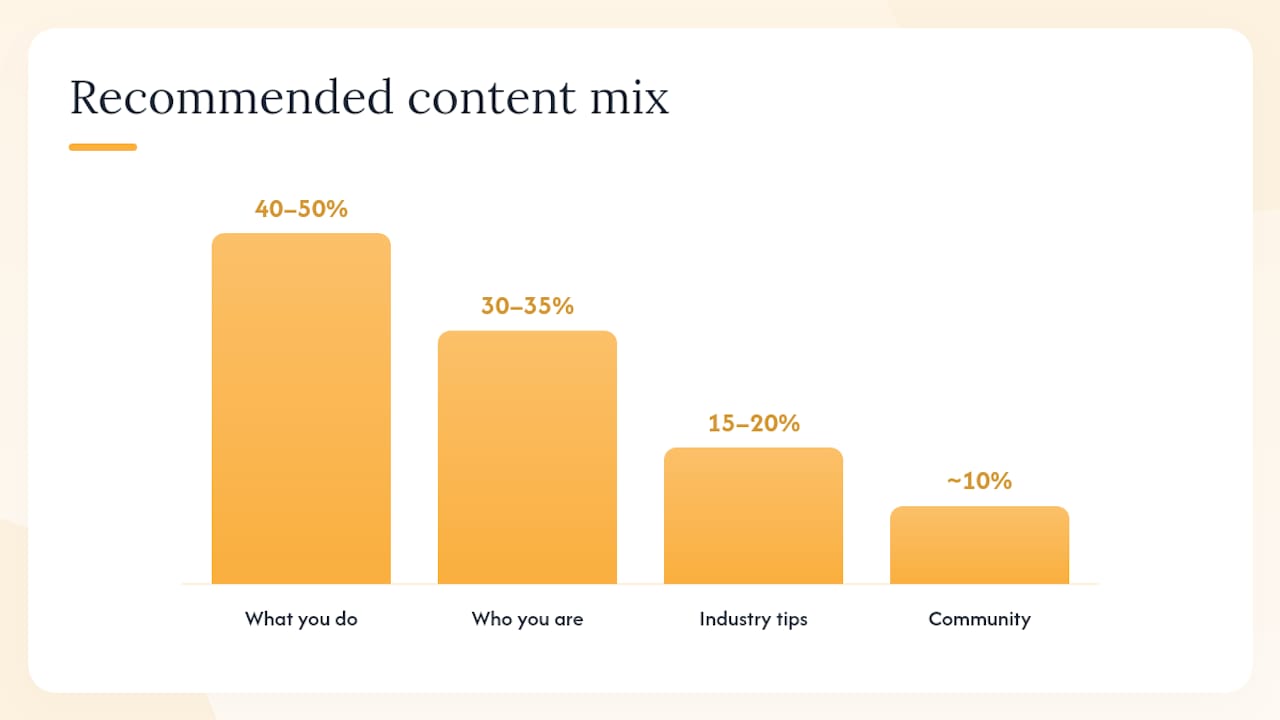
What you do (services, products, results, before/after): 40–50% of content
Who you are (owner story, team moments, behind-the-scenes): 30–35% of content
Industry tips (education, how-to, myth-busting): 15–20% of content
Add a small community pillar (local events, customer spotlights, shared causes) at around 10% when you have the material. This mix roughly mirrors the 50/30/20 rule many practitioners teach: 50% educational or entertaining, 30% brand/personality, 20% promotional.
Every post, regardless of format, benefits from a Hook–Value–CTA structure:
Hook: The first line or first frame stops the scroll. Ask a question, state a surprising fact, or show the result before the process.
Value: Deliver the useful thing (the tip, the transformation, the story).
CTA: Tell people what to do next. “Comment below,” “DM us for a quote,” “Link in bio.”
For phone-shot content, three visual habits make a real difference:
Shoot near a window for natural light; avoid overhead fluorescents
Keep backgrounds clean or intentionally branded (a consistent color, a logo mug, a recognizable workspace)
Use captions and text overlays on video so content works with sound off
Pro Tip: Batch 8–10 posts in a single two-hour session every two weeks. You will produce better content when you are in a creative flow than when you are scrambling to post something at 8 AM on a Tuesday.
For format-specific ideas, 10 game-changing content formats for small businesses covers practical templates you can adapt immediately.
How do you set up a content calendar you will actually stick to?
The calendar is not the strategy. It is the system that keeps the strategy alive when you are busy. A simple template is all you need:
Column | What goes there |
Publish date | Exact day and time |
Platform | Which channel |
Format | Reel, carousel, static, Story |
Pillar | Which of your three pillars |
Caption draft | Full text or key talking points |
CTA | The specific ask in the post |
Status | Draft / Scheduled / Live |
Recommended weekly workflow:
Monday (content creation, 90 min): Film or photograph the week’s visual content in one session
Tuesday (writing, 45 min): Write captions, add hashtags, finalize CTAs
Wednesday (scheduling, 30 min): Load everything into your scheduling tool and confirm publish times
Daily (reply window, 20–30 min): Check comments and DMs, respond within the same business day
Free and low-cost scheduling tools that work well for small businesses include Meta Business Suite (free for Facebook and Instagram), Later, and Buffer. Each lets you draft, preview, and schedule posts without switching between apps.
For a deeper look at calendar setup and batching, this content calendar guide walks through the template in more detail.
Time budget to expect:
Owner-led, minimal: 5–7 hours/week
Owner-led with batching: 3–4 hours/week
Freelance support added: 1–2 hours/week for oversight
Full agency management: under 1 hour/week for approvals
When social starts generating leads but you cannot keep up with the content load, that is the signal to hire help.
How should you handle community engagement and customer interactions?
Reply discipline is one of the highest-leverage habits in social media, and most small businesses underinvest in it. Responding to comments and DMs within 60 minutes during business hours keeps algorithmic momentum and builds the kind of trust that converts browsers into buyers.
Engagement checklist:
Assign one person (you or a team member) as the daily reply owner
Set two reply windows: once in the morning and once mid-afternoon
Respond to every comment with at least a sentence, not just an emoji
Move booking or pricing conversations from comments to DMs immediately
Flag negative feedback for a same-day response; never delete unless it violates your policy
Short response templates:
Thank-you: “Thank you so much, [name]! We’re really glad you had a great experience. We’d love to see you again soon.”
Booking request: “We’d love to help! We’ll send you a DM right now with availability and next steps.”
Negative feedback: “We’re sorry to hear this wasn’t the experience we aim for. We’d like to make it right. Can we connect in DMs?”
On automation: quick auto-replies for DMs outside business hours are fine (“Thanks for reaching out! We’ll respond by [time].”). Full chatbot responses for substantive questions tend to feel impersonal and can damage trust. Reserve automation for acknowledgment only; keep the real conversation human.
Pro Tip: Turn your best comment threads into content. A customer who asks a great question in the comments is telling you exactly what your next educational post should be.
For more social media engagement tactics that build community without burning you out, that resource covers the practical side in detail.
Key Takeaways
A focused small business social media strategy built on one platform, three content pillars, and outcome-based measurement consistently outperforms a scattered presence across five channels.
Point | Details |
Start with one platform | Pick the platform where your customers already research; add a second only after the first produces results. |
Set a money-linked goal | Define one KPI tied to leads, sales, or retention with a 90-day deadline before you post anything. |
Batch and schedule content | A biweekly two-hour batching session produces more consistent content than daily improvisation. |
Measure business outcomes | Track DM leads, phone calls, and store visits monthly, not just follower count or likes. |
SOL Social Media | SOL Social Media applies this full framework for small business clients, from strategy and content creation to daily engagement and monthly reporting. |
What most social media advice gets wrong
The conventional wisdom says to “be on every platform” and “post consistently.” Both are true in isolation and destructive in combination for a small business owner with a real job to run. Spreading yourself across Facebook, Instagram, TikTok, LinkedIn, and Pinterest simultaneously does not multiply your reach. It multiplies your workload while diluting the quality of everything you produce.
The businesses SOL Social Media sees grow fastest are the ones that commit to one platform long enough to understand its algorithm, its audience, and what content format their specific customers respond to. That usually takes 60–90 days of focused effort. Only after that foundation is solid does adding a second channel make sense.
There is also a quieter mistake worth naming: treating social media as a broadcast channel rather than a conversation. The reply window, the DM follow-up, the comment that turns into a booking call, these are where the real return on social investment lives. A post that gets 200 impressions and generates three DM leads is worth more than a post that gets 2,000 impressions and generates none. Build the habit of measuring that distinction from day one, and your strategy will compound in ways that follower-count-focused accounts never do.
SOL Social Media can build and run this strategy for you
Running a business and managing social media simultaneously is genuinely hard. SOL Social Media exists specifically for small business owners who want a real strategy, real content, and real results without adding 10 hours a week to their plate.
SOL Social Media’s services cover every layer of this guide: social media strategy and audits, content creation with human copywriting (no generic AI filler), daily community engagement, live event coverage, monthly content planning, and one-on-one training for owners or teams who want to manage their own accounts. The difference is a personalized approach built around your business goals, your voice, and your customers, not a recycled template.
Whether you need full management or a one-time strategy session to get your plan in place, the next step is a consultation. Visit SOL Social Media’s engagement services page to see what a managed program looks like, or reach out directly to book a strategy call and get a clear picture of what your social presence could look like in 90 days.
Useful sources and further reading
FAQ
What is the 50/30/20 rule for social media?
The 50/30/20 rule is a content-mix guideline: 50% of posts educate or entertain, 30% reflect your brand personality or behind-the-scenes content, and 20% are directly promotional. It keeps your feed from feeling like a constant sales pitch.
What is the 5-3-2 rule on social media?
The 5-3-2 rule suggests that for every 10 posts, five should be curated or educational content from others, three should be original content from your brand, and two should be personal or conversational posts. It is a quick framework for balancing value and promotion.
How many posts per week should a small business aim for?
A consistent rhythm of 3–7 posts per week on one primary platform outperforms sporadic posting across multiple channels. Engagement signals typically appear within 30–45 days of maintaining that cadence.
What is the 5-5-5 rule for social media?
The 5-5-5 rule is not a single standardized framework; definitions vary across practitioners. A common version suggests engaging with five accounts, commenting on five posts, and sharing five pieces of content daily to build community reach organically.
When should a small business hire help for social media?
When social media starts generating leads but you cannot keep up with content creation or reply discipline, that is the clearest signal to bring in support. SOL Social Media offers both full management and training options so you can choose the level of involvement that fits your business.
Recommended
Comments