


Real-Time Social Media Monitoring: A Practical Playbook

Real-time social media monitoring is the continuous tracking of mentions, sentiment, and engagement as they happen, rather than in a weekly or monthly report. Done right, it delivers three outcomes fast: earlier crisis detection, sharper campaign optimization, and quicker customer care. None of that happens without four working parts: data ingestion, message classification, alerting, and a team workflow that turns an alert into an action.
Crisis detection: catch a spike in negative mentions before it becomes a news story.
Campaign optimization: adjust spend or creative while a launch is still live.
Customer care: answer questions and complaints inside the window people expect.
This complements periodic social listening reports rather than replacing them. You still need the monthly synthesis. You just can’t wait for it when something is happening right now.
Key Takeaways
Real-time social media monitoring only creates business value when a validated signal reaches a named owner inside a platform-appropriate response window.
Point | Details |
Watch the right metrics live | Track mention volume, sentiment ratio, and engagement velocity continuously; check share of voice periodically. |
Validate before you escalate | Require a repeat signal across two time windows or two platforms before acting on a spike. |
Set platform-specific SLAs | Aim for a response within one hour during business hours as a baseline, tighter on X and TikTok. |
Diversify your data sources | Relying on a single platform creates coverage bias; blend multiple sources for accurate intelligence. |
Get workflow support from SOL Social Media | SOL Social Media builds pre-approved response templates and quick-approval workflows for small teams managing live engagement. |
What Are the Benefits of Real-Time Social Media Monitoring?
Real-time social engagement pays off in five distinct ways, and each one connects to a metric you can watch on a live dashboard instead of a Friday report.
Crisis detection — a sudden jump in negative sentiment or complaint volume around your brand name.
Campaign optimization — engagement velocity on a new post tells you within hours, not weeks, whether the creative is working.
Customer service — a support question buried in comments gets answered before the customer gives up and posts somewhere louder.
Trend participation — catching a relevant conversation early enough to join it, not just watch it.
Competitive intelligence — noticing a competitor’s product complaint or launch stumble while it’s still fresh enough to act on.
The metrics worth watching live are mention volume, sentiment ratio, engagement velocity, share of voice, response time, and influencer mentions. Mention volume and sentiment ratio need continuous tracking because they’re your early-warning system: a spike in either one is often the first sign something needs attention today, not next week. Engagement velocity and response time matter most during active campaigns or live events, when speed itself is the product.
Share of voice and influencer mentions are useful daily but rarely demand second-by-second tracking; a periodic check usually catches what matters. Real-time marketing tends to produce meaningfully higher engagement in the first 24 hours when response times meet platform-specific windows, which is exactly why velocity and response time deserve the tightest monitoring loop of the group.
How Do You Avoid False Positives in Real-Time Sentiment Analysis?
Automated sentiment scoring struggles inside short time windows. Sarcasm, regional slang, and a single viral joke can all skew a sentiment score in minutes, and a tool reading text in isolation has no way to know the difference between real anger and a meme.
Build validation into the process before anyone reacts:
Require a repeat signal across at least two time windows before escalating, not just one spike.
Cross-check the same story appears on more than one platform before assuming it’s real momentum.
Use boolean queries to strip out unrelated homonyms and brand-name collisions.
Weight mentions from verified or high-follower accounts differently than anonymous ones.
Apply metadata filters (language, location, account age) to cut bot noise before it reaches a human.
Platform coverage bias compounds the problem. Heavy reliance on a single source creates blind spots, and combining multiple platforms beyond one dominant source produces a far more accurate read of what’s actually happening.
Pro Tip: Set a two-strike rule: a signal needs to reappear in a second scan or a second platform before it triggers anything beyond a Slack notification. This alone eliminates most false alarms.
What Tools and Architecture Do You Need for Near-Real-Time Tracking?
You don’t need enterprise infrastructure to run this well, but you do need the right categories of capability working together. Think of it as five layers, not five products:
Listening layer: captures mentions, keywords, and hashtags across platforms.
Streaming ingestion: pulls that data in continuously rather than on a batch schedule.
Analytics engine: applies sentiment scoring, trend detection, and classification.
Dashboard layer: visualizes what’s happening for both operational and executive audiences.
Alerting and routing: pushes the right signal to the right person at the right threshold.
Academic research on high-volume social media analysis confirms that interactive, visual systems are necessary once volume climbs past what a single analyst can scan manually. Integration issues show up fast at scale: platform APIs cap request volume and often sample rather than deliver full data, which means your “real-time” feed may be missing a meaningful slice of the conversation. Historical context also matters. A spike means little without a baseline to compare it against.
When evaluating a build or a vendor, require these capabilities at minimum: latency under a few minutes, automated classification with a manual override, coverage across more than one platform, configurable alert thresholds, and native integration paths into your existing marketing stack. A dedicated comparison of analytics tools can help you weigh options without locking into the first platform you demo.
What Are the Best Team Workflows and SLA Targets for Live Social Media?
Speed without ownership creates chaos. Every incoming signal needs a named owner before it needs a response.
Assign signal owners. Route customer complaints to support, brand-reputation spikes to PR, and product feedback to product marketing. One person per category should be the directly responsible individual (DRI) during business hours.
Pre-approve response templates. A library of vetted response language for common scenarios, apologies, refund language, “we’re looking into it” holding statements, let a community manager act on manager-level signoff instead of waiting on full legal review.
Set platform-differentiated SLAs. X and TikTok move fastest and need the tightest windows; LinkedIn and Facebook allow more breathing room. As a baseline, enterprise best practice targets responding promptly during business hours to materially impact customer satisfaction to meaningfully affect customer satisfaction.
Escalate on clear triggers. A repeat-confirmed spike (see the two-strike rule above) that touches safety, legal exposure, or a public figure skips the queue and goes straight to a human decision maker.
Run postmortems. After any real incident, log what the signal looked like, how fast the team responded, and whether the SLA held. Use that baseline to tighten the next one.
Pro Tip: Keep your escalation path to three steps or fewer: flag, confirm, act. Every extra approval layer you add is another hour a fast-moving story gets to spread before you respond.
How Should You Visualize Live Social Media Data for Stakeholders?
Operational teams and executives need different views of the same data, and conflating them is a common mistake. A community manager needs a live feed with filters and one-click drill-down. An executive needs a weekly trendline with three or four numbers that map straight to business outcomes.
Use velocity charts to show how fast a conversation is growing, not just how big it currently is.
Annotate spikes with provenance, what caused it, which platform, what time, so a stakeholder six months from now can understand the context without asking.
Track a sentiment trendline over weeks, not hours, for the executive view, since hour-to-hour noise means little at that altitude.
Automate the routine actions (routing, tagging, first-response templates) so human attention goes to judgment calls, not repetitive triage.
The through-line from live signal to strategy is a monthly synthesis: someone has to translate a week of spikes and mentions into three sentences an executive can act on. Visual analysis research backs this up. Interactive visual systems consistently outperform raw data tables at helping people spot patterns across high-volume streams, which is exactly what a monthly rollup needs to do.
What Are the Real Limits of Real-Time Social Media Data?
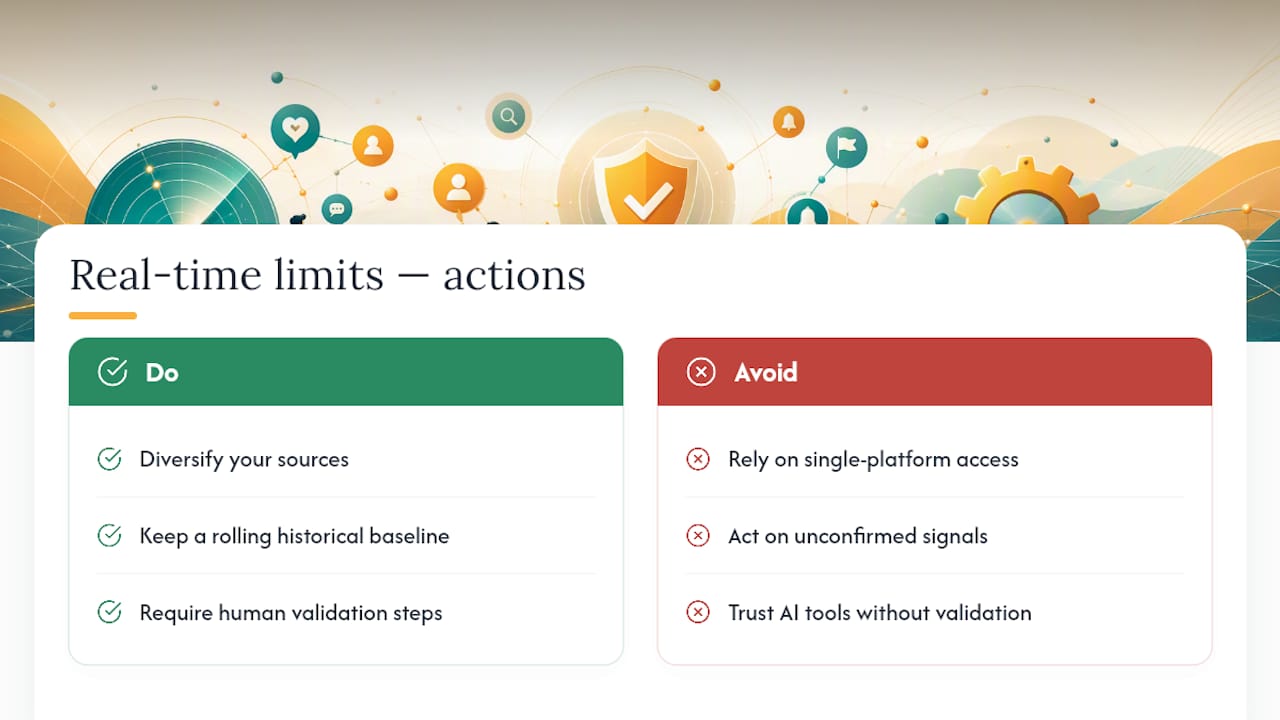
Every real-time monitoring setup runs into the same three walls: platform access, coverage bias, and tool reliability. Platform APIs restrict volume and frequently sample data instead of delivering the full firehose, which skews results toward whichever platform gives you the most generous access rather than whichever platform your audience actually uses.
Trust in the tools themselves is a live problem too. Marketers report deep skepticism about whether their AI tools actually surface real-time activity accurately, and a majority say campaigns have launched after a trend window already closed because a tool didn’t deliver signals fast enough. Feeding real-time listening into strategic decisions helps teams move faster, but it also brings organizational friction. Data overload and siloed teams are common obstacles when integrating social listening into decision cycles.
“Only 28% of marketers trust their AI tools to accurately surface real-time social activity, and 59% say campaigns have launched after the relevant trend window closed.” That gap between promise and delivery is the single biggest reason teams need human validation steps, not just faster software.
Diversify your sources, keep a rolling historical baseline for comparison, and never let a high-risk response go out on an unconfirmed signal.
How Do You Connect Real-Time Social Data to CRM and Analytics Platforms?
A mention or complaint that lives only inside your social dashboard is a missed opportunity. The real value shows up when that signal flows into your CRM, so a customer who complains on X shows up with full context the next time they call support, and into your broader analytics platform, so social sentiment sits next to revenue and traffic data instead of in its own silo.

Practically, this means routing flagged mentions into your CRM as tickets or contact notes, tagging them by product line or issue type so patterns become visible over time. It also means piping aggregate metrics like sentiment ratio and mention volume into whatever dashboard your leadership already uses for revenue and marketing reporting, so social data gets weighed alongside the numbers that drive budget decisions instead of living in a separate report nobody opens.
The technical lift varies by company size. Some teams manage this with native integrations built into their social analytics platform; others rely on middleware or a marketing operations specialist to map fields correctly. Either way, the goal is the same: a support rep, a salesperson, and an executive should all be able to see the same customer’s social history without switching tools. Automating routine parts of this handoff, flagging, tagging, first assignment, is one of the highest-leverage places small teams can apply automation, since it removes manual copy-paste work that eats hours every week.
SOL Social Media’s Approach for Small Businesses
We build pre-approved response templates and quick-approval workflows so small teams move fast without a legal bottleneck. Our live event coverage and hands-on training sessions give business owners the same speed advantage larger brands pay agencies for.
Ready to Put Real-Time Monitoring to Work?
Most small businesses don’t need a full listening platform and a data analyst on staff. They need a team that already knows how to spot a signal, route it correctly, and respond inside the window customers expect, without spending a fortune building that infrastructure from scratch.
SOL Social Media builds exactly this for small businesses: content creation, live event coverage, and the response workflows this article walks through, sized for teams that don’t have an in-house analyst. We also run customized training sessions for owners and staff who want to manage this in-house but need the frameworks to do it well. If you want an outside read on how your current setup handles a real spike, request a social media audit and see exactly where your response gaps are. For businesses whose real-time strategy includes local events and community moments, our community involvement work shows what live coverage looks like in practice. Book a consultation and get a workflow built around your actual response capacity, not a generic template.
Sources
FAQ
What Are the Top 3 Most Used Social Media Platforms?
Facebook, YouTube, and Instagram consistently rank among the most used platforms globally, though X and TikTok generate the fastest-moving real-time conversations that monitoring teams need to watch closest.
What Is the 5-3-1 Rule on Social Media?
The 5-3-1 rule is a content-mix guideline suggesting you share 5 pieces of curated content, 3 original posts, and 1 promotional post within a given posting cycle to keep your feed balanced.
What Are the 7 Types of Social Media?
Common categories include social networking (Facebook), microblogging (X), photo sharing (Instagram), video sharing (YouTube, TikTok), professional networking (LinkedIn), discussion forums (Reddit), and messaging apps (WhatsApp).
What Are Real-Time Social Media Examples?
Examples include live tweeting during a breaking news event, a brand jumping into a trending hashtag within hours of it forming, and a support team resolving a customer complaint on X within the same hour it was posted.
How Fast Should a Business Respond to Social Media Mentions?
Enterprise best practice sets a target of within one hour during business hours, though fast-moving platforms like X and TikTok often demand quicker turnaround than LinkedIn or Facebook.
Recommended
Comments