


U.S. Practices: 4 Step Patient Photo Consent Checklist for Social Media

Most patient photos posted for promotional purposes on social media require a written HIPAA authorization under 45 CFR §164.508, while photos tied strictly to treatment or care coordination usually do not. Before you post anything with an identifiable patient in it, classify the post as marketing or treatment, secure a written authorization naming the exact image, channels, and revocation method when it’s marketing, and log that authorization somewhere retrievable. Consult HHS’s marketing guidance, the regulation itself, and AMA ethics guidance before your next post goes live.
TL;DR:
Marketing posts with patient photos require a specific, written HIPAA authorization that clearly describes the image, platforms, and revocation process.
The authorization must include details such as the exact image, targeted channels, an expiration date, and plain-language revocation instructions.
A patient revocation mandates immediate removal of the content, thorough documentation, and checking for reshares or cached copies that are harder to delete.
Photos taken during treatment or shared in clinical documentation do not generally need authorization, but promotional captions like “Ask us how we did this” do.
Staff should follow a strict workflow: classify posts, obtain and store consent before posting, and verify consent during audits, especially for vulnerable patients or sensitive scenarios.
Before You Post: A Step-by-Step Consent Checklist
Every practice needs a repeatable routine for vetting a photo before it goes anywhere near a social feed. Skipping steps here is how well-meaning front-desk staff turn a nice patient photo into a HIPAA complaint.
Start with the marketing test. A photo crosses into marketing territory when the caption encourages someone to book, buy, or try a service. Phrases like “book your consult today,” a before-and-after transformation with a call-to-action, or a testimonial promoting a specific treatment all push the post into marketing, which triggers the authorization requirement.
Classify the post. Ask whether the primary purpose is promotional. If yes, treat it as marketing under HIPAA.
Draft or pull a written authorization naming the specific image, the exact platforms it will run on, and how the patient can revoke consent.
Route it for approval. One designated person, usually a practice manager or compliance lead, signs off before anything publishes.
File the signed form in a secure, searchable location tied to the image file itself, not a general folder.
Every authorization needs a few non-negotiable fields:
A specific description of the photo or video (not “any photos taken during my visit”)
The named platforms and pages where it will appear
An expiration date and clear revocation instructions
A signature line and date
If a patient revokes permission, pull the post immediately, note the time and platform in the patient’s file, and check whether the image has been reshared or cached elsewhere. Our guide to HIPAA social media guidelines walks through this in more operational detail.
The Legal Ground Rules: HIPAA, 45 CFR §164.508, and FTC Disclosures
HIPAA’s marketing rule is the piece most practices misunderstand. HHS defines marketing broadly: any communication that encourages someone to purchase or use a product or service generally counts, and identifiable photos used that way require prior written authorization except in narrow situations. A photo shared purely to document treatment progress in a clinical chart is different from that same photo captioned “Ask us how we did this.”
45 CFR §164.508 sets the bar for what a valid authorization must contain. The regulation isn’t vague about this. A compliant authorization needs:
A specific, non-generic description of the information or image being used
The identity of who is authorized to make the disclosure and who may receive it
A clear statement of the purpose
An expiration date or event
The patient’s signature and date
Plain language the average patient can actually understand
A statement disclosing remuneration, if any third party is paying for the endorsement
The exceptions are narrower than most staff assume. Face-to-face communications between a provider and patient don’t require authorization, and neither do nominal promotional gifts. Treatment-related communications, like a reminder about a follow-up appointment, also fall outside the marketing definition. But these exceptions do not extend to a polished social post crafted to attract new patients.
FTC rules add another layer once a testimonial or endorsement is involved. If a patient’s photo appears alongside praise for your practice, and there’s any compensation, discount, or perk involved, the post needs a clear and conspicuous disclosure. A hidden hashtag buried at the end of a caption doesn’t meet that bar on every platform.
Drafting a Compliant Photo Authorization That Holds Up
A weak authorization is often worse than none at all, because it creates a false sense of security. The fix is specificity, not length.
Every authorization form should include:
A description of the exact photo or video, ideally referencing a file name or date
The specific channels where it will run (Instagram, Facebook, the practice website, partner pages)
Named recipients if the content will be shared with a marketing vendor or agency
An expiration date, even if it’s simply “one year from signature”
Plain-language revocation instructions the patient can follow without calling a lawyer
A signature and date line, plus a witness line if your practice requires one
Sample language for a standard marketing post might read: “I authorize [Practice Name] to use my photograph on its Instagram and Facebook pages and website for promotional purposes until [date], and I understand I may revoke this authorization at any time by notifying [contact].” For a testimonial with no compensation, add a line confirming no payment or discount was exchanged. When there is compensation, state it plainly: “I received [description of benefit] in exchange for this testimonial.”
Pro Tip: Never bundle photo consent with your general treatment consent form. A compound consent buried on page four of an intake packet almost never meets the specificity standard 45 CFR §164.508 demands, and it’s the first thing an investigator will flag.
The most common drafting mistake is overbroad permission. “Use my image for any purpose” fails the specificity requirement outright. Name the purpose, name the channels, and give the patient a real way out.
Turning Consent Into a Daily Workflow
Getting a signature is only half the job. Most compliance failures happen after the form is signed, when nobody links the authorization to the actual image file or forgets to check it during an audit.
Ask at the right moment. Request authorization at check-in for planned marketing photos, or immediately after a procedure if the image is spontaneous. Whoever captures the photo should confirm consent exists before it leaves the building digitally.
Store it securely and link it to the file. Keep the signed authorization in a secure document system, referencing the specific image file name or ID, rather than a loose EHR note that’s hard to cross-reference later.
Handle revocation immediately. Remove the post from every platform it appeared on, document the removal time, and note in the patient’s record that the image may still exist in third-party reshares or cached versions you can’t fully control.
Keep an audit trail. A simple log tracking the image ID, authorization document, signer, approver, and publish date gives you something concrete to show if HHS ever asks questions.
Pro Tip: A HIPAA-compliant check-in process makes this whole workflow easier because consent capture happens at a predictable point every time, rather than as an afterthought after the photo’s already taken. Some practices integrate consent verification into check-in so nothing slips through.
Special Cases That Deserve Extra Caution
A few scenarios carry higher risk than a routine marketing photo, and they deserve a slower, more deliberate process.
Minors need a parent or guardian signature, and older minors often benefit from an assent conversation even though it’s not always legally required. Some states layer additional consent rules on top of HIPAA, so check your state’s specific requirements before publishing.
Incapacitated patients present a harder call. If there’s no clear decision-maker or the capacity to consent is in question, the safest move is to not post until that’s resolved.
Public events and unique identifiers make de-identification unreliable. A local health fair photo, a distinctive tattoo, or a recognizable landmark in the background can re-identify someone even without a name attached, a point AMA ethics guidance raises directly.
Before-and-after photos are marketing by nature. They need explicit marketing authorization, not a generic treatment consent, and should carry a clear disclosure about what the image represents.
Platform Rules and Everyday Posting Discipline
Treat “de-identified” as a starting point, not a guarantee. Context often does the re-identifying for you, and ethics guidance on pathology image sharing makes the same point: a de-identified case can still be traceable once it’s combined with other details in a caption or comment thread. When there’s any doubt, get explicit authorization instead of relying on cropping or blurring.
Where you place a disclosure matters as much as whether you include one. FTC guidance points toward disclosures that are hard to miss: in the caption itself, as a visual overlay on the image, or spoken at the start of a video rather than buried in a description box. If a post gets shared across multiple platforms, that disclosure needs to travel with it every time, not just on the original post.
Prohibit staff from posting identifiable patient content from personal accounts without approval
Require every patient-related post to clear a single designated approver first
Build a written employee social media policy that spells out what’s off-limits
When a revocation comes in, check for reposts, screenshots, and third-party shares, and document what you couldn’t remove
Testimonial posts deserve their own layer of scrutiny. Our guide on testimonials in social media covers formatting disclosures correctly, which matters more once a patient’s face is attached to the claim.
What We See Go Wrong (and How Small Practices Fix It Fast)
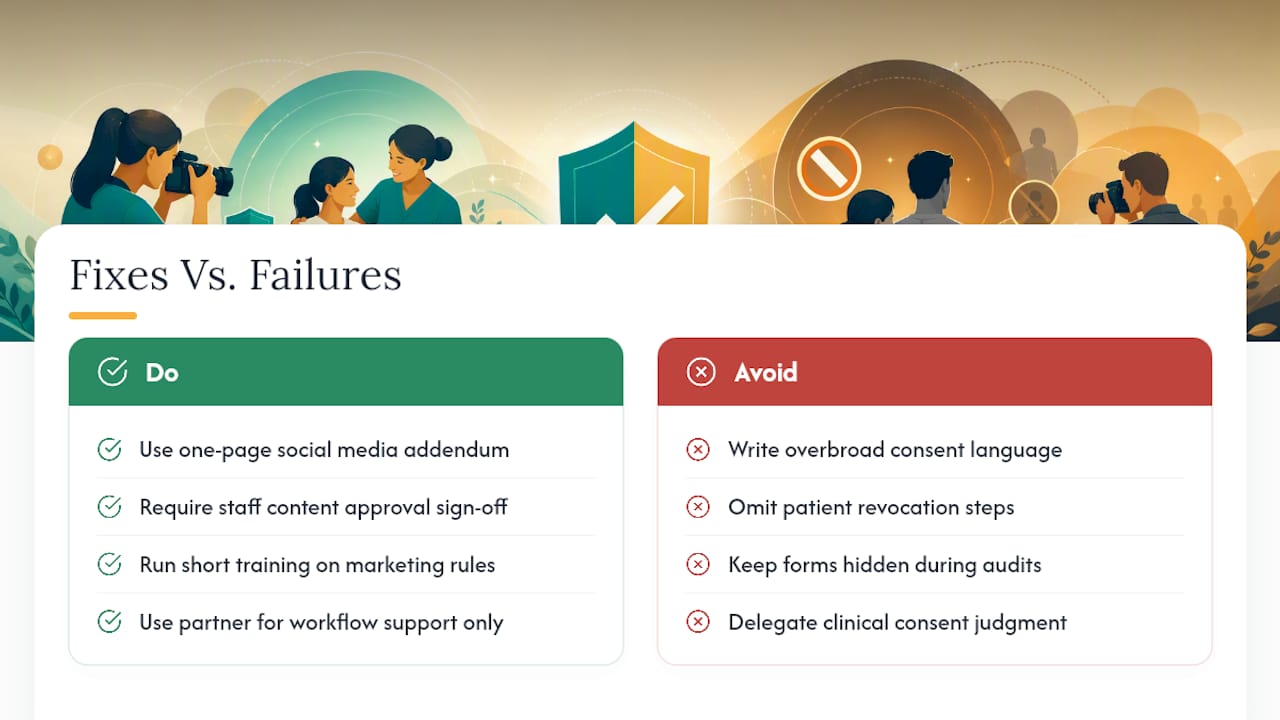
The gap between having a consent form and having a working consent system is where most practices actually get into trouble. Overbroad language, missing revocation steps, and forms nobody can find during an audit show up constantly.
The fix rarely requires a legal overhaul. A one-page consent addendum specific to social media, a content approval checklist a designated staff member signs off on, and a short training session on what counts as marketing close most of the gap within weeks. A social media partner can help build that approval workflow and keep content consistent, but the clinical judgment about what a patient actually consented to has to stay with the practice.
— SOL Social Media
How SOL Social Media Helps Practices Post With Confidence
SOL Social Media works with healthcare practices to build the systems this article just walked through: content approval checklists, consent-aware posting calendars, and staff training that keeps everyone clear on what needs sign-off before it goes live.
A typical engagement starts with an audit of your current posting habits, then moves into a workflow with clear approval steps, templated language your team can reuse, and training so staff understand the difference between a treatment update and a marketing post. For practices that want content created with real human copywriting instead of generic templates, that structure makes the difference between consistent, compliant posting and constant second-guessing. Visit SOL Social Media’s social strategy services to get a workflow built around how your practice actually operates.
This article is general information, not a substitute for advice from a qualified lawyer. Consult a qualified legal professional about your own circumstances before acting on anything here.
Sources
FAQ
Is It Illegal to Post Photos of Patients Without Consent?
Posting identifiable patient photos for marketing purposes without written authorization violates HIPAA’s marketing rule, and it can also expose a practice to state privacy claims depending on jurisdiction.
Can You Photograph Patients Without Their Consent?
Taking a photo generally requires the same consent standard as using it. Practices should get authorization before capturing marketing images, not just before publishing them.
Is It a HIPAA Violation to Look Up a Patient on Facebook?
Looking up a patient’s personal social media account isn’t a HIPAA violation by itself, since HIPAA governs a covered entity’s use of protected health information, not casual browsing. It becomes a problem if staff access, screenshot, or share information from that lookup in a way that discloses PHI.
Do I Need Separate Consent for Each Platform I Post To?
The authorization should name every platform where the image will run. A form that only mentions Instagram doesn’t automatically cover a repost on Facebook or the practice website.
What Happens If a Patient Revokes Consent After a Post Goes Viral?
Remove the original post immediately, document the removal across every platform, and note in the patient’s record what could and couldn’t be removed, since reshares and cached versions may persist outside your control.
Recommended
The distinction between marketing and treatment photos is especially useful, as is naming the exact image, channels, and revocation method in the authorization. I’ve been using https://mageai.site/tools/sql-workflow-generator