


Small Chains: Build a Multi-Location Social Media Strategy in 4–8 Weeks

Adopt a hybrid model: set brand standards centrally, then let each location contribute local content within those guardrails. Start with two moves this week: audit every existing account (including dormant ones), then set a written rule for which locations earn a full social account versus a Google Business Profile listing alone. From there, pick a composer built for multi-account publishing and write a one-page style guide before you post anything new.
TL;DR:
Locations need a Google Business Profile by default, but full social accounts should only be set up when staff can reliably produce local content and engage daily.
Central teams should establish brand guardrails while local staff supply market-specific insights, with shared operations handling content quality and publishing.
Use publishing tools that support multiple accounts, allow quick edits, and support Google Business Profile integration, with trial runs on real accounts to avoid workflow issues.
Standardize content with a style guide that enforces key visuals and tone, while allowing 20% personalization to maintain authenticity across locations.
Tracking publication rates weekly reveals workflow problems early, while engagement metrics and local links help measure actual business impact.
What Is a Multi-Location Social Media Strategy?
A multi-location social media strategy is the system a brand uses to manage brand consistency and local relevance across every physical site it operates, from a two-clinic healthcare practice to a ten-store retail chain. It answers three questions: who owns which decisions, which locations get their own accounts, and how content stays on-brand without sounding identical everywhere. Get those three answers wrong, and you end up with either a rigid corporate feed nobody local recognizes, or a scattered mess of orphaned accounts that damage trust more than silence would.
Which Locations Need Their Own Social Accounts?
Not every location needs an Instagram or Facebook page, and treating that as a given is how brands end up with a graveyard of dormant profiles that hurt credibility more than they help. Every physical location should have a Google Business Profile at minimum. It is free, it drives local search visibility, and it requires almost no ongoing content production. A full social account is a bigger commitment, and it only makes sense when a location clears three bars:
A reliable local content source. Someone on-site can take photos, film short video, or report what happened this week, consistently.
Staff capacity. Someone has time to check messages, respond to comments, and flag issues, even fifteen minutes a day.
Distinct offers or events. The location runs promotions, hosts events, or serves a market different enough from the flagship that shared content would miss the point.
The account math matters more than it looks. Ten locations sharing three regional accounts is easier to manage, easier to keep active, and cheaper in labor than ten thin accounts posting once a month. Fewer, well-fed accounts consistently outperform many neglected ones.
Who Should Own What: Central Vs. Local Roles
The best-performing multi-location networks split ownership deliberately instead of leaving it to whoever has time that week. Centralizing everything kills local relevance; decentralizing everything kills brand consistency. A working division looks like this:
Central owns the guardrails. Brand voice, visual identity, platform permissions, publishing tools, approval workflows, and crisis escalation rules all live at headquarters.
Local owns the ground truth. Store managers or local staff supply market context, event photos, customer language, and same-day updates central teams can’t fabricate convincingly.
Shared operations owns production and quality control. Someone, whether an in-house coordinator or an outsourced team, turns local input into finished posts and checks them against the style guide before anything publishes.
This pattern works because it matches effort to expertise. Local staff know their customers; they should not be expected to master brand voice guidelines or platform algorithms. Central marketers know the brand; they should not be writing copy about a hyperlocal event they’ve never attended.
What Should a Multi-Location Publishing Tool Do?
Most tool comparisons focus on price tiers and dashboard screenshots. The features that actually determine whether your team can manage locations without burning out are less visible, and they only show up once you’re running real accounts through the software.
Look for a composer that lets you select several accounts on the same platform at once, tweak the caption per account before it goes out, duplicate an existing post in a couple of clicks, and edit a post that’s already scheduled without deleting and rebuilding it. Confirm Google Business Profile and YouTube support directly, since these two surfaces are frequent deal-breakers on budget-tier schedulers that market themselves as multi-location friendly but only support Instagram and Facebook.
Pricing deserves its own math exercise. Calculate the total monthly cost against your actual account count and user seats, not the pricing page’s example scenario. Tools that charge per connected account get expensive fast once you pass eight or ten locations; allowance-based or flat-tier plans usually win as you scale.
Connect two or three real accounts on the same platform during any trial, not just a demo account.
Run through the four everyday actions: multi-select, per-account caption edits, fast duplication, and editing a scheduled post.
Count the clicks each action takes. If duplicating a post across five locations takes fifteen clicks, that’s fifteen clicks your team repeats every week.
Test Google Business Profile publishing specifically, since many demos never surface this workflow.
Pro Tip: Ask the sales rep to let you trial with your own real accounts, not their demo environment. Same-platform multi-select scenarios frequently break in ways a curated demo never reveals.
Networks that pair the hybrid operating model with a platform built for personalization and deduplication have reported publication rates climbing from around 15% to over 80% within months, which tells you the tool choice is not a minor operational detail. It’s often the difference between a program that runs and one that quietly stalls.
How Do You Standardize Content Without Making Every Post Feel Identical?
Treat your content like an 80/20 split. Eighty percent should be locked: brand anchors, core visuals, legal claims, and the tone that makes a post recognizably yours no matter which location published it. That ratio keeps every location’s feed feeling authentic without letting brand consistency slip.
A one-page style guide makes that split enforceable instead of aspirational. It should document voice pillars, a visual kit with logos and exact hex codes, platform-specific caption rules, and clear instructions for what local teams can and cannot change. Written guides remove the daily back-and-forth of “can I post this?” and prevent the slow brand drift that happens when ten people are each making their own small judgment calls.
Approach | Risk if skipped | Fix |
Text rotation across locations | Identical captions can flatten organic reach | Vary phrasing per location automatically or manually |
Dynamic variables (city, staff name) | Posts read as obviously copy-pasted | Insert location-specific fields into every template |
Staggered scheduling | All locations post at once, competing for the same audience attention | Space publish times across the day or week |
What Does an Actual Multi-Location Publishing Workflow Look Like?
A workflow only helps if every location follows the same sequence, so write it down once and reuse it everywhere.
Audit. List every account tied to the brand, including forgotten or dormant ones from a past employee or agency.
Connect. Link every active page to your chosen platform, handling OAuth logins and Facebook page claims up front so nothing breaks mid-campaign.
Build the calendar. Create a shared editorial calendar and schedule batch content so no location is left guessing what’s live this week.
Set personalization and approval rules. Define exactly what local staff can edit and who signs off before anything publishes.
Publish and stay flexible. Confirm that editing an already-scheduled post is simple. Plans change, and rebuilding a post from scratch every time a date shifts wastes hours.
Collect feedback and iterate. Ask local contacts what’s working, track publication rate, and adjust the calendar or the rules based on what you find.
What Should You Actually Track by Location?
Publication rate, tracked weekly, is the single clearest signal of whether your operating model works. A location that consistently misses its scheduled posts has a workflow problem, not a content problem, and no amount of caption polishing fixes that.
Beyond publication rate, track average engagement per post, clicks through to Google Business Profile or a local landing page, and the quality of any inquiries or leads that follow. Assign a unique UTM-tagged link to every location so your analytics platform can attribute traffic and conversions to the right store instead of lumping everything into one brand-wide number. Without that tagging, you’re guessing which locations are actually driving business results and which are just posting into the void.
Networks running the hybrid model alongside a platform with real deduplication support have seen publication rates jump from roughly 15% to more than 80%, which makes publication rate worth watching before engagement metrics even enter the conversation.
A Realistic 4 to 8 Week Rollout Plan for Small Networks
For a business running up to about ten locations, this timeline gets a functioning program live without hiring anyone new.
Weeks 1 to 2: Run the account audit, decide the hybrid model’s exact division of labor for your team, and shortlist two or three publishing tools to trial with real accounts.
Weeks 3 to 4: Pick the tool, write the one-page style guide, and set up UTM tracking for each location.
Weeks 5 to 6: Train local contacts on what to submit and how, using a simple photo and event intake form rather than an open-ended request.
Weeks 7 to 8: Publish a pilot campaign across two or three locations, measure publication rate and engagement, then expand.
For staffing, estimate roughly how many accounts one person can manage based on posting frequency and comment volume, not headcount alone. A manager overseeing five quiet locations posting twice a week has a very different job than one overseeing five locations posting daily with active comment sections.
Pro Tip: Give every location the same simple submission template for photos and event details. A structured intake form turns a vague “send me content” request into something a busy store manager can actually complete in two minutes.
Handling Crisis Communication Across Multiple Locations
A crisis at one location, a health code violation, a safety incident, a viral customer complaint, becomes a brand-wide problem the moment someone screenshots it. The central team needs a pre-written escalation rule before that happens, not while it’s happening.
Set a clear chain: which local contact reports an issue first, who at headquarters has authority to approve or pause posting at the affected location, and how fast that approval needs to happen. Twenty-four hours of silence on a real incident reads as evasion even when the delay was just process confusion.
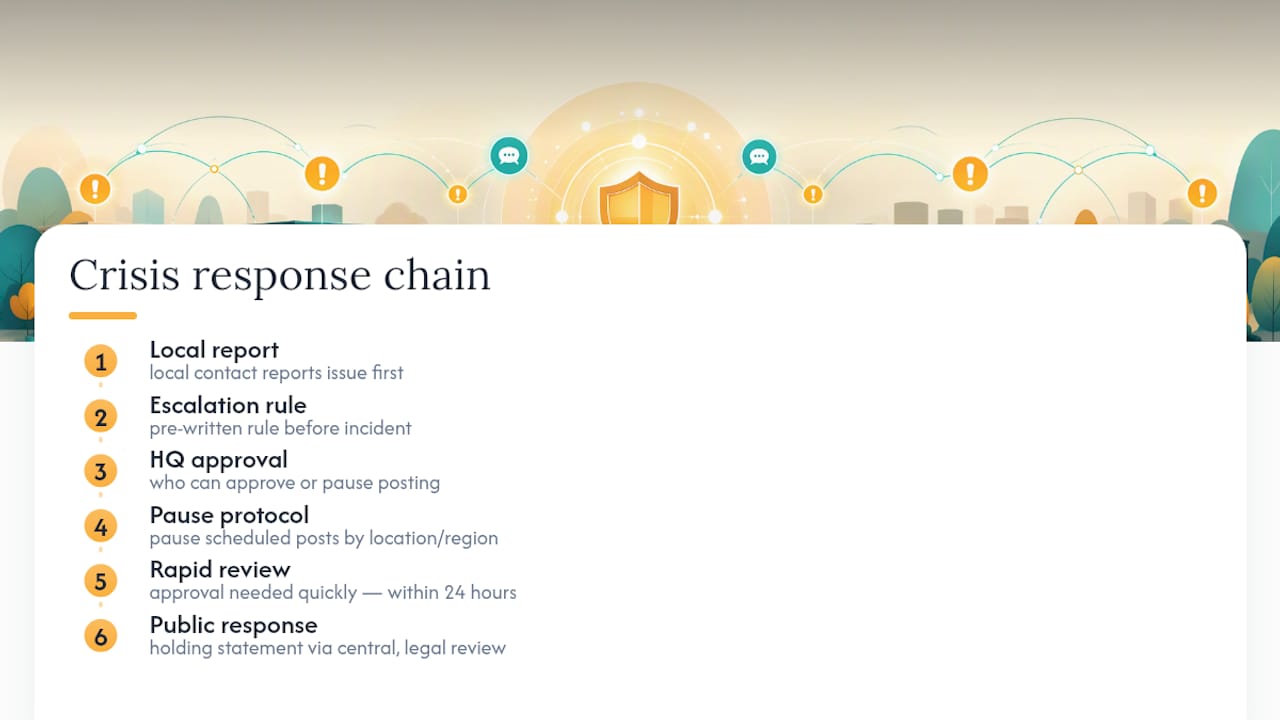
Build a pause protocol into your publishing tool. If one location faces a crisis, the rest of the network should not be posting cheerful promotional content that appears tone-deaf next to breaking news about a sister location. Most multi-account composers let you pause scheduled posts by location or region with a few clicks. That capability is worth testing during your tool trial, alongside the everyday publishing verbs.
Draft a holding statement template in advance, one that acknowledges the situation without admitting liability or speculating, and route it through whoever handles legal review at your business. Local teams should never improvise a public response to a serious incident. Give them a clear rule instead: acknowledge briefly, direct concerns to a specific contact, and defer to central for anything beyond that. The goal is speed without recklessness, and that only happens when the process exists before the crisis does.
Working With Local Influencers and Partners
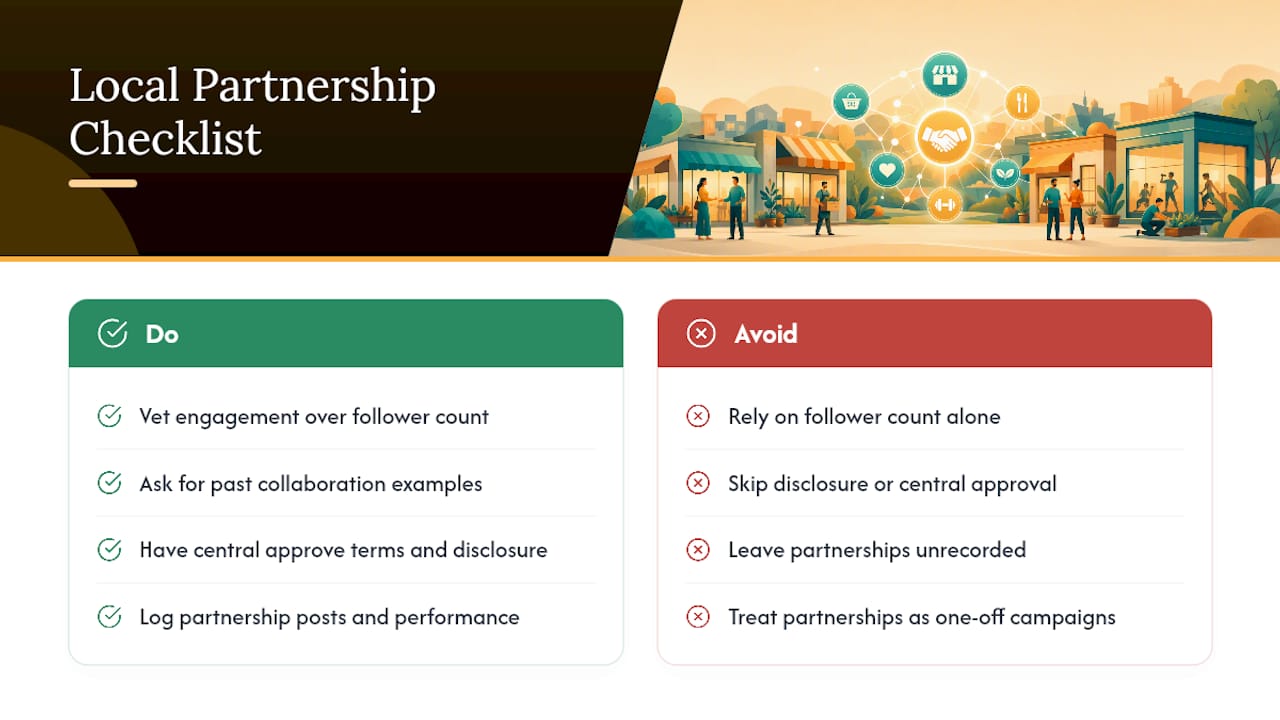
Local partnerships do something brand-wide content can’t: they borrow trust that already exists in a specific community. A gym partnering with a nearby physical therapist, or a boutique cross-promoting with a local coffee shop, reaches an audience that a corporate post will never fully penetrate.
Vet local influencers the same way you’d vet a vendor. Check engagement quality over follower count, since a local micro-influencer with 3,000 genuinely engaged neighborhood followers often outperforms a regional account with 30,000 passive ones. Ask for examples of past brand collaborations before committing to anything paid.
Keep the same central/local split here that governs everything else in your program. Central should approve the partnership terms, disclosure language, and any paid arrangement to stay compliant with platform and advertising rules. Local staff should manage the actual relationship, since they’re the ones who’ll run into that influencer or business partner at the farmers market next month.
Document partnership content the same way you document regular posts: log what was posted, when, and how it performed, so a partnership that works at one location can be replicated at another instead of reinvented from scratch. A local PR strategy built around genuine community relationships tends to outlast one-off influencer deals, because it’s grounded in reputation rather than a single campaign.
Training and Resourcing Local Teams
Local staff are not marketers, and expecting them to become skilled copywriters overnight sets your whole program up to fail. What they need is a short, specific training session covering exactly three things: what the style guide requires, how to submit photos and updates through your intake process, and who to contact when something looks off-brand or urgent.
Keep training sessions under an hour. A dense onboarding deck that no one reopens after week one is worse than no training at all, because it creates the illusion that expectations were set clearly. Short, recurring training sessions tied to real examples from your own locations stick far better than generic best-practice slides.
Resource allocation follows the same logic as account structure: match effort to what a location can realistically sustain. A location with one part-time staff member and no camera equipment should not be expected to produce daily video content. Give that location a lighter, simpler role, like sending a weekly photo, while a better-staffed flagship location carries more creative weight.
Revisit training every quarter, not because policies change constantly, but because staff turnover at the local level is high in retail and healthcare, and an untrained new hire is often how a location’s account goes quiet for a month without anyone at headquarters noticing.
Legal and Compliance Considerations by Location
Multi-location social programs run into compliance issues that a single-location brand rarely faces, and the risk multiplies with every new account you connect. Healthcare practices, in particular, need to keep patient privacy front of mind. Never post identifiable patient photos or details without documented consent specific to that location, even when a story seems flattering or harmless.
Advertising disclosure rules apply per post, not per brand. If a local partnership or influencer collaboration involves any exchange of value, free product, discounted service, payment, the post needs a clear disclosure regardless of which location’s account publishes it. Central teams should own this rule and enforce it consistently, since local staff are far less likely to know current disclosure requirements.
Different locations may also operate under different state or local advertising regulations, especially in regulated industries like healthcare or financial services. Build a simple compliance checklist into your approval workflow rather than trusting each location to know the rules independently. A five-minute review before publishing is far cheaper than a retraction after the fact.
Finally, keep a record of who approved what and when. If a compliance question ever comes up about a specific post, being able to show your approval trail matters more than being able to explain your intentions after the fact.
SOL Social Media’s Perspective: What We See Go Wrong
The most common failure point we see is not bad content, it’s orphaned accounts. A location gets a page set up during a launch, posts twice, and then goes silent for a year while still showing up in local search. That silence reads as closure to anyone who finds it. The second most common failure is the opposite problem: over-centralizing so heavily that every location’s feed sounds identical, which quietly erodes the local trust that made a physical location worth having in the first place. We build around human copywriting, a one-page style guide, and a publication-rate target we check monthly, not quarterly.
— SOL Social Media
How SOL Social Media Can Help You Run This Without Adding Headcount
If everything above sounds right but your team has no bandwidth to execute it, that’s exactly the gap SOL Social Media fills. Instead of hiring an in-house marketer for every location or hoping a store manager finds time between shifts, you get a team that builds the strategy, writes the content, and trains your local staff, without a big agency’s overhead or a rigid enterprise contract.
We work across social strategy, content creation, and hands-on training sessions for the people actually running your locations day to day, which makes it a fit whether you run a retail chain, a healthcare practice group, or a growing multi-location service business. Small business owners who’ve tried managing five or ten accounts alone usually hit the same wall: not a lack of ideas, but a lack of hours in the week. Our community-focused engagement work and ongoing management services are built specifically for that gap.
The next step is simple: book a social media audit. This can help flag dormant accounts and map out what a hybrid model could look like for your specific locations.
Sources
FAQ
Should every location get its own social media account?
No. Every physical location should have a Google Business Profile, but a full social account only makes sense for locations with reliable local content, staff capacity, and distinct offers or events.
What is the 80/20 rule in multi-location content?
Eighty percent of a post should stay fixed across locations (brand voice, visuals, legal claims), while the remaining 20% is personalized per location, such as the store name or a local event detail.
How do you stop duplicate content from hurting reach?
Use text rotation, dynamic variables like city names, and staggered scheduling so identical captions don’t post across multiple accounts at the same time, which can flatten organic reach.
What’s the single most important metric for a multi-location program?
Weekly publication rate. A location that consistently misses its posting schedule signals a workflow breakdown before engagement metrics even become relevant.
Can a small business manage multi-location social without hiring a full team?
Yes, with the right tooling and a written style guide, or by working with a service like SOL Social Media that handles strategy, content, and training for small teams.
Recommended
Comments