


Instagram Algorithm 2026: Use Sends per Reach and Relative Watch Time

Instagram runs on watch time, sends per reach, and originality enforcement in 2026. The platform now lets users steer recommendations directly through Your Algorithm topic controls. If your reach dropped, the fix isn’t more posting. It’s narrowing your themes and building Reels that hold attention in the first three seconds, because that single habit touches every signal the platform now rewards.
TL;DR:
Narrowing your content themes and focusing on quick attention-grabbing hooks in Reels improves discoverability and engagement ratios.
Using up to five relevant hashtags as topical labels and optimizing caption keywords increases search visibility without relying on hashtag stuffing.
Consistently tracking ratios like sends per reach, native Reel retention, and originality rates helps identify drops in reach before followers decline.
Producing genuinely original content across formats and avoiding repost-heavy patterns boosts overall algorithm eligibility and recommendation chances.
Testing new formats with Trial Reels in low-risk pools allows for optimized engagement and better signal data without risking core account metrics.
How the Instagram Algorithm Works in 2026 Across Feed, Reels, and Explore
Instagram doesn’t run one algorithm. It runs several, and treating them as a single system is the first mistake most creators make. Feed, Reels, Stories, Explore, and Search each pull from a shared content pool but score and rank it differently based on what that surface is designed to do.
The underlying mechanics follow a three-stage pipeline: candidate generation, scoring, and re-ranking. Retrieval models pull a wide set of possible posts for a given user, ranking neural networks score those candidates against that user’s behavior history, and a final filtering pass removes low-quality or policy-violating content before anything appears on screen. This is the architecture technical breakdowns of Instagram’s recommendation system describe, and it explains why the same post can perform completely differently depending on which surface it lands on.
Instagram itself names watch time, likes per reach, and sends per reach as the primary ranking signals shaping distribution across Feed, Reels, Stories, and Explore in 2026. But each surface weighs those signals differently:
Reels prioritizes watch time (specifically relative retention compared to similar content) and sends per reach, since Reels exists to surface new content to non-followers.
Feed leans on likes per reach and relationship history, meaning how often a specific follower has engaged with your account before.
Explore rewards saves and watch time, favoring content people want to revisit rather than content that just gets a quick reaction.
Stories weighs completion rate and reply activity more heavily, since it’s a followers-first surface built around maintaining existing relationships.
Search now factors caption keywords more than it used to, a shift covered in the section on hashtag changes below.
Every one of these signals is a ratio, not a raw count. Sends per reach matters more than total sends, and likes per reach matters more than total likes. That distinction changes how you should think about growth tactics. Buying followers or running engagement pods inflates your reach denominator without adding real watch time or sends, which mathematically drags your ratios down. A coherent analysis of Instagram’s 2026 signal structure makes clear that purchased engagement doesn’t just fail to help. It actively damages long-term recommendation odds because the algorithm is scoring your account’s pattern over time, not just individual posts.
That account-level scoring is the part most creators underestimate. Instagram doesn’t only judge post number 47. It’s tracking whether your last 30 posts, on average, earned strong ratios or weak ones, and whether your content mix leans original or repost-heavy. An account with a habit of reposting content from elsewhere sees its recommendation eligibility drop across the board, even on posts that are genuinely original. The algorithm is pattern-matching your behavior, not grading you post by post in isolation.
What Changed in 2025 and 2026: Your Algorithm, Originality Rules, and Hashtag Limits
Three shifts define the current version of the Instagram algorithm, and all three affect how discoverable your content is right now.
Your Algorithm expanded beyond Reels. Instagram launched user-facing topic controls in December 2025, letting people add or remove specific topics from their recommendations. Through 2025 and 2026, that control expanded from Reels into Feed and Explore, which means users are now directly telling Instagram what they want to see across every surface, not just short video. For creators, this raises the cost of vague content. If your posts don’t clearly signal a topic, you’re easier for a user to filter out entirely.
Originality enforcement now covers photos and carousels. Instagram’s originality rule used to apply mainly to Reels. On April 30, 2026, the platform extended that restriction to photos and carousels as well, and accounts that primarily post unoriginal or recycled content lose recommendation eligibility to non-followers. This is an account-level penalty, not a per-post one, meaning a pattern of reposting screenshots, memes, or other people’s content drags down your entire account’s discoverability.
Hashtags are capped at five, and captions carry more search weight. Instagram capped hashtag counts at five in December 2025, formalizing a shift that had been happening for a while: hashtags now function mainly as topical labels for search categorization rather than as a discovery lever. The old strategy of stuffing 30 hashtags into a caption to maximize reach simply doesn’t work anymore, and social SEO through caption keywords has taken its place as the more reliable path to search visibility.
Trial Reels and Early Access give creators a testing layer. Trial Reels let you publish content to cold, non-follower audiences first, and if the concept performs well, you can share it to your main audience without it having dragged down your account metrics during the test. If it flops, the damage stays contained to that test pool. This makes Trial Reels the lowest-risk way to test new formats or hooks in 2026.
Industry coverage through August 2026 hasn’t surfaced any additional major ranking overhaul beyond the Your Algorithm rollout, according to ongoing platform analysis. The core signal order (watch time, sends, likes) and originality enforcement remain the story for now, which means the tactics below aren’t chasing a moving target. They’re addressing the rules as they currently stand.
Practical Tactics to Rebuild Reach Under the 2026 Rules
Once you understand what Instagram is measuring, the tactical shift is straightforward, even if executing it consistently takes discipline.
Pick two to four content themes and stick to them. Every post should map obviously to one of those themes. If a user or the algorithm can’t quickly categorize what your account is about, you lose eligibility for the topic-based recommendations that Your Algorithm now drives. A skincare brand might settle on “ingredient breakdowns,” “before and after results,” and “founder Q&A,” and refuse to post outside those lanes for a full quarter.
Build a three-second hook checklist for every Reel. Open on motion or a visual surprise, not a static frame. State the payoff in the first sentence rather than building up to it. Cut any preamble, including logo intros or slow zooms. Watch your first three seconds against your average skip rate in Insights, and if skip rate is high, the hook is the problem, not the topic. Our guide on creating Reels that actually get views breaks down pacing and editing patterns that hold retention longer.
Design for sends, not just likes. Content that makes someone think “my friend needs to see this” earns sends, and sends per reach is one of the two highest-leverage ratios in the current system. Relatable humor, surprising statistics, and “tag someone who…” prompts all tend to outperform generic inspirational posts on this specific metric.
Use up to five hashtags for categorization, and put your real keywords in the caption. Treat hashtags as filing labels, not a discovery engine. Spend the effort you used to spend hunting for trending hashtags on writing captions that use the actual words your audience searches for.
Choose carousels when you want saves and depth, Reels when you want new-audience reach. Carousels reward people who slow down and swipe through, which builds save rates. Reels reward people who’ve never seen your account before. Running both formats around the same core idea covers both goals without duplicating effort.
Build an editorial workflow that protects originality. Batch-film hook variations in one sitting, run every piece of AI-assisted or repurposed content through a human editorial check before publishing, and label repurposed posts internally so you can track your originality ratio over time. This matters more now that originality enforcement covers photos and carousels, not just video.
Pro Tip: Before you publish a Trial Reel, write down the exact retention percentage or sends-per-reach number you’d need to see to call it a win. Testing without a threshold just gives you a number with no meaning attached to it.
How to Measure Your Instagram Engagement Strategy in 2026
You can’t optimize signals you’re not tracking, and most accounts that feel like they’ve been “shadowbanned” have simply stopped measuring the right ratios.
Start with sends per reach, calculated as sends divided by reach, multiplied by 100. Track this weekly on a rolling 30-day trend rather than judging any single post in isolation, since one viral outlier can distort a snapshot but won’t distort a monthly average.
Relative watch time is trickier to pull as a raw number, but Instagram’s native retention graph on each Reel shows you exactly where viewers drop off. A steep drop in the first three seconds means your hook failed. A steady decline across the whole video usually means pacing, not the concept, is the problem.
For account health, track your originality ratio over a rolling 30-day window: what percentage of your posts are genuinely original versus repurposed or reposted. According to the April 2026 originality enforcement update, accounts skewing heavily toward unoriginal content lose eligibility for non-follower recommendations, so this ratio functions as an early warning system before reach actually drops.
Useful measurement tools include:
Instagram Insights for reach, sends, saves, and native retention graphs on Reels.
A weekly export or dashboard tracking sends-per-reach trend, not just raw counts.
Trial Reels performance data, compared against your account average, to judge whether a concept is worth scaling.
Pro Tip: Set a clear pass/fail threshold before testing. A Trial Reel that beats your account’s average relative retention by 15 percent or lands a stronger sends-per-reach ratio than your typical post is worth pushing to your full audience. If a post is underperforming, our breakdown of low Instagram engagement causes and fixes walks through the most common diagnostic steps.
Choosing the Right Format: Reels, Carousels, and Stories
Format choice should follow your goal, not habit or trend-chasing. Reels are built for discovery: they reach people who don’t follow you yet, and they live or die on watch time and sends. Carousels serve depth and consideration: they reward saves and slower engagement from people who are already curious, which makes them strong for tutorials, comparisons, or anything worth revisiting. Stories exist mainly to maintain relationships with people who already follow you, weighted more by completion rate and replies than by reach to strangers, a dynamic covered in more depth in our breakdown of the Stories algorithm.
A practical hook-writing habit: storyboard your first three seconds before you film anything else, since that’s the segment carrying the most weight for Reels retention.
Repurposing content safely under the originality rules means genuinely transforming it, not just recycling. That means:
Adding new narration or a fresh voiceover rather than reusing the original audio track.
Re-editing pacing and cuts natively in-app rather than reposting an unedited clip.
Shooting new supplementary footage to accompany a repurposed core idea.
Writing an entirely new caption built around search keywords relevant to that specific post.
Keep an internal content log noting which posts are original versus repurposed, so your originality ratio is something you can check at a glance instead of guessing.
SOL Social Media’s 30-Day Recovery Framework for Instagram Reach
When a client’s Instagram reach drops, SOL Social Media runs a straightforward 30-day audit before touching content strategy. First, calculate the account’s originality ratio over the trailing month. If unoriginal content makes up more than a small share of the feed, that’s addressed before anything else. Second, schedule at least two Trial Reels to test fresh hooks on cold audiences without risking the main account’s metrics. Third, pause any repost-heavy publishing cycle immediately, since that pattern actively suppresses recommendation eligibility.
The dashboard we track alongside clients centers on three numbers: sends-per-reach trend, relative retention on the three most recent Reels, and the rolling originality ratio. Watching those three consistently catches a decline weeks before follower counts show it. This is the same audit framework available through SOL’s insights and optimization service, built to be replicable for any team willing to track it weekly.
The Role of AI and Machine Learning in Instagram’s Ranking System
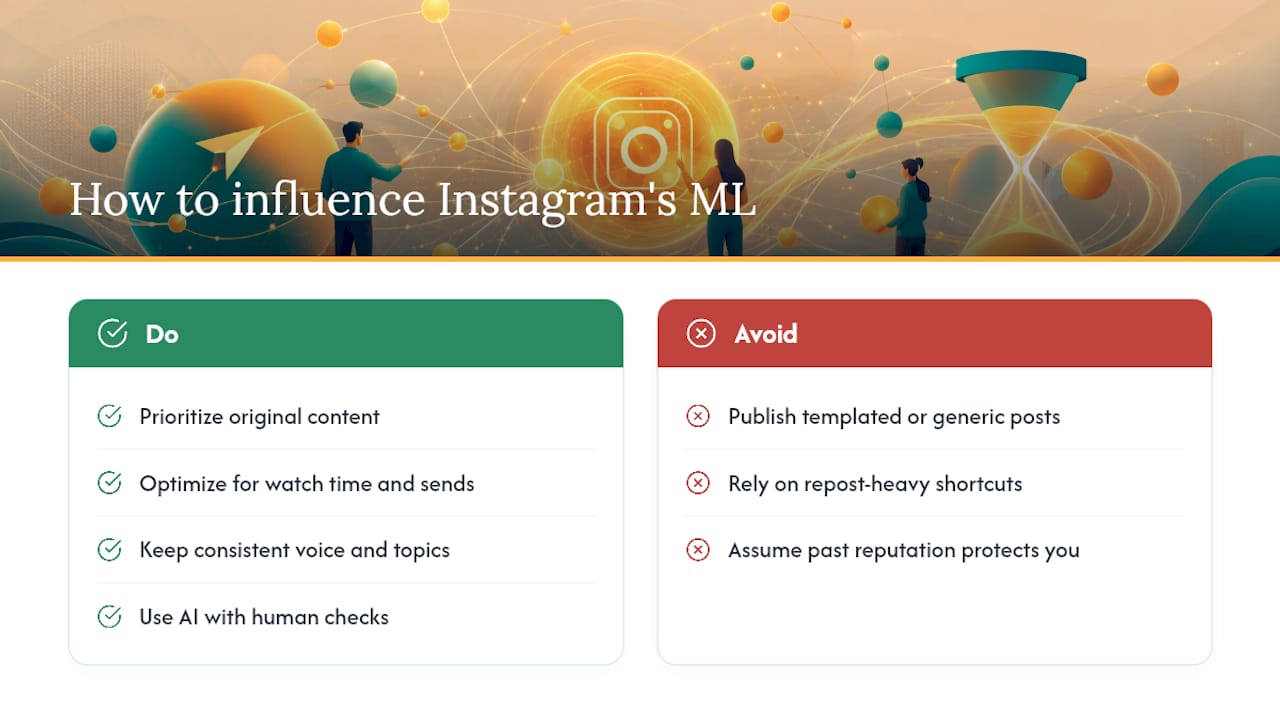
Instagram’s ranking system isn’t a fixed rulebook. It’s a set of machine learning models that retrain continuously on fresh behavioral data, which is why the platform can shift what it rewards without a formal announcement. The candidate generation and scoring models described in technical explainers of the recommendation pipeline process video, audio, and captions together as multimodal signals, meaning the system is increasingly evaluating the substance of your content, not just metadata around it.
This has a direct implication for creators using AI tools to produce content. AI-assisted editing or scripting isn’t penalized on its own, but content that reads as generic, templated, or indistinguishable from thousands of similar posts tends to score worse on engagement ratios, which the models pick up on and use to suppress future reach. Voice and topic consistency, the things a purely automated workflow struggles to fake convincingly, still carry weight because they drive the watch time and sends the models are trained to detect. A useful discussion of where automation helps versus where it needs a human check is covered in this breakdown of AI tools for marketers, which is worth a look if your team is scaling output with AI assistance.
Because these models retrain on rolling data, an account’s standing isn’t permanent in either direction. A strong originality ratio and solid retention this month build momentum, but a few weeks of repost-heavy shortcuts can undo that just as fast. The system rewards recent behavior more than historical reputation.
How Shopping and Ads Features Affect Your Organic Reach
Monetization features like Instagram Shopping tags and paid ads run through a separate distribution track from organic ranking, but they intersect with it in ways worth understanding. Shopping tags don’t inherently boost or suppress organic reach. What matters is whether the underlying post still earns strong watch time and sends. A product carousel with a shopping tag competes on the exact same ratios as any other carousel.
Ads, meanwhile, don’t feed back into your organic scoring at all. Paid reach and organic reach are calculated independently, so running ads on a post won’t lift its organic distribution afterward, and a strong organic post won’t automatically perform well as a boosted ad without its own creative testing. Treating ads as a shortcut to organic momentum is a common misread of how the two systems relate.
Where monetization features do help indirectly is through sends and saves. Product posts that solve a specific, useful problem tend to get shared and saved at higher rates than generic promotional content, and those ratios feed directly into the organic signals covered earlier in this guide. The lesson isn’t to avoid Shopping or Ads. It’s to keep judging monetized content by the same watch time and sends benchmarks you’d apply to anything else, rather than assuming a shopping tag does any algorithmic heavy lifting on its own.
Why Hidden Posts and Reports Quietly Hurt Your Reach
Negative signals carry real weight in Instagram’s scoring, and they’re often invisible to the creator posting the content. When a user taps “hide post,” “not interested,” or reports content, that action feeds directly back into the ranking models as a strong negative signal, arguably a heavier one than a missing like, because it represents active rejection rather than passive scrolling past.
A pattern of hides or reports on a specific type of content teaches the algorithm to stop showing that content to similar users, even if the same post is earning decent watch time elsewhere. This is part of why content that feels borderline (misleading claims, aggressive sales language, repetitive engagement bait like “comment YES to see more”) tends to lose reach over time even without an official policy strike. The negative feedback compounds quietly in the background.
The practical response is to watch your ratio of hides and reports relative to reach wherever Instagram surfaces that data, and to treat a spike as a genuine warning sign rather than noise. Content that repeatedly triggers “see fewer posts like this” is actively working against your account’s long-term eligibility, and no volume of positive engagement on other posts fully offsets a consistent pattern of negative signals on a specific content type.
Staying Ahead as the Instagram Algorithm Keeps Evolving
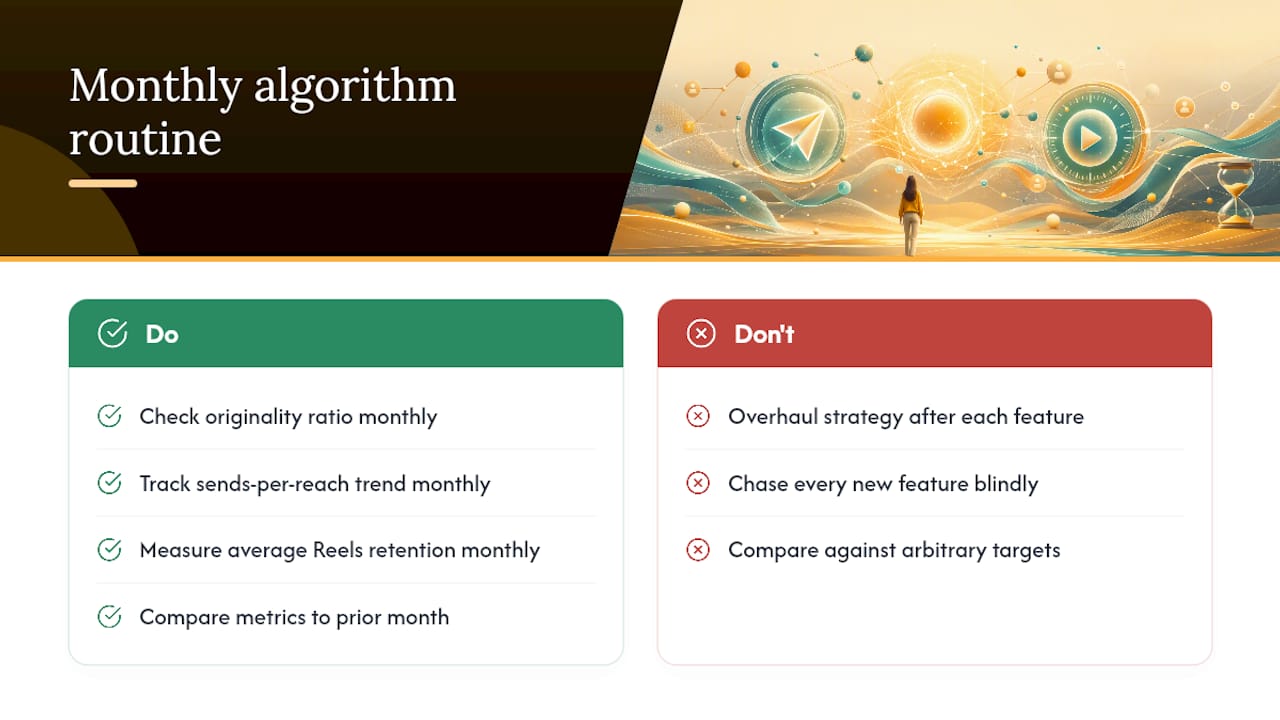
Treat algorithm literacy as an ongoing habit, not a one-time audit. Instagram updates weighting and features multiple times a year, and the accounts that stay visible are the ones that revisit their numbers monthly rather than reacting only when reach visibly drops.
Build a simple recurring routine: check your originality ratio, sends-per-reach trend, and average Reels retention on the same day each month. Compare against the prior month rather than against an arbitrary target, since Instagram’s baseline shifts as it rolls out changes like the ones covered above. Following official channels, including Adam Mosseri’s public updates and reporting from established industry outlets, helps you catch policy shifts before they show up as a mystery drop in your numbers.
Resist the urge to overhaul your entire content strategy every time a new feature launches. Most updates, including the 2026 changes detailed in this guide, reward the same underlying behavior: clear topics, original content, and formats that earn genuine watch time and sends. Chasing every new feature (Trial Reels, Your Algorithm controls, whatever comes next) is worth doing in small tests, but your core content themes should stay stable enough that your audience knows what to expect from you. Stability and experimentation aren’t opposites here. The stable themes are what make the experiments measurable in the first place.
Our Take: Specificity Beats Gaming the System
The accounts recovering fastest in 2026 aren’t the ones chasing hacks. They’re the ones getting more specific about who they serve and refusing to repost filler. That alignment between algorithm incentives and genuine audience value isn’t an accident. The risk is over-optimizing into something generic. Keep an authenticity check in every content review, and treat each new model update as a reason to sharpen your niche, not abandon it.
— SOL Social Media
Get Help Applying the 2026 Instagram Playbook
Reading the signals is one thing. Building a content calendar, filming hooks that actually hold retention, and tracking sends-per-reach every week is another, and it’s the part most small business owners don’t have hours left in the day for. An alternative to hiring a full in-house social team is to use a service that runs the strategy, shoots and edits content, tests it with Trial Reels, and reports back on key engagement ratios, without requiring you to become a full-time analyst.
Our work spans strategy development, content creation, measurement, and hands-on training for teams who want to run more of this in-house. If you’re rebuilding a brand’s visual identity alongside your content strategy, our branding campaign services cover that creative foundation, and if community response and DM engagement are where you’re losing ground, our community involvement work focuses on exactly that. You can request an account audit that reviews originality ratio, sends-per-reach trends, and identifies opportunities for improvement.
Sources
FAQ
What Is the 5-3-1 Rule on Instagram?
The 5-3-1 rule is a content-planning framework suggesting that for every nine posts, five should be curated or educational, three should be original personal content, and one should be promotional. It’s a useful starting ratio, but under 2026’s originality enforcement, the “curated” bucket needs genuine transformation, not straight reposts, to stay eligible for full recommendation reach.
How Do You Go Viral on Instagram in 2026?
Going viral in 2026 depends heavily on sends per reach and relative watch time, since Reels with strong first-three-second hooks and high shareability get pushed to larger cold audiences. There’s no reliable shortcut, but testing hooks through Trial Reels before committing to your main audience meaningfully improves your odds.
How Often Should You Post on Instagram in 2026?
There’s no fixed number that guarantees reach, since consistency and content quality matter more than frequency. Our posting frequency guide covers cadence benchmarks by content type, but the priority in 2026 is making sure every post clearly matches one of your core themes rather than posting more often with unfocused content.
How Do You Grow Instagram Followers in 2026?
Growth now comes primarily from earning strong sends-per-reach and watch time ratios on original content, since those signals drive distribution to non-followers through Reels and Explore. Narrowing your topic focus so Your Algorithm and search can categorize your account correctly also plays a direct role in follower growth.
Does Reposting Content Hurt My Instagram Reach?
Yes. Since April 30, 2026, originality enforcement covers photos and carousels in addition to Reels, and accounts that primarily repost unoriginal content lose recommendation eligibility to non-followers at the account level, not just on individual posts.
Recommended
Comments