


30 Day Social Media Engagement for Small Businesses: Focus, Batch, Reply

Pick one or two platforms, build a repeatable content system around short-form video and fast replies, and commit to answering comments and DMs within 60 minutes. That combination is the single most effective engagement strategy social media accounts can run without a dedicated team. Start this week: choose your primary platform, block a 90-minute batching session, and expect a measurable lift in engagement velocity within 30 days, with real conversion signals by day 90. This system can also be built and run by an external service if you’d rather hand it off.
TL;DR:
Focusing on one or two platforms and building a short-form video habit can significantly boost organic reach and engagement within 30 to 90 days.
Responding to comments and messages within the first hour after posting doubles comment thread growth and enhances distribution across platforms.
Using specific captions, interactive polls, and targeted user-generated content prompts filters for higher intent engagement and potential conversions.
Tracking engagement rate, click-through, and response time monthly provides clearer insights than vanity metrics, guiding effective experimentation.
Leveraging managed services can help small businesses sustain consistent posting, batching, and fast replies without overextending internal resources.
What Counts as Social Media Engagement, and Which Metrics Matter?
Engagement is any action that shows a person did more than scroll past your post. Likes are the weakest signal because they cost almost nothing. Comments, shares, saves, and direct messages carry more weight because each one requires a decision to stop and respond.
Ranked roughly by buyer intent, the actions look like this:
Saves and shares signal a person found enough value to return to it or pass it along, which often predicts purchase intent better than likes.
Comments and DMs show active interest and give you a direct line to ask questions or move someone toward a sale.
Replies to your Stories or polls reveal who’s paying close attention, which makes them good candidates for retargeting or personal outreach.
Likes confirm reach but rarely predict anything about buying behavior on their own.
Engagement rate by followers = (Likes + Comments + Shares + Saves) ÷ Total Followers × 100.
Engagement rate by reach = (Total Interactions) ÷ Reach × 100. This version is more honest for accounts running paid boosts or benefiting from viral reach, since it measures engagement against the people who actually saw the post, not your full follower count.
Statistic Callout: Consumers reward responsiveness directly. Sprinklr’s research shows most people feel more loyal to brands that reply to comments and messages, and are less likely to buy from brands that stay silent.
For a small business, three KPIs matter more than the rest: engagement rate, click-through rate to conversion (site visit, booking, purchase), and average response time. Track all three monthly using the same formula each time. Switching between follower-based and reach-based math from month to month makes your trend line meaningless.
Which Tactics Should You Try First?
Not every tactic deserves equal time. Some move engagement fast; others build slowly. Here’s the order that tends to pay off for a one- to three-person marketing operation.
Pick one primary platform and one secondary platform. Choose based on where your actual customers spend time, not where you personally enjoy posting. A HVAC company probably gets more traction on Facebook and YouTube Shorts than TikTok; a boutique fitness studio likely sees the opposite. Spreading effort across five platforms with no depth on any of them is the single most common mistake small accounts make, and it’s why narrow platform focus consistently outperforms trying to be everywhere.
Build a short-form video habit. Short-form video generates two to three times the organic reach of static posts across major platforms. The first two seconds decide whether someone keeps watching, so open with motion, a face, or a question, never a logo or a slow zoom. Aim for four to six short videos per week if your team can sustain it, and repurpose one long-form piece (a webinar clip, a customer walkthrough, a how-to demo) into three or four short cuts instead of filming new content every time.
Write captions that invite a specific answer. “What do you think?” gets ignored. “Which of these two paint colors would you pick for a kitchen this size?” gets a comment. The difference is specificity. Behind-the-scenes content works especially well here because it gives people something concrete to react to: a half-finished product, a messy workspace, a decision you’re wrestling with.
Use interactive stickers and polls deliberately, not decoratively. A poll only drives engagement if the two options are genuinely close calls for your audience. Asking “Do you love our new product?” invites nobody to respond. Asking “Would you rather see this in navy or olive?” gives people a real reason to tap.
Run UGC prompts and contests with entry mechanics that filter for intent. Requiring an email signup, a tagged friend who fits your customer profile, or a photo using your product pulls in people closer to buying, rather than sweepstakes chasers who’ll never convert. A simple “tag someone who needs this” contest brings in low-intent traffic; “post a photo with our product and tell us how you use it” brings in people already invested.
Batch everything in one 90-minute weekly session. Film or shoot five to seven pieces of raw content, write captions for the week, and schedule posts using your platform’s native scheduler or a third-party tool. Keep a running content bank, a folder of unused photos, quotes, and video clips, so a slow week never means an empty feed.
Testing hooks against each other over a month teaches you more about your audience than any single viral post will.*
AI tools have made steps 2 and 6 dramatically faster. Solo founders using AI-assisted editing and caption drafting have cut weekly content creation time from eight to twelve hours down to one or two, as long as a human still edits for voice before anything publishes. For deeper tactical examples, SOL Social Media’s proven engagement tactics guide breaks several of these down further.
What Should You Actually Post Each Week?
Push past that ratio toward more selling and audience fatigue sets in fast, since research on posting frequency consistently shows value-driven content sustaining attention better than promotional content.
Format choice should follow platform norms rather than your personal taste:
Instagram: Reels for reach, carousels for saves and depth, Stories for daily connection and polls.
TikTok: Native video only. Cross-posted clips carrying another platform’s watermark underperform compared to content filmed and edited natively.
LinkedIn: Carousels are the format-level winner, with engagement rates that can reach into the low twenty percent range for well-designed decks.
Facebook: Static images and short native video still perform for local and older-skewing audiences.
YouTube Shorts: A strong home for repurposed TikTok/Reels content, provided you re-export without a competing watermark.
A one-owner team might run three posts a week on the primary platform and one on the secondary, all produced in a single Sunday batching session. A small marketing team with a part-time hire can stretch to five posts on the primary platform and two to three on the secondary, matching the 4 to 5 posts per week benchmark that practitioner guides recommend for accounts serious about growth.
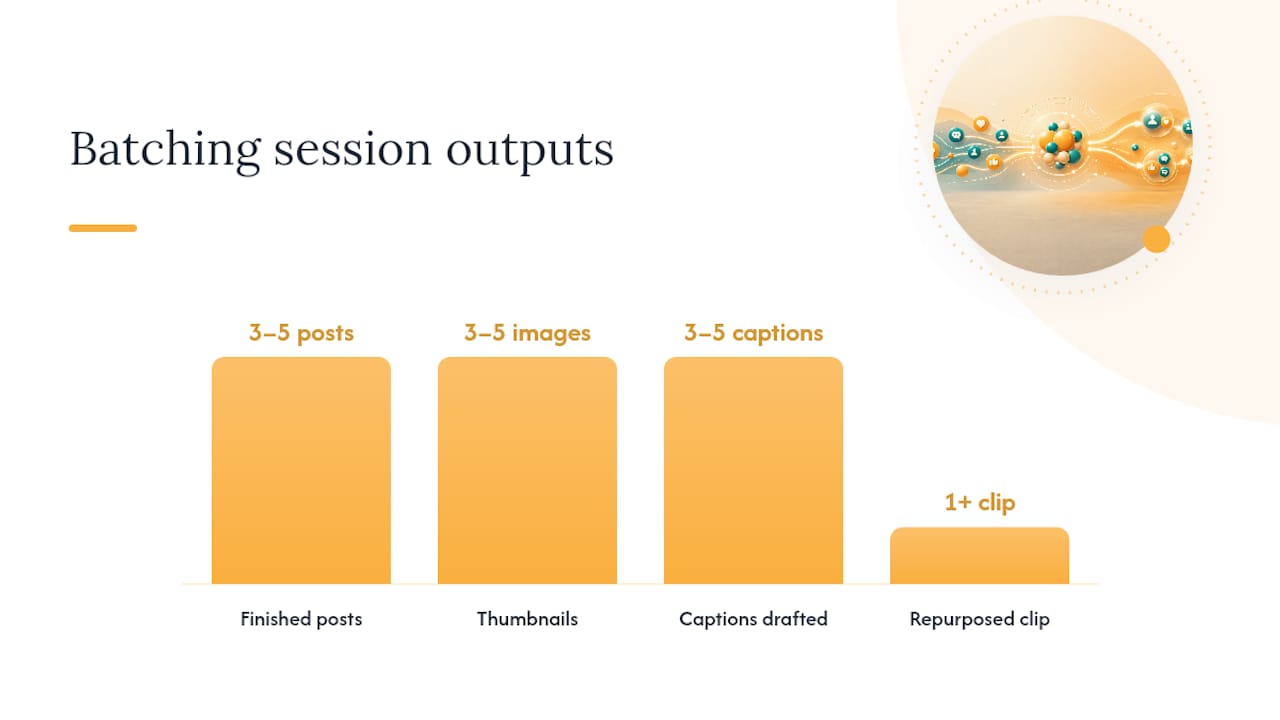
In your 90-minute batching session, aim to leave with three to five finished posts, thumbnail images pulled or cropped for each, captions drafted with a question or CTA, and at least one repurposed clip ready for a secondary platform.
How Do You Keep Engagement Momentum Once You’re Posting Consistently?
Posting is only half the job. What happens in the hour after you publish decides how far the algorithm carries it.
Protect the first 60 minutes after publishing. Reply to every early comment before doing anything else. Accounts that respond within the first hour see comment thread length roughly double, and platforms reward that early activity with wider distribution. Reply lifts vary: Threads sees the largest jump, followed by LinkedIn, then Instagram, but the direction holds everywhere.
Triage comments and DMs by urgency, not by order received. A pricing question or complaint jumps the line; a compliment or emoji reply can wait an hour. Write three or four reply templates for your most common questions (hours, pricing, availability), then edit each one by hand before sending so it doesn’t read like a bot answered it.
Build reciprocity into your weekly routine. Spend fifteen minutes leaving genuine, specific comments on customers’ and local partners’ posts. Feature a customer photo or repost a tag with a real thank-you caption. Tag suppliers, collaborators, or neighboring businesses when relevant. This is the part most small accounts skip, and it’s the part that turns a follower into someone who feels seen.
Pro Tip: Keep a shared notes doc of your five most common DM questions and their best-performing answers. Reusing a proven, warm response beats improvising a new one every time, and it cuts your average response time significantly.
A consolidated inbox tool (Meta Business Suite, or a paid social inbox if you’re managing multiple platforms) keeps comments and DMs from scattering across five apps. Turning on native push notifications for direct messages, even without paid software, closes most of the gap between “someone messaged us” and “someone got a reply.”
How Do You Know If Your Strategy Is Working?
Set up a monthly one-page report tracking engagement rate, click-through-to-conversion rate, and average response time with guidance on the role of analytics in campaigns. Three numbers, tracked the same way every month, tell you more than a dashboard full of vanity metrics ever will.
Compare your numbers against realistic benchmarks, not idealized ones. LinkedIn carousels can post engagement rates near 21.77% on that platform specifically; that number means nothing if you’re comparing it against Instagram Reels performance. Keep your formula (follower-based or reach-based) consistent from month to month, and never compare a follower-based rate on one platform to a reach-based rate on another.
Run three short experiments over 30 to 90 days:
Hook testing: three different opening lines on the same video concept; scale whichever gets the highest 3-second view retention.
Reply-speed testing: commit to sub-15-minute replies for two weeks; compare comment thread length against your baseline.
CTA testing: swap a soft CTA (“check the link in bio”) for a direct one (“DM us the word STARTER for our price list”); track DM volume.
Saves and clicks are quiet signals that people intend to act later; comments and shares are loud signals of immediate reaction. Both matter, but a post with high saves and low comments often converts better than a post with the reverse, since experiment-driven measurement consistently shows saves correlating with return visits and eventual purchase.
How SOL Social Media Approaches This for Clients
This exact system, platform focus, batching cadence, and fast-reply community management is often offered as a managed service for small businesses that don’t have the internal bandwidth to sustain it alone. Such services can include full engagement management, monthly content planning, live event coverage, and customized training for owners who want to run it in-house but need the framework built for them first.
…
Readers who want a closer look at what managed engagement looks like day to day can review the social media engagement services page for scope and deliverables.
Why Do People Actually Engage? The Psychology Behind It
Two forces explain most of what happens in your comments section: social proof and reciprocity. Social proof means people look to others’ reactions before deciding whether something is worth their attention. A post sitting at zero comments looks unproven; a post with fifteen genuine replies signals “other people found this worth responding to,” which pulls in more responses on its own. That’s why seeding the first two or three comments yourself, or asking a colleague to respond early, has an outsized effect on posts from smaller accounts.
Reciprocity is simpler: people respond to brands that respond to them. A brand that replies to every comment trains its audience to expect a two-way conversation, and audiences that expect a reply are more likely to leave one. This is also why a brand’s silence compounds. Once followers learn a business rarely responds, they stop bothering to comment, and the account’s true engagement rate quietly erodes even as follower count keeps climbing.
A third, quieter principle is scarcity of attention. Specific, narrow content (“this exact question,” “this exact product”) beats broad content because it signals the post was made for a particular person, not for everyone. That specificity is what makes a well-targeted caption outperform a generic one even with identical reach.
Who Are You Actually Talking To?
A single “target audience” is too broad to write for. Most small businesses serve two or three distinct personas even if they’ve never written them down. A dental practice might have anxious first-time patients, long-term family patients, and cosmetic-procedure shoppers, each of whom responds to entirely different content.
Building a persona doesn’t require formal market research. Pull ten recent customers and note what they had in common: age range, the problem that brought them to you, and the objection they raised before buying. That’s usually enough to write two or three working personas.
Once personas exist, segment your content calendar around them instead of posting generically. The anxious-patient persona responds to gentle, reassuring behind-the-scenes content showing a calm office and friendly staff. The cosmetic-shopper persona responds to before-and-after proof and pricing transparency. Running both content types on the same feed, but timing them to when each persona is most likely to be scrolling, produces stronger engagement than either a fully generic feed or a feed split evenly with no logic behind it.

DMs and comment replies are also a segmentation opportunity. Notice which persona tends to ask which kind of question, and tailor your reply templates accordingly rather than sending the same canned response to everyone.
Can You Actually Work With the Algorithm Instead of Against It?
Every major platform’s algorithm optimizes for the same underlying goal: keeping people on the app longer. Content that gets watched to completion, saved, shared, or commented on quickly gets treated as “worth showing to more people.” Content that gets scrolled past in two seconds gets buried, regardless of how good the product behind it is.
That means the fastest way to work with the algorithm, rather than around it, is to give people a reason to stop scrolling in the first two seconds and a reason to act before they swipe away. Early engagement velocity, that first-60-minutes window covered earlier, is itself an algorithm signal, not just a courtesy to your audience.
Native format matters more than most small businesses realize. Posting a TikTok-branded video to Instagram Reels, or vice versa, tells the receiving platform’s algorithm this content wasn’t made for its audience, and it distributes accordingly poorly. Re-exporting clean, native versions for each platform takes a few extra minutes and consistently outperforms lazy cross-posting.
Consistency also feeds the algorithm indirectly. Accounts that post on a predictable cadence build a base of return viewers whose repeat engagement signals reliability to the platform. That’s a stronger long-term lever than chasing a single viral moment, which rarely repeats and often attracts the wrong audience anyway.
How Do You Turn Followers Into Loyal Customers?
Engagement that never evolves into a relationship is just noise. The businesses that build real loyalty treat their comment section and DMs as an ongoing relationship, not a one-off transaction.
Featuring customers publicly, reposting their tagged content, thanking them by name in a comment, does more for retention than almost any paid tactic. People remember being seen, and they tell friends about it. Recurring content series (a weekly customer spotlight, a monthly Q&A, a “we tried your suggestion” follow-up post) give returning followers a reason to keep checking in rather than scrolling past.
Consistency in tone matters as much as consistency in posting. A brand voice that feels warm and specific in captions, then turns stiff and corporate in DM replies, breaks the trust that built the relationship in the first place. Keeping the same voice across posts, comments, and private messages is what makes a follower feel like they’re talking to a person rather than a brand account.
Loyalty also shows up in the numbers eventually. Repeat commenters and long-term DM contacts convert at a higher rate than cold traffic, simply because the relationship groundwork is already done by the time you make an offer.
What Do Successful Engagement Strategies Look Like Across Industries?
A local retail boutique built momentum by shifting from static product photos to short video try-ons with a specific caption question (“Which fit would you grab for a weekend trip?”) and by replying to every comment within the hour. Comment volume and saves both climbed as the account leaned into the reciprocity effect described earlier.
A healthcare practice used behind-the-scenes content, staff introductions, office tours, “day in the life” clips, to soften the anxiety many patients feel before a first visit. Pairing that with prompt DM responses to scheduling questions turned social media into an actual booking channel rather than just a brand-awareness tool.
Each case followed the same underlying operational skeleton: a narrow platform focus, a repeatable batching habit, and a fast, human reply window, applied to a completely different industry and audience.
Where Effort Actually Pays Off First
The honest trade-off is this: reach is easier to buy than engagement, and engagement is what actually keeps customers coming back. A business owner with one or two hours a week can realistically sustain a consistent posting cadence and fast replies on one platform. Trying to run two platforms well with that same time budget usually means both suffer. An agency-managed approach buys back that time and adds the batching discipline most small teams struggle to maintain past the first few weeks. Whichever route you choose, the near-term goal stays the same: one platform, one reliable cadence, and reply speed you can actually hold.
— SOL Social Media
Ready to Build a System You Can Actually Sustain?
There are agencies offering full engagement management, content planning, and training as an alternative to hiring an in-house marketing coordinator, providing these services without the overhead of a full-time salary or the guesswork of running it solo. If the tactics above sound right but the time to execute them consistently isn’t there, such agencies can close that gap.
A first consult typically starts with an audit of your current accounts, benchmarking your engagement rate against realistic platform norms, followed by a 30-day plan covering platform focus, content mix, and reply protocols. From there, SOL builds out the batching system and either runs it for you or trains your team to run it, depending on what your business needs. Businesses that want to stay hands-on but need the framework built correctly can also book a social media strategy session to walk away with a documented plan instead of a loose set of ideas. If community-driven partnerships and local collaboration are part of your growth plan, SOL’s community involvement work shows what that looks like in practice. The next step is simple: reach out for an audit and get a 30-day plan built around your actual platform, audience, and team size.
Sources
FAQ
What Are the Four C’s of Social Media Strategy?
The four C’s commonly cited are Content, Community, Commerce, and Conversation, referring to what you post, who you build relationships with, how social drives sales, and how you engage in two-way dialogue rather than one-way broadcasting.
How Often Should a Small Business Post to Improve Engagement?
Aim for four to five posts per week on your primary platform and two to three on a secondary platform, produced through a single weekly batching session rather than daily improvisation.
What’s a Good Engagement Rate for a Small Business Account?
It depends entirely on platform and format.
How Fast Should I Reply to Comments and DMs?
Reply within the first 60 minutes after publishing whenever possible. Early replies roughly double comment thread length and improve distribution on platforms like Threads, LinkedIn, and Instagram.
Should I Manage Engagement Myself or Hire an Agency?
If you have one to two hours a week and one platform, DIY management can work with a disciplined batching routine. Once you’re stretched across multiple platforms or losing reply speed, a managed service like SOL Social Media’s engagement services closes that gap without adding headcount.
Recommended
Comments