


Employee Advocacy Social Media: Your 2026 Playbook

TL;DR:
Employee advocacy on social media transforms employees into credible voices who extend brand reach beyond company pages. A 6–8 week pilot focusing on Usage Rate as a KPI can build posting habits and demonstrate tangible impacts like increased reach and faster lead conversion. Small businesses benefit from authentic content generated by trusted individuals in local networks, strengthening trust and generating high-quality prospects.
Employee advocacy on social media means your team members share brand-related content on their personal profiles, turning everyday employees into credible voices that reach audiences no company page can touch. The single first action to take: run a 6–8 week pilot with a measurable Usage Rate KPI before you chase leads or ask for budget expansion.
Starter checklist to brief stakeholders or launch a pilot today:
Pick a pilot group of several willing employees across sales, marketing, and customer-facing roles
Set one headline KPI: Usage Rate (the share of pilot participants posting regularly)
Choose one priority network based on where your buyers already spend time (LinkedIn for B2B, Instagram or TikTok for consumer brands)
Draft three pre-approved post templates employees can personalize and publish immediately
Prepare two exec-ready benchmarks: personal posts reach up to 800% more people than identical company posts, and advocacy-generated leads convert 7× faster than brand-sourced leads
Those two figures alone tend to shift a skeptical CFO. Bring them to your first stakeholder meeting.
How does employee advocacy on social media actually work?
Employee advocacy amplifies your brand by routing content through personal networks instead of a single corporate channel. When a sales rep shares a product update or a customer story on LinkedIn, that post lands in front of their connections, not just your followers. Platform algorithms reward early engagement, and personal posts typically generate more of it because friends and colleagues interact faster than strangers scrolling a brand feed.
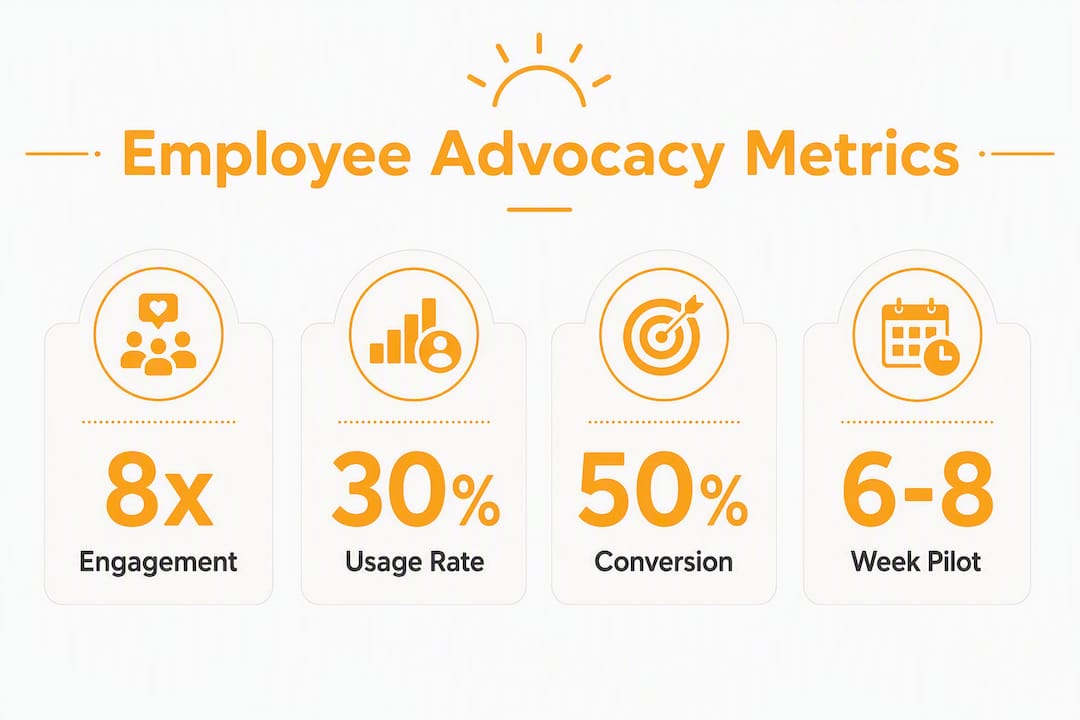
The mechanics work like this: an employee publishes or reshares content, their first-degree connections engage (likes, comments, shares), and the algorithm interprets that early signal as relevance, pushing the post to second- and third-degree connections. A company page rarely triggers that cascade because followers are often passive. Personal networks are not.
Where employee advocacy fits in a modern social strategy:
Marketing reach: Employees collectively hold networks that dwarf most brand pages. A team of 50 people, each with 500 connections, represents 25,000 potential first-degree impressions per post cycle.
Social selling: Sales reps who share thought leadership and customer wins warm prospects before a cold outreach, shortening the trust-building phase of the sales cycle.
Recruiting: Employee-shared job posts and culture content attract candidates who already trust the source, producing higher-quality referral hires than job boards alone.
PR and brand reputation: When employees speak positively about their workplace during an industry moment or news cycle, that earned credibility is harder to manufacture with paid media.
The key distinction from influencer marketing is authenticity. Your employees are not paid spokespeople. Their networks know them personally, which is exactly why the content lands differently.

What are the real business benefits of employee social sharing?
The benefits split cleanly by stakeholder, which makes it easier to build a business case for each department head you need to convince.
Stakeholder | Benefit | Sample metric improvement |
Marketing | Organic reach and engagement | Up to 800% more reach per post vs. company page |
Sales | Faster prospect conversion | Advocacy-generated leads convert 7× faster |
HR / Recruiting | Referral quality and talent attraction | Employee-shared roles attract higher-quality applicants than job boards |
Individual employees | Personal brand and career visibility | Thought leadership posts build professional authority and speaking opportunities |
For marketing leaders, an increased reach is the most immediate win. For sales leaders, faster conversion tends to resonate more. HR leaders care about referral quality: candidates who apply because a real employee vouched for the culture tend to stay longer and ramp faster.
Individual employees benefit too, and this point often gets overlooked in program design. When a team member builds a reputation as a credible voice in their industry, they attract speaking invitations, podcast appearances, and professional opportunities. Framing advocacy as a career development tool, not just a company ask, consistently improves voluntary participation rates.
Translating benefits into short-term pilot targets:
Impressions goal: total reach generated by pilot group over 6 weeks
Engagement lift: compare pilot participants’ post engagement to company page baseline
Referral traffic: UTM-tagged links from employee posts to your website
Referral hires: track applications that cite an employee post as the discovery source
Set these targets before the pilot launches so you have a clean before-and-after comparison to present to leadership.
How to launch a 6–8 week employee advocacy pilot
The pilot goal is simple: build posting habits before you measure business outcomes. Usage Rate — the percentage of eligible employees posting at least once per week — is your single headline KPI for the first 90 days. Leads and revenue attribution come later. Habit formation comes first.
Week-by-week pilot checklist:
Weeks 0–1: Stakeholder alignment and business case. Present the reach and conversion benchmarks to your executive sponsor. Frame advocacy as a revenue and sales-enablement motion, not a brand awareness project. Ask three questions up front: What budget is available for training and tools? Which sales team members should be in the pilot? What does a successful outcome look like in 8 weeks?
Week 1: Recruit your champions. Identify 8–15 employees who are already active on at least one social platform. Prioritize people in customer-facing roles. Explain the personal brand benefit clearly — this is not mandatory, and voluntary participants produce better content.
Weeks 2–3: Content plan and drafting support. Build a content calendar with three to five post ideas per week. Provide pre-approved templates employees can personalize. Use AI tools to generate first drafts, but require human editing before publishing. Fully AI-generated posts show about 21% lower engagement than posts where an employee’s voice comes through.
Weeks 4–6: Publish and measure. Track Usage Rate weekly. Log impressions, engagement rates, and any referral traffic from UTM-tagged links. Hold a 15-minute weekly check-in with champions to surface friction points and celebrate early wins publicly inside the team.
Weeks 7–8: Review and scale decision. Compile a one-page results summary. If Usage Rate is above 60% and engagement is trending up, present the case for a full program rollout. If adoption stalled, diagnose the friction point before expanding.
Pilot KPI tracker fields to capture:
Usage Rate (% of participants posting weekly)
Total impressions generated by pilot group
Average engagement rate per post
Referral traffic sessions from employee links
Influenced leads (prospects who engaged with employee content before converting)
Sample questions to ask executives before the pilot launches:
“If this pilot generates X qualified leads in 8 weeks, would you fund a full program?”
“Which sales reps should be in the first cohort so we can tie results to pipeline?”
“What’s the one outcome that would make this a clear win for you?”
Getting those answers in writing before the pilot starts protects your program from moving goalposts at the review stage.
Which platforms and content formats work best for employee posts?
Prioritize the networks where your customers and your sellers already spend time. For B2B companies, LinkedIn is the non-negotiable starting point. For consumer brands in retail, food, or wellness, Instagram and TikTok deliver more organic reach per post. Most teams should start with one platform, build the habit, then expand.
LinkedIn: the B2B anchor
LinkedIn rewards personal commentary over pure reshares. A 150–250 word post where an employee shares a genuine opinion on an industry trend, a client win (with permission), or a behind-the-scenes moment consistently outperforms a reshared company article. One critical technical note: placing an external link in the post body reduces organic reach by up to 47%. Put the link in the first comment instead, or use a link-in-bio approach. Employees should aim for two to three posts per week on LinkedIn during the pilot.
Instagram and TikTok: consumer and culture content
Short-form video is the dominant format on both platforms. Employee-generated content that shows real workplace moments, product demonstrations, or customer stories performs well precisely because it looks less produced than brand content. One post per week per employee is a realistic starting cadence for teams new to video. Stories and Reels on Instagram offer a lower-stakes format for employees who are camera-shy.

X (formerly Twitter) and other networks
X works well for real-time commentary on industry news and events. If your brand operates in a space with active professional conversations on X, employees who engage in those threads build visibility quickly. Facebook remains relevant for local businesses and community-focused brands, particularly in healthcare and retail.
Practical cadence by platform:
LinkedIn: 2–3 posts per week per employee
Instagram: 1–2 posts per week, mix of feed posts and Stories
TikTok: 1 video per week minimum to stay visible in the algorithm
X: 3–5 short posts or replies per week during active news cycles
Pair your platform guidance with ready-to-adapt post formats employees can customize for each network rather than asking them to create from scratch every time.
What should your social media policy actually say?
Keep it short. A 1–2 page permission-focused policy outperforms a 20-page legal manual every time. Long, restrictive documents create fear, and fear kills participation. The goal is to tell employees what they can do, with a short list of guardrails.
Sample policy bullets that work:
You are encouraged to share your professional experiences, industry opinions, and company news on your personal social accounts.
Always identify yourself as an employee when posting about the company or its products.
Do not share confidential client information, unreleased product details, or internal financial data.
Avoid making claims about competitors that you cannot personally verify.
If a customer complaint or media inquiry reaches you through social media, flag it to the marketing team before responding.
Personal posts on your own time are your own — this policy applies to posts where you reference your role or the company.
Dos and don’ts for employee posts:
Do: add your own perspective to company news rather than copying the brand caption verbatim
Do: engage with comments on your posts — replies extend reach and build relationships
Don’t: post about active legal matters, pending acquisitions, or HR disputes
Don’t: use the company logo or branded assets without marketing approval
A brief U.S. HR note: the National Labor Relations Act protects employees’ rights to discuss wages, working conditions, and collective concerns online, even at at-will employers. Your policy should not restrict protected concerted activity. When in doubt, have employment counsel review the final document before distribution. For a deeper look at building a compliant framework, the social media policy guide for employees covers U.S.-specific considerations in practical detail.
How do you measure employee advocacy and prove ROI?
Measurement follows a priority ladder. Start at the top and add layers as the program matures.
The measurement priority ladder:
Usage Rate — are employees actually posting? This is your leading indicator in weeks 1–6.
Reach and engagement — how many people saw and interacted with employee posts?
Referral traffic — how much website traffic came from employee-shared links?
Influenced leads — how many prospects touched employee content before converting?
Revenue — what pipeline or closed deals can be attributed, even partially, to advocacy activity?
KPI | How to measure | Reporting cadence |
Usage Rate | Posts published ÷ eligible employees | Weekly |
Total reach | Sum of impressions across all employee posts | Weekly |
Engagement rate | (Likes + comments + shares) ÷ impressions | Weekly |
Referral traffic | UTM-tagged sessions in Google Analytics | Bi-weekly |
Influenced leads | CRM field: “touched advocacy content” before close | Monthly |
Revenue attribution | Pipeline influenced by advocacy-sourced contacts | Quarterly |
UTM and CRM attribution in practice:
Create a UTM parameter structure that tags every employee-shared link with a source (employee-advocacy), medium (social), and a campaign name. When a prospect clicks an employee’s LinkedIn post and lands on your site, that session gets tagged. If they convert, your CRM can flag the lead as advocacy-influenced. Avoid claiming direct attribution for every influenced lead — most will have touched multiple channels. Flag them as “advocacy-assisted” and report the assisted pipeline number, not a standalone revenue figure. That honesty actually builds more credibility with finance teams than inflated direct-attribution claims.
What tactics reliably increase engagement and sustain participation?
The highest-impact tactics share one trait: they lead with a human story before they mention the brand. Personal story hooks, employee commentary on industry news, and short customer micro-case studies consistently outperform product announcements and reshared press releases.
The 5-5-5 rule is a simple engagement habit: spend 5 minutes engaging with five other people’s posts before you publish your own. Commenting on industry conversations before you post signals to the algorithm that you are an active participant, not just a broadcaster. It also builds reciprocal engagement — people whose posts you comment on are more likely to engage with yours.
The 3 C’s of advocacy content are clear, concise, and credible. Clear means a reader understands the point in the first two lines. Concise means no padding — most LinkedIn posts that perform well run under 200 words. Credible means the post reflects something the employee actually knows or experienced, not a generic brand talking point.
Three post templates employees can use immediately:
Industry observation: “I’ve been watching [trend] for the past few months, and here’s what I think it means for [industry]: [2–3 sentence opinion]. What are you seeing on your end?”
Customer win (with permission): “A client came to us with [problem]. We tried [approach]. The result: [outcome]. The lesson I took from it: [insight].”
Behind-the-scenes: “Here’s what a typical [day/project/meeting] looks like on our team: [short description]. It’s not glamorous, but it’s how [result] actually gets done.”
Pro tips for higher reach and authenticity:
Pro Tip: Use AI tools to generate a first draft, then rewrite at least 40% of it in your own words before publishing. Fully AI-generated posts show measurably lower engagement than posts that retain the employee’s natural voice.
Pro Tip: Post at the start of the LinkedIn engagement window — Tuesday through Thursday mornings between 8 AM and 10 AM tend to generate the strongest early engagement signals, which drives broader distribution.
Pro Tip: Founders and senior leaders who post consistently attract earned media opportunities over time. Repeated authentic posting from leadership leads to podcast invitations, speaking slots, and press mentions that no paid campaign can replicate as efficiently.
For more social media engagement ideas that complement employee-shared content, the tactics in that resource translate directly to what employees can adapt for their personal profiles.
What do you do when employee advocacy adoption stalls?
Low adoption is almost always a friction problem, not a motivation problem. Before you redesign the program, run through this diagnostic checklist.
Diagnostic checklist:
Low Usage Rate: Are employees unclear on what to post, or do they fear saying the wrong thing? The fix is micro-training (a 30-minute session on post templates and policy basics) plus a content calendar they can pull from without starting from scratch.
Low engagement on posts: Are employees posting product announcements instead of personal perspectives? Redirect them to the three post templates above and review the 3 C’s with the group.
Leadership skepticism: Has the executive sponsor gone quiet? Re-anchor the conversation to revenue language. Share the influenced-lead count and any pipeline numbers, even if small. Framing advocacy as a sales-enablement motion rather than a brand project tends to re-engage leaders who have lost interest.
Compliance anxiety: Are employees afraid of saying something wrong? Simplify the policy to a one-page document and run a Q&A session. Most compliance anxiety comes from ambiguity, not actual risk.
Quick fixes matched to each problem:
Stalled adoption: introduce a weekly “post of the week” spotlight that recognizes one employee’s post in a team channel
Engagement dips: rotate content formats — if everyone is writing text posts, introduce a video week or an image-with-caption week
Content fatigue: refresh the content calendar monthly with new themes tied to business priorities or seasonal moments
When to pause vs. when to scale:
Pause and iterate if Usage Rate is below 30% after six weeks and you cannot identify a clear friction point. Scaling a low-adoption program just amplifies the problem. Double down on scaling when Usage Rate is above 60%, engagement is trending up, and at least one influenced lead has been logged in the CRM. Those three signals together indicate a program worth investing in.
What does recent data show about employee advocacy for small businesses?
Small businesses hold a structural advantage that enterprise programs cannot replicate: local employees already have real community relationships. When a team member at a neighborhood dental practice or a regional retail shop shares authentic content, their network recognizes them as a trusted neighbor, not a corporate spokesperson. That trust advantage compounds over time — each post builds on the credibility of the last.
Key finding: Founders and early employees at small businesses have outsized influence. Repeated authentic posting from these individuals leads to invitation-based visibility — podcasts, local press, speaking opportunities — that paid advertising rarely generates at the same cost.
The compounding reach effect is real for SMBs. A small team of five to ten active employee advocates can generate thousands of weekly impressions across their combined networks, reaching prospects the brand page never would. That reach is not just broad — it tends to be higher quality because it arrives through a trusted personal connection.
Short executive pitch template (revenue-first language):
Fill in the lead target based on your current pipeline conversion rates. Keep the pitch under two minutes. Executives respond to numbers and sales language, not brand awareness arguments.
AI best practice for small teams:
Use AI tools to generate draft posts for employees who struggle with blank-page anxiety, but build in a mandatory human-edit step. Fully AI-generated posts show about 21% lower engagement than posts where an employee’s voice comes through, making the edit step nonnegotiable. AI scales the drafting; the employee’s voice is what makes the post perform.
Key Takeaways
Employee advocacy on social media works when you build posting habits first, measure Usage Rate before leads, and frame the program in revenue language that executives actually care about.
Point | Details |
Start with Usage Rate | Track the percentage of employees posting weekly before measuring leads or revenue. |
Reach multiplier is real | Personal posts reach up to 800% more people than the same content on a company page. |
Keep policy short | A 1–2 page permission-focused policy drives more participation than a restrictive manual. |
Prioritize one platform | Start where your buyers already are — LinkedIn for B2B, Instagram or TikTok for consumer brands. |
SOL Social Media supports the full cycle | From team workshops to managed social engagement, SOL helps small businesses launch and sustain advocacy programs with human-led content. |
Why most employee advocacy programs fail before they start
The most common mistake is treating employee advocacy as a content distribution problem when it is actually a culture and habit problem. Programs that launch with a tool, a policy document, and a Slack announcement — then wonder why nobody posts — skipped the most important step: giving employees a genuine reason to participate and removing every possible friction point between intention and action.
The revenue-framing insight matters more than most guides acknowledge. When advocacy is pitched internally as “help us get more brand awareness,” employees hear “do unpaid marketing work for the company.” When it is pitched as “build your professional reputation while supporting the team’s sales goals,” the calculus shifts. People will invest time in something that benefits them directly.
There is also a persistent myth that employee advocacy requires a large team or a dedicated platform tool to work. Small businesses with five to fifteen active employees often outperform enterprise programs on a per-person basis precisely because the content feels personal and the networks are tight. A founder sharing a genuine story about a client problem they solved will outperform a polished corporate post from a brand with a million followers, because the audience trusts the person, not the logo.
The AI question deserves a direct answer: use it, but use it carefully. AI-assisted drafts that preserve an employee’s voice are a legitimate productivity tool. Fully automated posts that sound like no human wrote them erode the one thing that makes advocacy work in the first place — authenticity. The engagement data backs this up clearly.
SOL Social Media helps you build an advocacy program that actually runs
Running an employee advocacy program alongside your existing marketing workload is a real operational challenge. SOL Social Media offers the specific support that makes the difference between a pilot that stalls after six weeks and one that scales into a consistent growth channel.
The team workshop is the fastest way to get your employees posting with confidence. In a single session, your team walks away with post templates, a clear understanding of the policy guardrails, and a content calendar they can actually use. For businesses that want ongoing support, SOL’s managed social engagement services handle content planning, drafting, and performance tracking so your team focuses on the human voice, not the logistics.
SOL works with small businesses across retail, healthcare, and professional services — the same types of organizations where employee advocacy has the strongest trust advantage. To scope a pilot or book a team training session, reach out directly through the website and get a clear picture of what a program looks like for your specific team size and goals.
Useful sources and further reading
Use these resources to deepen your research, build your business case, or find templates for presentations and policy documents.
Employee Advocacy Benchmark 2026 — Apostle Social: The most current benchmarking data on reach multipliers, engagement rates, and AI post performance. Use this for exec presentations and pilot KPI-setting.
Social Media Policy for Employees — SOL Social Media: U.S.-specific policy guidance and template structure for small business teams building their first advocacy policy.
10 Proven Social Media Marketing Strategies for Small Businesses — SOL Social Media: Broader strategic context for integrating employee advocacy into your overall social media plan.
FAQ
Which social media platform is best for employee advocacy?
LinkedIn is the strongest starting point for B2B brands because its algorithm rewards personal commentary and professional networks are already primed for industry content. Consumer brands in retail, wellness, or food tend to see stronger results on Instagram and TikTok, where short-form video and authentic behind-the-scenes content perform well.
What is the 5-5-5 rule on social media?
The 5-5-5 rule is an engagement habit: spend 5 minutes engaging with five other people’s posts before you publish your own. This signals active participation to the platform algorithm and builds reciprocal engagement from the people whose content you interact with.
What are the 3 C’s of advocacy?
The 3 C’s are clear, concise, and credible. Clear means the point lands in the first two lines. Concise means no filler — most high-performing LinkedIn posts run under 200 words. Credible means the content reflects something the employee genuinely knows or experienced, not a recycled brand talking point.
Can an employee be fired for posting on social media?
In the U.S., at-will employment generally allows termination for social media posts that violate company policy, disclose confidential information, or damage the organization. However, the National Labor Relations Act protects employees’ rights to discuss wages, working conditions, and collective concerns online — even at at-will employers. A well-drafted social media policy should not restrict that protected activity. When in doubt, have employment counsel review your policy before distributing it.
How does SOL Social Media support employee advocacy programs?
SOL Social Media offers team workshops that train employees on post templates, platform best practices, and policy guardrails, plus managed social engagement services for businesses that want ongoing content and performance support. Reach out through solsocialmedia.com to scope a pilot or book a training session.
Recommended
Comments