


Social Media Content Audit Guide for Colorado Businesses

A social media content audit is a systematic review of every profile, post, and performance metric your brand owns across platforms. Done right, it tells you exactly what content earns attention, what wastes your budget, and where your strategy needs to shift. For small businesses in Colorado, it’s the clearest path from guesswork to growth.
Here’s what a complete audit covers:
Content inventory: Every active account, post format, and publishing date documented in one place
Performance analysis: Reach, engagement rate, saves, shares, watch time, and conversions measured against your goals
Branding consistency: Logos, bios, tone, and messaging checked across every platform
Competitive benchmarking: Your content gaps mapped against what market leaders are doing
Strategic alignment: Each piece of content evaluated against actual business objectives
Social media audits help small businesses benchmark performance, refine content, and align campaigns with goals, revealing strengths, weaknesses, and growth opportunities to scale efforts.
How to conduct a social media content audit step by step
A thorough content audit process covers 6 to 10 defined steps to ensure full content review and optimization. Here’s a practical framework built for small business owners and social media managers.
Step 1: Build your content inventory
List every social media account your business owns, including old or inactive ones. Many businesses discover duplicate profiles that confuse customers and dilute engagement. For each account, document the platform, username, URL, and account owner.

Step 2: Set your look-back period
Tailor your look-back window by platform: 30 days for fast-moving platforms like TikTok or X, and 90 days for evergreen platforms like YouTube or Pinterest. Using the same window across every platform produces misleading comparisons.
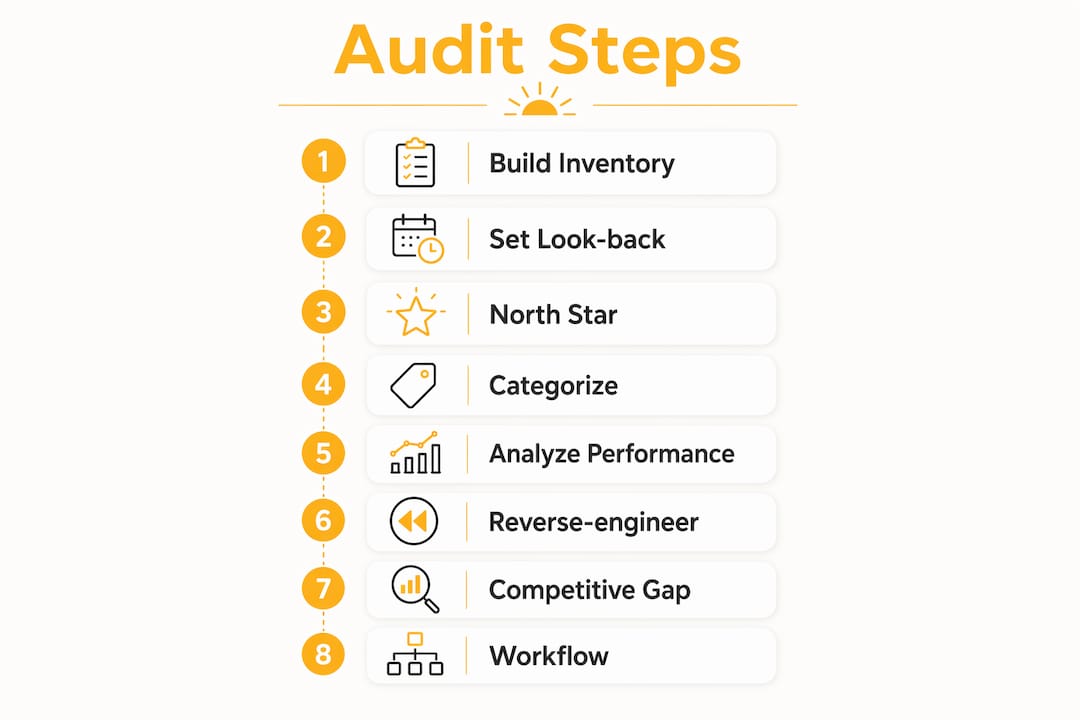
Step 3: Define your North Star metric
Pick one metric that directly reflects your current business goal. If you want Instagram reach, your North Star is shares. If you’re building LinkedIn authority, it’s comments. Trying to optimize every metric at once means you optimize none of them.
Step 4: Categorize content by topic and format
Group posts into content pillars and format types (video, carousel, static image, text). This reveals which themes and formats drive results and which ones you’ve been overproducing without return.
Step 5: Analyze quantitative and qualitative performance
Pull reach, engagement rate, saves, shares, watch time, and click-through rates from native analytics. Then go qualitative: review audience sentiment in comments, recurring questions, and objections. A comment like “this sounds great but I don’t have time” is literally your next content idea.
Step 6: Reverse-engineer your top performers
Take your top 5% of posts and analyze their hooks for format, specificity, and curiosity gap. Did the hook use a specific number or a vague claim? Was the visual native to the platform? What information did it withhold that kept people reading? Replicating those patterns is more reliable than starting from scratch.
Step 7: Apply the KEEP framework
The KEEP framework turns audit data into clear decisions for every post:
K — Keep what still works and drives results
E — Edit posts with a strong idea but weak execution
E — Extend winners into new formats or platforms
P — Purge outdated, off-brand, or irrelevant content
Step 8: Run a competitive gap analysis
Look at what your top three competitors post most, then identify what they’re ignoring entirely. If every competitor runs short-form talking-head videos, that format is saturated. The white space between what your audience wants and what competitors provide is your content opportunity.
Step 9: Translate findings into a production workflow
Audit insights feed directly into your production plan with clear ownership, timelines, and content mix reallocation. Assign an owner to every action item. Without ownership, audit findings stay in a spreadsheet.
Pro Tip: Avoid optimizing for likes. Saves, shares, and watch time signal real value. An audience of scrollers won’t buy from you; an audience that saves your posts will.
Regular audits suit active creators, while audits spaced a few months apart align better with small business and agency workflows for actionable updates.
Which Colorado providers can help with your social media audit?
Two Colorado-based agencies stand out for small businesses seeking professional social media audit and strategy services: Intero Digital and Boss Babe Networking. They differ significantly in approach, specialization, and the type of business they serve best.
Provider | Services Offered | Specialization | Location | Approach & Technology | Best For | Rating |
Full-service digital marketing, integrated channel management, AI-driven campaigns | Integrated marketing across all channels | Colorado Springs, CO | Proprietary InteroBOT AI platform | Businesses wanting AI-powered, full-channel marketing | 4.8★ (256 reviews) | |
Social media strategy, content creation, community building, audience engagement, event and fundraising support | Purpose-driven brands, nonprofits, storytelling | Colorado Springs, CO | Award-winning strategy services, community-first approach | Nonprofits and purpose-driven brands focused on storytelling | 5★ (26 reviews) |
Intero Digital operates as a full-service digital marketing agency in Colorado Springs, combining human expertise with its proprietary InteroBOT AI platform to align every marketing channel. Their model suits businesses that want integrated campaigns across paid, organic, and social channels managed under one roof. If your audit reveals gaps across multiple channels simultaneously, Intero Digital’s cross-channel approach addresses them together rather than in isolation.
Boss Babe Networking, also based in Colorado Springs, takes a fundamentally different angle. Their award-winning strategy services center on storytelling, community growth, and audience engagement, with particular depth in the nonprofit and purpose-driven brand space. For a business whose audit reveals weak community connection or inconsistent brand voice, Boss Babe Networking’s content creation and social media management packages address exactly those gaps.
Comparing these two providers comes down to scope versus specialization. Intero Digital covers the full marketing stack with technology at the center. Boss Babe Networking goes deep on social media strategy and community, which is precisely what most small business social media audits surface as the primary gap.
Solsocialmedia brings audit-driven strategy to small businesses
If the agencies above feel like more than your current scope requires, Solsocialmedia offers a focused alternative built specifically for small businesses. Rather than a full-stack agency model, Solsocialmedia delivers social media strategy services that start with a genuine audit of your content, your audience, and your goals, then build a plan around what the data actually shows.
Every piece of content Solsocialmedia produces is written by real humans, not generated by templates. That matters because authentic copy that reflects your brand’s actual voice performs differently than generic content. For businesses in retail, healthcare, or any sector struggling with consistent engagement, Solsocialmedia’s approach to social media engagement builds real community relationships rather than inflating follower counts. Monthly content planning, live event coverage, and customized training for your team are all part of the offering, so the audit doesn’t just produce a report. It produces a working plan your team can execute.
Key Takeaways
A social media content audit works best when it produces a clear decision for every post and feeds directly into a production workflow with assigned ownership.
Point | Details |
Set platform-specific look-back periods | Use 30 days for TikTok and X; use 90 days for YouTube and Pinterest to capture real trends. |
Pick one North Star metric | Align your primary metric to your current business goal rather than tracking everything at once. |
Apply the KEEP framework | Classify every post as Keep, Edit, Extend, or Purge to turn audit data into concrete next steps. |
Prioritize intent metrics over vanity metrics | Saves, shares, and watch time indicate real audience value; likes alone do not. |
Solsocialmedia for small business audits | Solsocialmedia delivers audit-driven social media strategy with authentic human copywriting for small businesses in Colorado. |
FAQ
What is a social media content audit?
A social media content audit is a structured review of all your profiles, posts, and performance metrics to determine what content works, what needs fixing, and what should be removed from your strategy.
How often should you audit your social media content?
Monthly audits work well for active creators, while quarterly audits align with most small business and agency workflows. The right frequency depends on how often you publish and how quickly your goals shift.
What metrics matter most in a social media audit?
Saves, shares, watch time, comments, reach, and click-through rates are the most meaningful signals. Likes are a weak indicator of real audience intent and should not drive your strategy decisions.
How long does a social media content audit take?
A focused audit using native analytics and a spreadsheet can be relatively quick for a single platform. A full multi-platform audit with competitive analysis typically takes several hours spread across one to two days.
When should a small business hire a provider for a social media audit?
Hire a provider when your internal team lacks the time or expertise to act on audit findings, or when the audit consistently reveals gaps you don’t know how to close. Agencies like Intero Digital, Boss Babe Networking, and Solsocialmedia each offer different levels of support depending on your scope and budget.
Recommended
Comments